
- The full $1 billion isn’t guaranteed. Only $10 million has been secured so far, and officials say the rest will likely come over several years — if Congress approves it.
- Great Salt Lake Commissioner Hannah Freeze laid out five core focuses of Utah leaders: Water infrastructure projects, agricultural optimization, municipal conservation, habitat and wildlife and dust management.
Since February, President Donald Trump has publicly backed “making the Great Salt Lake great again” — and Utah legislators can’t wait to get their hands on his proposed $1 billion budget line item to restore the lake.
Read more Former University of Utah president seeks confirmation as U.S. ambassador to Serbia
But it may not come as soon as they want.
Utah Rep. Celeste Maloy secured $10 million to create a new Great Salt Lake Watershed Recovery Program in June, but said she doubts the $1 billion will come speedily.
“I don’t think we’re going to get a billion dollars in one year. We’re going to get a billion dollars over a series of years,” she said in a previous interview with the Deseret News.
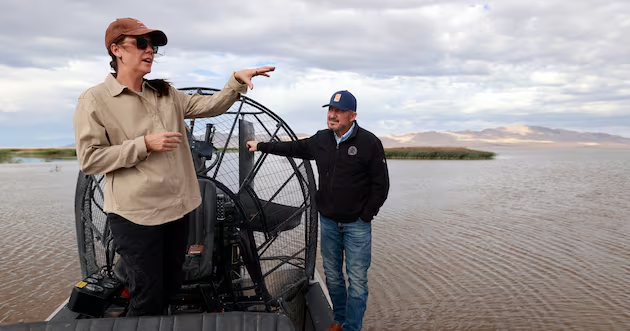
Nevertheless, Utah leaders look ahead with optimism. Before conducting a airboat tour of areas of the lake around Farmington Bay with state lawmakers and others, Great Salt Lake Commissioner Hannah Freeze on Thursday shared five areas of priority with the Deseret News — areas she hopes will receive the federal funding the state needs.
1. Water infrastructure
Freeze first mentioned revamping old infrastructure to serve new purposes.
During a high-water period in the 1980s, water flowed around the Newfoundland Basin and became trapped in dikes and berms (raised areas to trap water in an effort to avoid flooding). Freeze said recent aerial surveys show water still pools in those areas today — which evaporates, leading to more water loss.
Freeze plans to implement engineering solutions to the Newfoundland Basin to capture the trapped water and channel it back to the lake.
“Some of the estimates for the Newfoundland Basin could (add) 30,000 to 60,000 additional acre-feet every year depending on the hydrology,” she said. “That would be a big chunk of water.”
Another water infrastructure project would include Stansbury Bay — a similar issue with pooled water.
“We also have been working with Rep. (Blake) Moore,” explained Freeze. “He — in a congressional directed funding pool — got us $4.5 million potentially to look at Stansbury Bay, which is a similar project to a new basin.”
2. Agricultural optimization
Although agricultural water use accounts for over 60% of all water use in Utah, Rep. Jill Koford, R-Ogden, argued that isn’t something Utahns should be most concerned about — including the highly controversial alfalfa crop, which uses over half of Utah’s annual water use.
“Alfalfa is a highly resilient crop,” she said in an interview with the Deseret News, explaining how it can withstand not being watered for long periods of time.
Alfalfa has deep taproots — over 15 feet deep — that can reach groundwater other crops can’t. This allows the plant to withstand drought-induced dormancy rather than dying when the water is cut.
However, the same resilience Koford pointed to is exactly why critics say the crop should be first in line for cuts: because it survives reduced watering.
Ben Stireman, deputy commissioner of the Utah Department of Natural Resources, also argued the agriculture industry is actually quite effective.
“Nobody’s just like dumping extra water on their fields,” he said. “We are dumping extra water on lawns.”
3. Municipal conservation
Freeze said the state was actively looking at multiple municipal conservation opportunities.
Read more 1st day of school, NHL edition: What stood out from Day 1 of Mammoth training camp
“That’s an ongoing opportunity for us to not just ask our homeowners to save water, but to accumulate that water and show a dedication to the lake,” she said.
Announced April 6, Sandy and Salt Lake City struck a first-of-a-kind agreement. The two are paid by a conservation trust to redirect 2,500 acre-feet of water annually to the Great Salt Lake for up to a decade — something built on residential conservation rather than agricultural water leasing programs.
“We’ve been telling people to flush twice for the lake,” said Stireman. “All that indoor water use goes through treatment — and we’ve regulated that. They reuse it, and it goes back to the lake.”
But one thing that cannot be reused are the resources spent watering lawns.
“People are probably watering their lawns four times as much as they should, and they don’t really have the resources to be able to tell,” said Stireman.
Koford said Utahns should understand if their grass dies in July, “it’s OK” — as long as precious resources aren’t wasted.
“I don’t want a heavy-handed government, but I fear we might have to have one (if residential efforts aren’t realized),” she said.
4. Habitat and wildlife
One of Utah leaders’ largest concerns was phragmites: an invasive reed that grows 12 to 15 feet tall.
Standing on the banks of the lake, one can see the tall, brown reeds line the water for as far as the eye can see — there are an estimated 55,000 acres around the lake. Phragmites choke open water and native vegetation, leaving birds unable to nest in affected areas.
The reed even consumes more water than alfalfa, according to Freeze.
Just recently, over Memorial Day weekend, the state treated thousands of acres of phragmites with controlled fires.
“We’ve seen over an 80% reduction of phragmites based on the work we’ve been doing over the last five years,” said Stireman. “So, it’s possible to get rid of — it just takes time and money.”
5. Dust management
Another effort that requires massive funds, leaders have found, is dust management.
“Protecting the Great Salt Lake is about more than the lake itself,” said Senate Majority Whip Chris Wilson, R-Logan. “Its health affects Utah’s air quality.”
As the Great Salt Lake has declined, more than 800 square miles of lakebed have been exposed to potential wind erosion, according to the University of Utah. Researchers identified approximately 70 square miles as active dust hotspots, with that area potentially expanding to as much as 187 square miles if protective surface crusts continue to degrade or groundwater levels decline.
The Great Salt Lake dust can cost Utah up to $116 million in annual health costs, can cause 6.34 premature deaths, and 17,748 school absences each year.
“We just want better information on where the dust is coming from, what’s in the dust, and then people can make accurate decisions about that,” said Freeze.
Read more Lindsay Clancy juror’s identity was supposed to remain private. Then the internet figured it out