
- The Trump Administration and its allies in Congress claim that banning the export of diesel will lower prices for Americans.
- This policy may lower prices in the short run, but only for some parts of the country for a limited time.
- Artificially low prices will cause refineries to cut back, lowering supply, laying off workers, and increasing prices higher in the long run.
- High gas prices hurt, but the consequences of ignoring market forces are more severe.
Many science museums and office desks have a Newton’s cradle: a series of metal balls held up by strings. Lift one ball and let it go, and its kinetic energy smacks into the others, popping up the ball on the far end. Pull back two, and two pop up on the other side, and so on.
Read more Opinion: The faith you can’t see: Are we misjudging American faith because our measurements miss it?
The toy is an excellent example of Newton’s Third Law of Motion: for every action, there is an equal and opposite reaction. In a closed system, if we push a lever, we should expect a consequence, whether that consequence is intended or not.
The current debate over banning American diesel exports is a textbook example of this principle.
Responding to the gas price spike
Today’s spike in gas and diesel prices has its roots in the U.S.-Iran conflict that began in February. Iran has been a thorn in the side of U.S. foreign policy since the Iranian Revolution in 1979, and the conflict has choked off the Strait of Hormuz, a narrow waterway that carries roughly a fifth of the world’s oil.
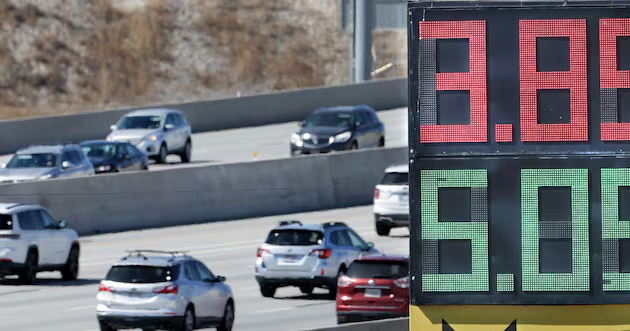
The national average for gasoline has climbed from under $3 a gallon in late February to about $4.44. Diesel now averages about $6.50, up roughly 74% from a year ago.
Add a fragile labor market and stubborn inflation, and the ingredients for 1970s-style stagflation are on the table, with midterm elections a few weeks away.
In response to the energy crunch, President Donald Trump and allies in Congress have publicly floated a 90-day ban on diesel exports from domestic refineries.
Like many populist economic policies, the idea makes sense on its surface. Why should Americans bear the cost of higher energy prices while big oil companies send scarce diesel, gasoline and jet fuel abroad? Shouldn’t the government prioritize American consumers, especially when American workers make those products in the first place?
But just like Newton’s cradle, a ban on exports would simply set another ball swinging, with unintended consequences of its own (much like the combat operations in Iran, which set things in motion leading to us paying more at the pump).
Export bans can trigger fewer jobs and higher prices
Advocates argue that banning exports would flood American energy markets with supply and thus drive prices down. However, the bottleneck in the supply chain is refinery capacity. Contrary to popular belief, profit margins in energy are quite slim because of volatile crude-oil markets and high transport costs.
Read more The Campus Cup is back — and UVU and BYU are already battling for it
Just shipping the excess diesel would prove difficult and expensive. Pipelines to the East Coast already run near capacity, and shipping fuel by tanker adds time and cost. The administration has waived the Jones Act, which normally limits such shipments to American-built ships, but that waiver is set to expire in mid-November, well before a 90-day ban would end. Other regions would also likely see their supplies squeezed and pay even more at the pump.
We tried this policy during the Carter administration to reduce gas prices during a similar energy crunch in the 1970s, but it backfired dramatically.
In the long run, the artificially suppressed price at the pump will fall below what it costs to produce the final oil-based products that we all depend on. Each barrel of crude is split into gasoline, diesel, jet fuel and other products at the same time. If diesel becomes economically nonviable, refiners won’t just make less diesel; they will run less crude and make less of everything. The industry would then need to lay off workers and reduce domestic capacity. Overall, this policy would result in a very short-lived price savings at the expense of reduced production capacity and higher long-run prices.
The pain would not just be limited to the gas station. The price of heating oil for many homes in the densely populated Northeast will spike right before winter, and airfares could well climb as jet fuel grows scarcer, too.
Export bans wreak havoc on economic systems
The policy’s dysfunction will not end at our borders. Brazil, for example, relies on American diesel for its planting season, which in the Southern Hemisphere falls in September and October. And cutting off our European allies could force them to do business with Russia at a precarious moment in the war in Ukraine.
While pain at the pump does not make for good politics, prices are incredibly important. Prices are the stoplights of the economic roadway. They signal information to consumers and suppliers. No one enjoys the hit to their pocketbooks, but higher prices give firms the incentive to boost production and consumers a reason to make temporary lifestyle changes during a crisis.
When policymakers try to control prices, the result is always negative consequences somewhere else in the economy.
Market forces are the apex predators of bad economic policy. We can run from them, hide from them and pretend they don’t exist, but they will always catch up with us in the end. As the Old Testament prophet Hosea wrote, “For they have sown the wind, and they shall reap the whirlwind.”
We are the product of our choices, and the bill always comes due.