
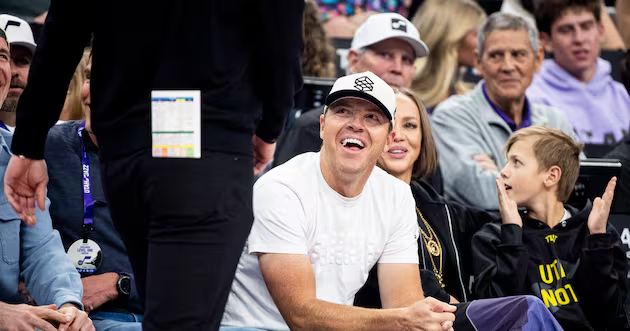
- Six years and several billion dollars into the Ryan Smith era, the Jazz are poised to field a competitive team.
- The value of the Jazz has more than doubled since Ryan and Ashley Smith bought the team in 2021.
- The Jazz are part of a broader development and elevation of sports as a major plank to Salt Lake City’s identity.
Ryan and Ashley Smith have owned the Utah Jazz for nearly six years now.
During that time, their Smith Entertainment Group launched one of the most ambitious building stretches in the NBA — a mix of massive capital investment, rising valuation and an expanding sports empire.
Read more Republicans look for a midterm fix
And the multibillion dollar investment goes beyond the team. SEG is spearheading the creation of a sports, entertainment, culture and convention district that will dramatically change downtown Salt Lake City.
The Jazz open training camp Monday in what likely will be their last season at the Zions Bank Basketball Campus. A new practice facility is under construction at the Shops at South Towne in Sandy. Utah’s first home game is Oct. 23 in the Delta Center, which just completed the second phase of a three-year renovation.
Six years and several billion dollars into the Smith era, the Jazz are poised to field a competitive team for the first time since the rebuild began — and the franchise looks nothing like the one they dismantled.
“I’m so bullish on the NBA and where we’re headed. Live entertainment is not slowing down and there’s nothing like an NBA game,” Ryan Smith told Front Office Sports in a recent interview.
Building a new identity
There was a time 30 years ago when the Utah Jazz were known the world over. Karl Malone and John Stockton put the team on the map with deep playoff runs and two NBA Finals appearances. Global travelers spotted Jazz gear wherever they went. Russian nest dolls featuring Jazz players were sold on the streets of Moscow.
The Jazz haven’t generated much conversation of late. But the Smith sports empire the NBA anchors could change that, especially if the team wins again.
David Carter, principal at The Sports Business Group, said Smith and his colleagues are having a demonstrable impact on the way sports and entertainment in Salt Lake City is viewed and continues to be viewed worldwide.
“Through his business interests he is attempting to make money and build equity by generating revenue off the extraordinary use of sports and entertainment to build brands, especially that of the region,” Carter told the Deseret News via email.
“The Jazz, for its part, is an important part of this broader development and elevation of sports as a major plank to the city’s identity. When many outsiders think about Salt Lake City’s sports scene, they don’t think of a particular team, event or attraction. They think, ‘Wow, Salt Lake has really planted its flag as a global player in sports. Its growth has been remarkable.’”
In the Front Office Sports interview, Smith said “there’s no question” SEG will pursue other sports franchises, including baseball and Premier League soccer, should opportunities arise. “The appetite is there. The operational expertise is there,” he said.
But “I think we’re pretty focused about like right now currently it’s Utah and what can we do with sports to build the state of Utah,” Smith said. “And how can sports be the ultimate anchor tenant.”
Keeping the Jazz in Salt Lake City
Since buying the NBA team in 2020, Smith has added the NHL to his pro sports portfolio with the unforeseen purchase of the Arizona Coyotes in 2024. Now rebranded as the Utah Mammoth, the team made the Stanley Cup Playoffs in its second year, sold out every game and set Delta Center merchandise records.
Smith flirted with the idea of building an arena to accommodate the Mammoth and Jazz at the south end of the Salt Lake Valley. But quick action by state and local government leaders secured both teams’ future in downtown Salt Lake City.
The Utah Legislature passed a bill to allow the city to raise its sales tax rate to divert $900 million over 30 years for renovation of the Delta Center and the surrounding blocks. SEG and the city also signed a deal that will keep the Jazz and Mammoth in the city center.
The company agreed to pay up to $125 million if either team leaves the arena in the first 15 years or $250 million if both leave, with the penalties decreasing by about $16 million a year after that. Also, if both teams leave, SEG could be required to repay whatever part of the $900 million it had received up to that point.
Delta Center renovations
SEG is two years into a three-year project to revamp the 35-year-old Delta Center as a dual-sport venue, with the work being done in basketball and hockey offseasons.
In 2025, construction crews installed a riser seating system in the lower bowl to optimize hockey sightlines while maintaining them for basketball. This past summer, they redesigned and rebuilt the north end with new terrace-style seating. They’ll do the same in the south end next summer.
“The biggest challenge is, especially for us, we have such great sightlines for basketball, and it’s very important to protect those sightlines for basketball, and we did that,” said Jim Olson, president of SEG Real Estate. “We’ve sat in literally every seat, so we’re really confident that they’re great sightlines for both sports.”
Olson said other NBA and NHL teams have called wanting to know how SEG is making the arena work for both sports.
Read more Well-rested BYU will be facing an angry TCU team coming off a loss at UCF
“You just don’t find it,” he said. “We’re really setting a standard here.”
Official capacity for Jazz games in the Delta Center is 17,867 for the 2026-27 season.
Once the interior is remodeled, the company will turn its attention to the exterior in another massive overhaul.
Revitalizing downtown
As the Delta Center undergoes a makeover, SEG’s plan to redevelop a three-block area in the city center for sports, entertainment, culture and convention district has not begun in earnest, at least not physically. The project includes reconfiguring the arena entrance to face east, pedestrian plazas, a residential tower, a hotel, retail and restaurant space. It would impact the Salt Palace Convention Center, Abravanel Hall, Utah Museum of Contemporary Art and Japantown.
In May, Salt Lake County approved the sale of 6.5 acres of the Salt Palace to SEG. Demolition and reconstruction of buildings in the district won’t begin until early next year.
In 2025, the company announced a joint venture with Live Nation, the world’s largest live entertainment promoter, to build a 6,000-seat indoor music venue as part of the downtown district.
Smith sees his Smith Entertainment Group as “one of the best up-and-coming brands” in the industry.
“We’re developing the downtown. We’ve got a Live Nation venue coming in right across the street from the arena with a new hotel and a bunch of other things coming there,” he told Front Office Sports. “So these assets, not only on the practice facility at the mall, but also in downtown, are transforming where they sit and where they stand unlike anything’s been able to do in a generation.”
The downtown project isn’t expected to be complete until just before the 2034 Olympics in Utah.
What are the Utah Jazz worth?
While the Smiths put large chunks of money into revitalizing the city, the value of their investment in the Jazz has grown significantly. They bought the club from the Gail Miller family for $1.66 billion in 2020. Despite being one of the worst teams in the NBA the past few years, its 2026 valuation exceeds $4 billion. CNBC Sports lists it at $4.35 billion, Sportico $4.27 billion and Forbes $4.1 billion. Forbes also listed the team’s revenue at $340 million.
That’s more than double the Smiths’ original outlay in under six years, even as the team has been in full rebuild mode on the court.
And the sale of the Los Angeles Lakers for a record $12.5 billion earlier this year only accelerates that trajectory. Recalculating the value of the Jazz based on the rising-tide-lifts-all-boats notion could push it closer to $5 billion, though that’s mere speculation.
Smith told Front Office Sports that “smart business people” told him he’d lose money owning the Jazz.
“I think they’re great. I think they’re nice. It’s way better than the alternative,” he said of the valuations. “But also this is my childhood team that I grew up cheering for as we’re talking about the Jazz. Like, it’s not for sale. I’m hopefully going to own this for a long time.”
The Jazz practice facility under construction adjacent to the Mammoth’s practice ice is expected to open in 2027. A shared state-of-the-art sports medicine center on the complex is slated to come online the following year.
Devoted fans
David Berri, a sports economist and chair of the Southern Utah University economics department, said the Jazz are on very solid footing in Utah.
“The Jazz are the state’s oldest professional franchise and they have a very loyal and dedicated following. That explains the profitability of the team,” he said, adding NBA teams are generally profitable. “I don’t see any reason to think their fanbase is going to go anywhere.”
Fans have stayed with the team — the arena has sold out every game since Dec. 7, 2017 — despite the tanking.
Berri said the NBA likes putting teams in smaller markets where they can find a fan base mostly devoted just to that NBA team, noting Oklahoma City, San Antonio, Sacramento and Portland.
“Those teams generally have very dedicated fans,” he said “But their ability to spark any interest beyond their market depends entirely on their ability to compete for an NBA title. When they can do that, the nation pays attention. When that doesn’t happen, the nation generally doesn’t think about them very much.”