
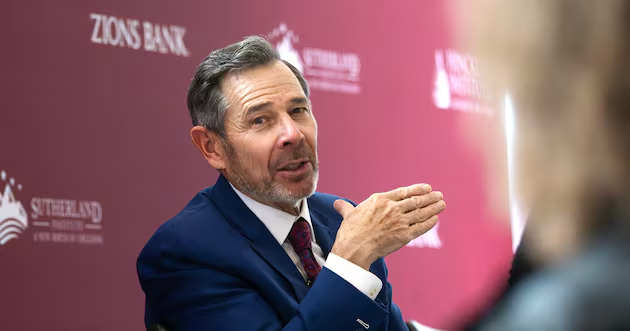
Sen. John Curtis said all ideas should be on the table when it comes to saving the Great Salt Lake during the Sutherland Institute’s 2026 Congressional Series at the Hinkley Institute of Politics on Monday.
Read more Watch how BYU and its fans celebrated a program-defining victory — beating No. 2 Notre Dame
The problem doesn’t come down to one issue — not just data centers, climate change or bad policy — according to Curtis. So the answer won’t come from fixing one area either.
“We’re all part of this together, right?” he said. “If you single out any group, you’re just going to make them an enemy in the cause. We need everybody on the team.”
The Great Salt Lake sat at 4.190 feet on Monday — only about two feet above the record low. About 800 square miles of lakebed are exposed, and every foot of elevation dropped exposes about 70 more square miles.
“You can’t ignore the Great Salt Lake in a very large ecosystem,” Curtis said. “All of these systems are tied together and if one’s not healthy, then the ecosystem’s not healthy.”
A University of Utah study of the state’s winter rain found that lake-effect storms — when cold air picks up moisture from the Great Salt Lake and dumps it as snow along the Wasatch — account for roughly 8% of the winter precipitation. That area includes the Cottonwood canyons resorts like Alta, Snowbird, Brighton, and Solitude, which means a dried-up Great Salt Lake could mean less snow, and less winter tourism revenue for the state.
‘We have to change the math’
“There is not enough water,” said Curtis. “Even with conservation, there is just not enough water. So we have to change the math.
“Well, how do you change the math? You do something dramatic.”
Curtis explained a realistic solution for solving the math equation involves contributions from a little bit of everyone — including reengineering the infrastructure of the lake.
During a high-water period in the 1980s, water flowed around the Newfoundland Basin and became trapped in dikes and berms (raised areas to trap water in an effort to avoid flooding). Great Salt Lake Commissioner Hannah Freeze told the Deseret News in a previous interview that recent aerial surveys show water still pools in those areas today — which evaporates, leading to more water loss.
Curtis said it’s time for another infrastructure investment.
“It’s also time for some rethinking of what that structure is, how that infrastructure works, and maybe changing some paradigms about what will work and what will not work when it comes to water,” he added.
Freeze plans to implement engineering solutions to the Newfoundland Basin to capture the trapped water and channel it back to the lake — reverse engineering the pumps.
“Some of the estimates for the Newfoundland Basin could (add) 30,000 to 60,000 additional acre-feet every year depending on the hydrology,” she said. “That would be a big chunk of water.”
Another solution Curtis referred to was valuing the water the state has left.
He called the water price in Utah “very, very cheap.”
“That arguably may be a mistake because we value most what we pay for,” he said.
A 2022 Brigham Young University study found that about half of the residents studied overwatered their lawns, and those who watered too much ended up with less healthy grass. Possible conservation solutions could include metering or increasing water rates, according to Curtis.
Read more Westminster Dog Show taps Utahn as agility judge
“When there’s no cost with something, it’s very hard to have it feel like it’s a precious commodity,” he said. “Water still doesn’t need to be that expensive, but arguably it’s close to free.”
He shared the example of Washington County — home to St. George, which has long been under water restrictions. “It’s amazing what that community has done, and it’s also amazing how it’s not been mandated. It’s been an education thing,” he said, referring to the county’s impressive water conservation efforts.
‘I’m trying to educate them’
One of the most promising solutions seems to be a line item in President Donald Trump’s budget: $1 billion dollars just for the lake.
Since February, Trump has publicly backed “making the Great Salt Lake great again.” In April, he requested $1 billion in his fiscal 2027 budget to establish a comprehensive federal restoration program led by the Interior Department. Utah legislators can’t wait to get their hands on it.
But it may not come as soon as they want.
Utah Rep. Celeste Maloy secured $10 million in June to create a new Great Salt Lake Watershed Recovery Program, but said she doubts the full $1 billion will arrive quickly.
The largest payout so far came from a courtroom, not Congress. In September, Utah settled a decades-old legal dispute with the federal government over land near the Bear River Migratory Bird Refuge, which ended in an additional $60 million for the Great Salt Lake, paid in four installments over 26 months.
“We are in that position where the president put a billion dollars in his budget, and now we as legislators have to figure out where that money is going to come from,” said Curtis. “And then the Utah delegation has to work with our colleagues to convince them that that is worth $1 billion.”
Curtis said current efforts to secure the $1 billion investment might include physically bringing Trump to Utah.
“I’m talking to them, I’m trying to educate them,” he added.
Curtis explained the state soon needs to come up with a list of solutions — no matter where they’re from — if they are to secure the funds: “We need to be able to say specifically, ‘here’s how your billion dollars would be spent, here’s why it’s a good investment,’” he said.
Optimistically, Curtis said he thinks the federal government’s investment may far exceed the initially promised $1 billion — if the state can convince them of the lake’s importance.
“There is no track record of success of ever saving a lake like Great Salt Lake,” he said. “We have never done it in the world’s history …
Read more 3 takeaways from Utah’s tough win over Colorado
“So doing it here, figuring it out, is important for the world, not just Utah.”