
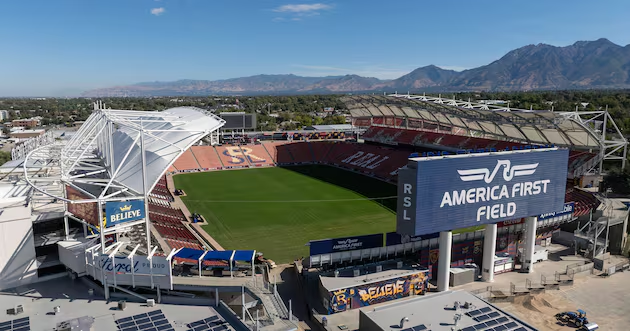
The United Football League is bringing the league to the Salt Lake Valley, partnering with local officials on its 10th expansion team that will begin play in 2028 at the Larry H. Miller family’s America First Field.
UFL co-owner Mike Repole made the announcement on ESPN early Wednesday.
The Salt Lake City team will be a new addition to the spring football league rather than replacing one of the discontinued markets. The league announced in July that it was ceasing operations in Birmingham and Houston following the 2026 season.
Salt Lake City joins four incoming markets set to enter the league over the next two seasons. Alongside the Oklahoma City franchise launching in 2028, and following new teams in Colorado and Rhode Island debuting in 2027, this expansion fulfills Repole’s pledge to establish a 10-team league by 2028.
Discussions with Salt Lake City officials go back to last November, said UFL President % CEO Russ Brandon, when league officials issued a request for proposal to find prospective markets for new teams. He noted following this past season’s championship game in June, league officials went on a city and venue tour of about a dozen sites including Salt Lake City.
“Throughout our tours and discussions, we landed in Salt Lake. We’re beyond thrilled about it,” Brandon said during a phone interview on Tuesday.
Although no local ownership is involved in the expansion team, Brandon credited Miller Sports + Entertainment, Real Salt Lake and Royals President John Kimball and Real Salt Lake GM Justin Nelson for helping form the team and becoming tenants of the 20,000-seat America First Field, which currently hosts Real Salt Lake and Royals games as part of the family’s holdings.
“That building is beautiful, and I know they’re going through a renovation, it’s going to be more spectacular when it’s completed,” said Brandon.
Although a specific timeline has not been announced, a dedicated local staff will be established in Salt Lake City year-round. Brandon emphasized that the franchise intends to stay actively involved in the community 365 days a year, far beyond the five home games, adding, “We’re going to have a lot of marketing muscle behind this team.”
He continued, “We’re about affordability, accessibility and transparency. All the things that we do is about the fan first and being affordable. So from that standpoint, that’s our focus.”
The arrival of the UFL gives Salt Lake City a professional football property as the region continues to add to its sports landscape. The team joins a market experiencing major investments in pro sports, alongside the Utah Mammoth and the Miller family’s Big League Utah initiative aimed at securing an MLB franchise.
According to a recent survey conducted by the Deseret News and the Hinckley Institute of Politics, MLB leads as the top choice for Utah voters, with 43% selecting it as their preferred professional sports expansion, while the NFL trails at 35%.
Because the NFL requires substantial economic support and stadium infrastructure, the UFL’s Salt Lake City team is likely the nearest the market will come to hosting professional football as no organized campaign has formally begun.
The UFL’s expansion comes as the league attempts to balance growth with the challenges facing spring football, particularly at the gate.
The league’s 2026 season featured three new markets — Columbus, Louisville and Orlando — and all three provided encouraging early results at the local level. The champion Louisville Kings, for example, averaged 11,195 fans across five home games during its inaugural season and finished second in the league in average attendance.
But the broader attendance picture was more difficult. Through the first eight weeks of the 2026 season, Sports Business Journal reported the UFL averaged 10,416 fans per game, down 14.3% from the 12,162 average in 2025. St. Louis, traditionally the league’s strongest market, was averaging 22,893 fans through four home games, down 22.5% from its 2025 average, while D.C. was down 32.6%.
Repole subsequently told SBJ that the league would increase its investment in marketing and business operations in St. Louis and Washington after attendance declines in those larger, established markets.
That puts the Salt Lake City expansion in the context of a league trying to find markets, venues and operating models that can support sustainable spring football as it pushes for a 12-team league by 2030, or earlier in 2029 if the league can find prospective markets in time. Repole has previously emphasized smaller venues and markets where the league can create a stronger connection between the team and its local fan base.
“In Birmingham, we were very clear that we had a venue that was far too large for our league,” said Brandon. “And if you look back to other markets that we left in the past 18 months, Memphis, Detroit, San Antonio, they were all solely related to venues. That’s it. So, when we looked at all the markets on our tours, the venue was critical, and there’s an amazing venue there in Sandy.”
The Salt Lake City team’s name and overall branding will be announced at a later date.
Read more Perspective: When religion meets constitutional democracy