
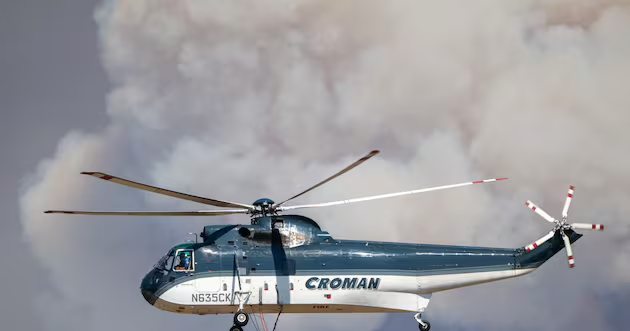
This year’s wildfire season in Utah is breaking records in ways that will be felt long after all the flames are doused.
Read more Deseret News archives: Craig Breedlove set a speed record on Bonneville Salt Flats
With a total of almost 475,000 acres burned across the state, 2026 is the second most devastating fire season on record in terms of acreage burned, but size isn’t the only thing that makes this season so devastating.
“What’s even more important is where this year’s fires are burning,” said Phil Dennison, a professor in the University of Utah’s School of Environment, Society & Sustainability.
A new study by Dennison shows that three large wildfires in Utah this year, the Cottonwood, Babylon and Widemouth 2 fires, have burned more than 60,000 acres of vegetation each.
“To put that number in context, there have only been a total of 10 fires since 1986 that have burned that much vegetation in Utah,” Dennison said.
This year saw more woodland and forest land burned than in any year on record since 1986, causing “an unprecedented impact on Utah’s trees,” Dennison said.
Right now, it’s hard to tell exactly how long Utah will feel the effects of this loss, but it’s clear that even once the 2026 season is over, the damage done by these fires won’t be out of sight.
Looking toward the future, Dennison said the increasing woodland and forest land burned “certainly seems like the new normal.”
Burning of forest and woodland impacts both Utah’s environment and economy
“The fact that we’re seeing such a big increase in woodland and forest burned in recent years has important economic and ecosystem impacts, and these trends are quite concerning,” Dennison said.
Losing Utah’s “iconic tall trees” to the rage of large wildfires “diminishes, at least temporarily, the recreational value of these areas,” Dennison explained.
Utah’s outdoor recreation industry contributes almost $10 billion annually, according to data released earlier this year, meaning if this sector takes a hit, it could cause “a massive economic impact” across the state.
Burn scars on the mountains will also increase the risk of flash flooding and debris flows, a problem already seen in Beaver, which was heavily damaged by the Cottonwood Fire.
Dennison said “there’s just not enough that we can do” to mitigate the effects of large wildfires and Utah residents will “continue to see these effects at high elevations as these forests and woodlands continue to burn this year and into the future.”
Read more More than 20 Republicans join Sen. Mike Lee’s bid to cancel recess unless Senate passes SAVE Act
Wildfire devastation sources from a team of 3 main fires
Of the seven fires on record since 1986 that have burned more than 60,000 acres of trees, three of them were this year: the Cottonwood, Babylon and Widemouth 2 fires. The combination of these massive wildfires is what makes 2026 so devastating compared to past years.
“Any one of them would be historic, and we’re having them burn at the same time in our state,” said Brian Maffly, a science writer at the University of Utah.
Utah has seen almost 215,000 acres of woodland burned this year, more than any year since 1986. The Babylon Fire is responsible for more than 80,000 of that and holds the record for the most acres of woodland burned in a single fire, according to data acquired in Dennison’s research.
The Cottonwood Fire burned more than 60,000 acres of forest land, making it the second largest in Utah history for forest acres burned, after the East Fork fire in 2020.
A total of 10% of Utah’s forest area has burned in the last 10 years, Dennison said, a trend that “has accelerated in just the last three years.”
“We’ve entered this period where Utah’s forests and woodlands are burning much more frequently,” Dennison said. “And this is a very concerning trend.”
Until conditions improve, the entire state remains at risk, Dennison says
There is “certainly potential” for more fires through the rest of the fire season, Dennison said, and mitigating the disastrous consequences is difficult.
“We need to be doing more in terms of forest management,” Dennison said. “But even in some of our best managed forests, we’re seeing that this big increase has occurred.”
Dennison said he is particularly concerned about the southern and central regions of Utah, areas where fires have been prevalent thus far. The northern regions have “largely escaped having too many fires,” he added, but that doesn’t mean the flames aren’t coming.
“We may be heading towards more fires at higher elevation, even in the Wasatch,” Dennison said.
With weather conditions a little too perfect to fuel massive fires, it’s hard to say when the fire season in Utah will end, or how the effects of wildfire will be felt until then.
“Without a change in climate for the wetter, without seeing Utah’s climate getting wetter, we are definitely concerned about this increase in forest fire and woodland fire being maintained into the future,” Dennison said.
Read more Watch: Behind the scenes of the trade call that made Ethan Belchetz a Utah Mammoth