
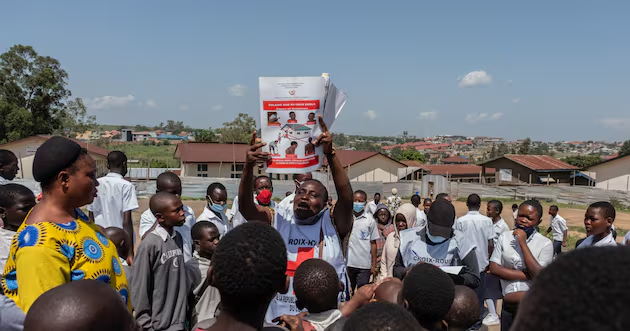
- Multiple epidemics amplify healthcare difficulties, worsening outcomes in impoverished nations.
- Ebola is spreading into urban environments, heightening concern among health experts.
- World Cup athletes’ safety remains a focus amid rising international health concerns.
The World Cup has added a layer of concern to the ongoing outbreak of Bundibugyo Ebola in Democratic Republic of Congo and neighboring Uganda.
U.S. health officials say they’re not worried about a major outbreak of Ebola, but they did announce a united effort with Canada and Mexico to make sure World Cup players and visitors are safe as the matches take place in multiple North American cities.
“This coordinated approach aims to protect our citizens and the millions of visitors, fans, athletes and tourists expected during the FIFA World Cup 2026, while maintaining travel and commerce across our borders,” the three governments said in a joint statement quoted by The Hill. “The health and safety of every person in the region remains our highest priority as we welcome the world to North America.”
But some medical experts note that the international public health system has been weakened recently by the dismantling of the U.S. Agency for International Development and the nation’s withdrawal from the World Health Organization.
Critics of those decisions maintain that global surveillance of disease has suffered and that quite possibly contributed to the delay in recognizing an Ebola epidemic in Congo that has also been linked to cases in Uganda. Ebola was likely raging, they say, weeks before it was officially recognized in May, leading to more cases because people were not aware, including those who monitor travel and trace contacts in infectious disease outbreaks to control them.
According to the Centers for Disease Control and Prevention on Tuesday, Congo and Uganda Ministries of Health note 344 confirmed cases and another 116 suspected, while Uganda has 15 confirmed, 1 probable case and 1 probable death. The ministry said it removed some cases and deaths from its count after more in-depth investigation.
The actual count is not known; at the time Bundibugyo was identified as the strain causing illness, there were no tests, vaccines or treatments available for it. That strain of orthoebolavirus — one of several that cause Ebola — is among the most serious because of those lacks, with up to 50% mortality.
But The Wall Street Journal also reported that Ebola “has reached a corner of the Democratic Republic of Congo controlled by Islamic State militants, a place too dangerous for health workers fighting to stop the deadly virus.”
What is a syndemic?
Because both Ebola and hantavirus have been circulating in the region, which also has challenges like poverty and health disparities, some consider the outbreak a “syndemic.”
The U.S. Department of Health and Human Services describes what happens this way: “A syndemic occurs when two or more diseases or health conditions cluster and interact within a population because of social and structural factors, leading to an excess burden of disease and continuing health disparities.”
The “syn” part of syndemic refers to the way multiple outbreaks or epidemics, which are not necessarily all infectious diseases, work together in a synergistic way that amplifies the outcome, according to Dr. Tyler Evans.
Evans is an adult infectious disease and addiction medicine specialist, founder and CEO of Wellness Equity Alliance and an associate professor at the University of Southern California Department of Population and Public Health Sciences. He’s also someone who has spent time, boots on the ground in African nations treating people, including many with Ebola. He wrote the book “Pandemics, Poverty and Politics,” published last year by Johns Hopkins University Press.
“When you’re looking at an infrastructure system that is so impacted by all these social drivers, particularly poverty, war, etc., and then you throw in all these sort of chronic infections like AIDS, malaria, measles and tuberculosis, and then you throw in Ebola and we’ve been dealing with hantavirus, then basically the outcome is amplified because they’re sort of interacting with each other,” he said.
Evans said people might remember during COVID-19 that folks who had some pretty common illnesses were sometimes not able to get treatment because COVID-19 was eating up resources. It meant there was potential even to die of something that would otherwise have been easily treated.
Co-infections may increase, but outcomes can also be bad because of related issues like being unable to access medicine or care. Population stresses can make outbreaks much worse, he said.
Evans said when the U.S. dialed back its public health presence, it resulted in CDC’s global health surveillance and response being significantly reduced, which added to the delays in recognizing the spread of Ebola. Taking America out of the global health scene is like trying to separate it from the global finance market, he added. “We are all connected through constant global travel. Microbes do not know the difference between borders.”
He’s among health experts worried about Ebola because it’s no longer confined to rural areas. “Now it’s gotten into cities, which is very, very, very concerning,” he said. “I can’t underscore how concerning that is.”
Evans is among those concerned about the potential for the World Cup to impact spread. “I think the good news is the U.S. response at this point — we’re late, but we’re setting up our infection prevention control surveillance at certain airports. It’s a step in the right direction,“ he told Deseret News.
Read more Deseret News archives: Evacuation at Dunkirk a pivotal moment in history
Nor is the situation completely new. There are U.S. Customs and other playbooks from the 2014-2016 outbreaks that led to the need to screen, he said.
More than 28,600 people were infected during the 2014-2016 Ebola outbreak in West Africa, the largest outbreak since the virus was first identified in 1976, according to the World Health Organization.
Ebola basics
Ebola is a virus most often seen in sub-Saharan Africa that most often comes out in rural settings, where bats are a natural reservoir. That keeps most outbreaks small.
The current outbreak is not small, comparatively. And the New York Times reported that the “doctors are just now gaining access to tests that can detect Bundibugyo.”
Because it’s not airborne like many infectious diseases — think COVID-19, measles, hantavirus or flu, for example — the CDC said the viruses that cause the disease pose little risk to travelers or the general public. The virus relies on contact with the body fluid of someone who is infected or who died. And it can only be spread during the period when someone has symptoms. There is a rare chance of getting the disease from contact with an infected animal, like a bat, as well.
That’s not a big concern for those pondering global travel or the World Cup.
The first stage of infection brings flulike symptoms such as a very high fever, muscle aches and fatigue. The second stage includes gastrointestinal symptoms similar to a stomach bug. The third stage, if it gets to that, is hemorrhagic, which means bleeding. IV fluids are very important for the second and third stage, when severe dehydration is possible and potentially life threatening. Having those fluids available is, in Evans’ words, “how we really can save lives.”
Evans notes that he has worked in the last two severe outbreaks and “I don’t scare easily, but in the first one I was frightened,” he said. Being surrounded by people who are desperately ill, some dying, while wearing protective suits that had to be monitored for tears that could be dangerous, while also in the heat of a tropical country is “really this sort of pressure cooker of issues. The healthcare workers that are managing right now are heroes.”
Spread: how likely and how far?
Evans thinks the odds are moderate to high that Ebola will spread to nearby countries in Africa. “My concern for this spreading beyond the continent is low to moderate. But if it spreads beyond the region, then the likelihood of it spreading to other continents is quite high.”
It’s not airborne — unless it gets on a plane with someone and is delivered elsewhere. But it is very infectious. So he is concerned, said Evans, who describes himself as “risk tolerant.”
“I would feel better if we had a functioning global health system in place right now.”
In the meantime, the U.S. government is not ignoring the issue.
Americans believed to have been exposed will be sent to an “observation post” in Kenya for 21 days’ observation, Marco Rubio told House lawmakers during a hearing Tuesday, as quoted by The Hill.
That plan has drawn violent protests in Kenya. Two people were killed and others injured during protests outside the Laikipia Air Base, over fears the facility would unleash Ebola in Kenya, according to ABC News. The Kenyan president supports use of the facility.
The Trump administration has also beefed up airport screening and said that air passengers from Congo, Uganda and South Sudan will be rerouted as they enter the U.S. so they arrive through one of four airports that are being set up to watch for signs of Ebola and know what to do. Those are Washington-Dulles International, Atlanta Hartsfield-Jackson International, George Bush Intercontinental or John F. Kennedy International.
Non-U.S. passport holders face entry restrictions if they came from being in Congo, Uganda or South Sudan in the past 21 days. The CDC said it’s also helping with contact tracing, lab testing capability, hospital readiness and other measures to prevent spread from the sub-Saharan countries.
South Sudan was included not because of known cases, but because of shared borders with Congo and Uganda, per the CDC. While the administration said it plans to have patients isolate in Kenya, it noted that one U.S. resident who was exposed and who tested positive for Ebola was taken to Germany for treatment because Germany is closer than the U.S. and also has previous experience treating Ebola patients.
And because of the World Cup, countries are paying a lot of attention to the outbreak. For instance, the mayor of a town in Spain that was to host a friendly match with Congo athletes withdrew permission a few days ago, although those athletes have not been in Congo for several weeks. And DC United canceled its match against the Ethiopian national team.
Others are assessing risks and seem pretty calm.
“Widespread transmission is very unlikely with Ebola,” Michele Barry, senior associate dean of global health and director of the Stanford Center for Innovation in Global Health, said in a recent statement in the StanfordReport quoted by USA Today. “However, a timely and collaborative global response is vital to support the DRC and its neighbors in tracking and containing this outbreak and saving lives.”
Read more Opinion: The ‘Frankenstein candidate’ frightening Democrats across the nation