
If you’re our age, you likely learned of Donald Trump not through “The Apprentice” or politics, but through boxing or professional wrestling.
Read more Former Jazz star Jordan Clarkson is an NBA champion
Tyson-Spinks. Tyson-Holmes. WrestleMania IV and V. All were hosted by Trump in Atlantic City during the late 1980s — and his name was impossible to miss.
As president, his brand of bare-knuckle, combative politics often reflects the type of events he used to host under his name. Trump often resembles a boxer hurling insults at his opponent during a weigh-in, or a pro wrestler doing outlandish things in the ring to get a reaction from the crowd. Or even a ringside manager distracting the referee so his man can grab a chair and deliver a cheap-shot.
Whether or not it’s presidential is up for debate. But I (Aaron) have long felt that Trump’s personality and actions could be better understood when viewed through the lens of the sports he’s watched ringside for so long.
These days, it’s the octagon. UFC President and CEO Dana White is one of Trump’s most vocal supporters. It’s not unusual to see victorious fighters acknowledge Trump — like when Paulo Costa climbed out of the cage in Miami to shake hands with the president. Trump wasn’t in Nashville when Derrick Lewis scored a first-round knockout, but he placed a congratulatory phone call to the fighter as he was being announced as the winner.
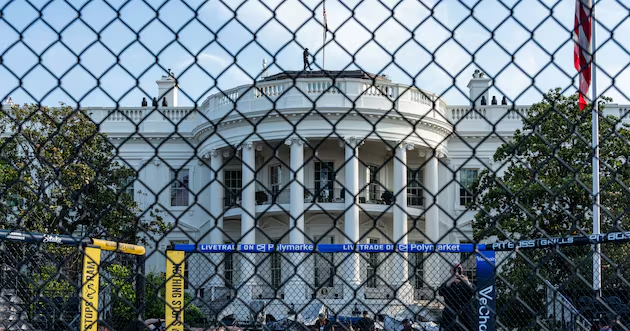
So Sunday’s UFC fight card on the White House lawn (dubbed UFC Freedom 250 and streaming on Paramount+) has intrigued me since the idea was first floated last year. As the event approached, I asked everyone I came in contact with in my small corner of the country what they thought of fights on the South Lawn.
Most people I’ve asked seem uneasy. Their take: Celebrating the country’s 250th birthday requires reverence. Is a “cage fight” really the way to do that?
Many used words like “profane,” “disrespectful” and “embarrassing.” Across media, I’ve seen the fight labeled as everything from “predictably weird” to a “hijacking.”
One of the opinions I wanted the most is from Deseret Magazine editor Jesse Hyde. Almost all of my appreciation for and knowledge of the sport has come from talking about and watching fights with Jesse. He knows the fight game, and has for a long time.
Jesse is also an astute observer of politics who has a way of seeing things that other people don’t. I wanted to know what he thought of this high-profile collision of a divisive sport with a presidency that specializes in getting big reactions from everything it does.
What started as a casual chat turned into a plan to meet in Washington, D.C., to continue the conversation as the events played out in front of us.
Aaron Shill: Do you think the backlash to UFC Freedom 250 is more rooted in dissatisfaction with the Trump administration, or discomfort with what UFC is?
Jesse Hyde: It’s important to start with some historical context. When you and I first became aware of UFC, back in the late 1990s, you could only watch UFC events by renting VHS cassettes at Blockbuster Video. It didn’t air on TV, and for a long time, most states wouldn’t sanction events.
The late Sen. John McCain famously called mixed martial arts “human cockfighting.”
We’ve come a very long way since then. Now UFC events are held at Madison Square Garden, and last August, Paramount bought exclusive rights to air events for $7.7 billion, or roughly $1.1 billion a year.
All that said, the UFC is still very much a niche sport. Of our mutual friends, most are diehard sports fans who closely follow the NFL, college football, college basketball, the NBA, etc. But very, very few watch UFC. Those who do are what we MMA fans call casuals: They couldn’t name the champions in most divisions and don’t really understand what they’re watching, in terms of the rules, technique or how fights are scored.
But everyone it seems, even people who don’t watch sports, are talking about this event, and that has nothing to do with the fighters, and everything to do with the venue and the spectacle of a cage match on the White House lawn. To some, this is grotesque, and a desecration of a sacred space in American civic life. To others, it’s fun. Bread and circus, as the Romans said.
I see both sides.
If UFC fans are dissatisfied with the event, it has more to do with the fighters on the card. The UFC as a business used to be built around a pay-per-view model, and that required building stars and events around those stars to get people to plunk down $80 for a night of fights.
Then in 2018, the UFC signed a $1.5 billion media rights deal with ESPN and the business model significantly changed. Suddenly, the UFC had to put on a lot more fights to meet ESPN’s demand for inventory, which watered down the quality of the cards. If anything, that’s only increased since 2018. When people think of UFC stars, if they think of them at all, they think of people like Conor McGregor or Ronda Rousey, who became crossover stars before the ESPN deal.
Dana White, the president of the UFC, had promised that this card would be bigger than any in history. Promoters are prone to hyperbole, but UFC fans hoped that meant McGregor would be on this card, or Jon Jones, who is widely considered the sport’s greatest of all time. Don’t get me wrong, this card has some of the sport’s biggest stars, but none are household names.
Maybe this event changes that.
JH: Our boss has called this event profane. He sees it as a desecration of a sacred space. I tend to agree, but I also think it’s very American to have a fight on the White House lawn, and I think this speaks to some extent to Trump’s appeal. Hillary Clinton famously referred to voters who didn’t like her as a “basket of deplorables.” Trump seems to know how to tap into the large slice of America that likes pro wrestling and demolition derbies and monster truck rallies. I’m curious how you see this event, and what, if anything, it says about Trump’s America.
AS: I admit to having a blind spot here.
I’m not nearly as knowledgeable about the sport as you are. But I’ve loved being part of social gatherings for big fight cards — particularly in the pay-per-view era.
I’ve come to love the sport and deeply admire the will, fitness and fortitude of these athletes. They’re built in a way most of us could never understand.
So when I first heard the idea floated for a White House fight, my first reaction was, “Cool. That will be tremendous theater.”
It wasn’t until “the claw” — the 92-foot-tall arches covering the octagon — went up that I realized some people have a real problem with the event.
That was my blind spot. Since then, I’ve read and watched everything I can about this event in traditional media and on social media. Some of the coverage has been fair, but some has been elitist and condescending. I’ve seen publications use words like “weird” and “trashy.” I’ve seen reactionary and even misleading lower-thirds (or the text crawl) on TV, particularly about the cost of the event — which is mostly being covered by the UFC and its sponsors. “Cage fight” is the term most media use, not mixed martial arts.
From what I’ve seen here in Washington, D.C., this weekend, people are here for the fights. At Friday night’s press conference, there wasn’t a single mention of Trump’s name. A good portion of the press corp here is international, with fighters like Alex Pereira (Brazil), Ciryl Gane (France) and Ilia Topuria (Spain) on the card.
I’m still trying to sort out in my mind how much of the negative reaction is Trump-related and how much is general discomfort with the sport itself. And I can’t assume that everyone who loves Trump loves the UFC, and everyone who loves the UFC loves Trump.
There’s a Venn diagram there, and I don’t know how big the overlap is.
But I believe that fans of the UFC — and Trump supporters in general — hate (or maybe love) being sneered at. So the reaction to this event is yet another cultural example of how divided we are politically.
AS: What are the risks for the UFC by its close proximity to the Trump administration in general, and with this event in particular?
JH: No American sports league has ever aligned itself with a presidential administration quite like this. It’s unprecedented, and I think risky both for the administration and, in the long term, the UFC.
A bit of historical context is important here, too. When Trump hosted fights at the Taj Mahal casino in Atlantic City, he was one of the only major figures to do so. White has said that helped the promotion survive. And they’ve been close friends since.
The relationship turned political in 2016, when Trump asked White to speak at the Republican National Convention, and that was the first of three times he would speak in Trump’s support at the convention.
When Trump was running in 2023, he regularly attended UFC events, and since he took office in 2025 for his second term, he’s attended quite a few events, where he sits cageside, usually right next to White.
He’s also brought members of his Cabinet, Republican lawmakers, prominent donors and his family with him on several occasions.
Read more Founding documents travel the country ahead of nation’s big birthday
And the crowd absolutely loves it. He’s regularly shown on the Jumbotron above the arena and gets the loudest pop of just about anyone. The fighters seem to love him, too, regardless of whether they’re American. It’s common for the fighters to give him a shoutout after a win, or even climb the cage to shake his hand, to figuratively kiss the ring. A few fighters have actually kissed his hand, like a knight bowing to his king.
Having attended a half-dozen UFC events in person, both as a reporter and as a fan, I would say the majority of UFC fans seem very much aligned with the Republican Party and with the MAGA movement, so I don’t know that there’s much risk for the promotion to be so tightly aligned with the administration — at least for now. They’re making as much money as they ever have, and if not for Trump, they’d never be able to host this event.
And it will probably go down as the most-watched UFC event in history. So for now, the relationship between White and Trump seems good for the UFC’s bottom line.
It is strange, however. I can’t think of another sports league being so overtly political in a way that will turn off at least half the country. And if Trump’s popularity continues to dip, or the MAGA movement loses favor with that fan base, long term, the UFC could have a branding problem.
In the lead-up to this fight, White did a ton of press with mainstream outlets, which is unusual both for him and the UFC, at least in recent years. He went on The New Yorker radio hour, he talked to NPR, he went on the Breakfast Club.
He faced a lot of tough questions, in particular about his ties to Trump. While he didn’t distance himself at all from Trump, he did try to position the UFC as nonpolitical, which is laughable at this point. You can’t have the president, the vice president, the speaker of the house, the head of the NSC, and Elon Musk all sitting cageside at an event, and do some version of that over and over, and then say the UFC isn’t political.
What you didn’t ask is what both sides gain from this event. I’ve already touched on what the UFC has to gain, but Trump has benefited enormously from this close association with the UFC.
Joe Rogan, who is the main color commentator during the UFC’s biggest cards, had Trump on his podcast, and so did a constellation of other comedians who are Rogan’s friends and also have large followings and podcasts with huge audiences. All of these guys — Theo Von, Andrew Schultz — did a lot of heavy lifting for Trump during the last election and played a significant role in getting young men to vote for Trump, especially Rogan, who is enormously popular with conservative men.
JH: I’m curious if you think this event could backfire in some way for Trump, the Republican Party, or the MAGA movement. Most people have never watched a UFC event. You’re going to have a lot of people tune in for this out of curiosity. We’ve watched fights together that have been pretty gnarly. Is there a political risk for Trump or the Republican Party to be associated with this kind of violence?
AS: Yes. I see a few risks here for Trump, but nothing that will determine the midterms.
In one sense, this fight is just the latest “can you believe what Trump is doing” talking point of the moment — like putting his name on the Kennedy Center (which was removed by order of the court Friday night), the $250 bill, or tearing down the East Wing of the White House to build the ballroom.
There’s a segment of America that will have a strong reaction to everything he does. And I believe the president loves it, just like a pro wrestling heel loves the boos.
A Reuters poll said that only 16% of Americans think it’s “appropriate” to have a fight on the White House lawn. That’s really low. But it’s important to note that 38% had no opinion on the matter. The event itself is probably not on your radar if you aren’t a UFC fan or an everyday follower of politics. Could a few people be turned off if they tune in and see a bloodbath like we witnessed with Josh Hokit and Curtis Blaydes in March? Probably. But I think overall, the event itself is low-risk, high-reward.
However, not everyone loves the timing. While UFC Freedom 250 is being marketed as part of the America 250 celebration, it’s also being held on Trump’s birthday. That’s easy fodder for charges of “self-aggrandizement.” And everyone — fans and non-fans of the UFC — is paying extremely high gas prices right now.
Even Rogan questioned the timing and the logistics of the event.
Which brings me to my next risk. This could be a Schadenfreude moment for Trump critics. Not only will there be heat and bugs, but there will very likely be storms. Weather already delayed the press conference on Friday, and fans in attendance were not happy.
White has vowed to press on, and my guess is that no matter how bad the weather is, they’ll manage to pull this event off. But the risk of embarrassment is there.
AS: As both a fan and observer, how do you feel about the mixing of politics and sport?
JH: Before I answer that, I feel like I have to explain how I became a UFC fan, because most people I know find the sport appalling and disgusting.
I grew up watching boxing. My grandpa boxed and taught my brothers and all my cousins to box and he’d regularly have us all over to watch big PPV fights. Tyson. Holyfield. De La Hoya. And he loved telling stories about Hearns, and Hagler and Sugar Ray Leonard, and especially Ali, who was his favorite fighter.
In spite of all that, I didn’t like the UFC at all. I thought it was barbaric, and I completely understand how people see it that way. It is incredibly violent and bloody and at times it’s hard to watch. I think we’ve watched fights together where fighters have been choked out to the point of unconsciousness or refused to tap to a jiujitsu hold and had their arm snap.
I became interested in the sport in 2011 when I did a profile on Jon Jones for “Rolling Stone.” I sat cageside, I met Dana White, I interviewed Jones after the fight and later traveled to Albuquerque to watch him train for a title defense. And what I realized meeting Jones and talking to fighters at his gym is that the sport is a chess match.
It’s a battle between very different disciplines of martial arts. Can the boxer beat the wrestler? (Almost always, no.) Can a karate black belt beat a judoka? And on and on. Once I realized there was almost never actual animosity between the fighters (when it appears, it’s usually contrived to sell the event), I saw it less as an actual fight (which makes my stomach turn) and more as a sport.
The UFC just released an AI promo for the White House event featuring Theodore Roosevelt pic.twitter.com/pSEII6Jpaw
— Championship Rounds (@ChampRDS) June 13, 2026
Now, to answer your question. I don’t have a problem with the mixing of sport and politics, per se. I have no problem with the way Ali used his platform, or how Sócrates (the soccer player, not the Greek philosopher), who played on one of the greatest Brazilian soccer teams of all time, used his fame through sport to push for democratic reforms in Brazil at a time when the country was under military rule.
But we live in an era when politics seems to permeate everything. I tell my kids: I can’t imagine fellow classmates wearing a George H.W. Bush T-shirt when I was in high school, or even putting a political bumper sticker on their trucks. Now, we can’t seem to escape politics and the discourse has become so toxic.
I don’t watch the UFC to think about politics. But the promotion is so aligned now with Trump that it’s become impossible to separate the two. At some events I’ve watched, it seems like the fighters are fighting for him, and this event is certainly that.
It’s on his birthday, after all.
JH: Assuming you don’t find this event grotesque or a desecration, I’m curious if there would be an event that would make you feel that way. TKO, the company that owns the UFC, also owns the WWE. Why wouldn’t the WWE want to host an event here next? And would that bother you? What about a monster truck rally? A demolition derby? Is there a line for you?
I talked to a lot of people before leaving for D.C., and most of them were opposed to the venue for this fight card. On a few occasions, I asked if they would object to a boxing match or a basketball game being held on the South Lawn. (College basketball games have been held on aircraft carriers, after all.)
The question caused a few people to pause, so it’s only fair that you ask me this.
The answer is, yes, there is a line.
Back to my blind spot. From Trump first suggesting in July 2025 to today, one day before the fight card itself, it’s never bothered me, because I see the UFC as a legitimate professional sport with combatants that I find captivating. And I see sport and competition as American and patriotic — and unifying — as we get in this country.
At Saturday’s ceremonial weigh-in and fanfest, they pulled out all the patriotic stops — the Golden Knights parachuting in with a giant American flag, a bald eagle soaring over the crowd, the Marines standing behind the fighters on stage and, of course, a playing of Lee Greenwood’s “God Bless the U.S.A.”
For the thousands of fight fans there, it was patriotic, not political.
But mixed-martial arts is a divisive sport. And Trump is a divisive president. And if you have a problem with either, the South Lawn fights aren’t going to sit well.
So I’m never going to tell anyone that they’re wrong to believe the venue is inappropriate. And I won’t try to convince anyone otherwise if UFC Freedom 250 isn’t their brand of patriotism.
But it’s been a pretty good party in D.C. so far, and I’m going to enjoy watching the fights.
Read more Shaping Christ: Sculptor of two Temple Square statues shares artistic and spiritual journey