
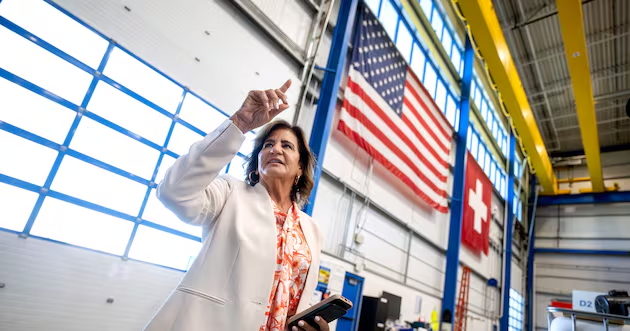
- Switzerland-based Stadler Rail is celebrating the 10th anniversary of its North American headquarters in Salt Lake City.
- The company launched in the U.S. with a handful of workers in a rented workspace but now employs 750.
- An novel apprenticeship program creates opportunities for Utah high school seniors to earn a degree and a high-paying job
Rows of white, nondescript, warehouse-sized buildings are the coin of the realm on both sides of Interstate 80 west of the Salt Lake City International Airport.
Read more Opinion: Graham Platner is not representative of America
The entrance to Stadler Rail’s manufacturing campus, as viewed from the outside, isn’t particularly notable among its neighbors except for the company’s moniker in large blue letters near the entrance.
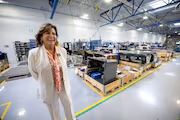
But once you pass through the doors, it’s like entering the world of Willy Wonka’s Chocolate Factory, if Wonka specialized in building state-of-the-art railcars.
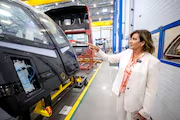
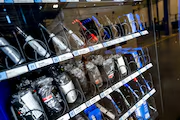
One section of the facility is full of the drive wheel assemblies, called bogies, that provide the power to Stadler’s various models. Poised on racks and rails built into the factory floor, technicians are busily adding components and making adjustments to the mechanisms.
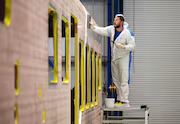
Another vast area is lined with rows of painted train cars, waiting for seats and interior finishes to be installed. In yet another area, primed cars are queued for a turn in the paint booth. Outside a newly added welding shop, stacks of bright aluminum extrusions are poised to be assembled into the skeletons of the next batch of rail vehicles. In a quiet side area, workers sit along tables putting together wiring harnesses that stretch for hundreds of feet.
But even with all the activity and duties afoot, one of the most striking characteristics is that the entirefacility is absolutely immaculate, like some futuristic, industrial-level operating room.
Swiss rail giant Stadler rolled into Salt Lake City a decade ago in the most humble of ways, with just a handful of employees working out of a rented corner of the Utah Transit Authority’s Frontrunner facility in the industrial north end of town.
But just three years later, Stadler was cutting the ribbon on a gleaming new building, a timely benchmark coinciding with the 150th anniversary of the completion of the nation’s first transcontinental railroad at Promontory Summit in rural Box Elder County.
That would represent just the first step in Stadler’s buildout of its Utah-based North American headquarters and manufacturing facility which now includes nearly 750 employees, over 500,000 square feet of facilities, a test track and plans for continued growth.


Why Stadler came to Utah
Lucy Knight Andre, CEO of Stadler Signaling North America and chief of staff for the Stadler U.S. division North America, said Stadler made its first railcar sales to U.S. customers in the early 2010s but updates to the Buy America Act compelled the company to seek out a U.S.-based location. Utah, Knight Andre said, quickly rose to the top of Stadler’s list of best places to establish a new North American headquarters. And it didn’t hurt, she said, that Utah’s snow-topped mountains and rich winter sports culture mirrors Stadler’s Swiss origins and global home base.
“We looked at a lot of places to locate and decided on Utah,” Knight Andre said. “And it’s been an amazing decision for us. It’s easy to say we liked the mountains — but there’s a tremendous workforce here.”
Beside access to a vibrant labor pool, Knight Andre said Utah’s business-friendly environment helped seal the decision.
“When we went around to different places, one of the biggest things that stood out to us about Utah was access to state and local decision makers, and federal decision makers as well, but also other businesses and industry associations and universities,” Knight Andre said. “And we found a tremendous commitment from the entire community to be here.”
Stadler also has a direct connection to Salt Lake City thanks to its cars being used by the Utah Transit Authority for both TRAX service and the S-Line streetcar that connects TRAX to the Sugar House neighborhood. But that wasn’t Stadler’s first foray into the U.S. market.
“Our first project was TEXRail, which runs from downtown Fort Worth to the Fort Worth airport,” Knight Andre said. “That was our first project here and it was an exciting one for us because our technology was new in the United States.”
A company built on innovation
Those technology innovations include all-aluminum railcars and open gangways that accommodate passenger movement from one car to another. Stadler cars are also self-powered, as opposed to the push-pull systems that rely on engine cars to propel connected units, and the company employs modular design systems that make it possible to power cars with electricity, on-board batteries, diesel or even hydrogen power. Knight Andre noted that even amid growing interest in cleaner drive systems, a full portfolio of power options is a reflection that different rail deployments require different solutions.
“We love electric trains and would they work in the Salt Lake Valley? Absolutely,” Knight Andre said. “Would they work going from Salt Lake out through the West Desert? Probably not because you can’t electrify that whole passage. So I think the future is in all of the different modes. Certainly, there’s a place for hydrogen, there’s a place for electrification, there’s a place for battery, and you know, there’s a place for intermittent electrification and battery. And, I will say, this might be an unpopular opinion, but there is still very much a place for diesel trains. Our diesel trains are very clean-burning.”
Knight Andre noted that Stadler built the first hydrogen fuel cell-powered train in the U.S. for the San Bernardino County Transit Agency and has set a world record for miles traveled in a single hydrogen tank fill-up. The company also built a first-of-its-kind electric powered train for California’s Bay Area Caltrain system. Stadler has amassed a client list that spans the country and includes Atlanta’s MARTA system which is about a month away from putting its first, custom-designed Stadler railcars into service. The new cars are part of a $700 million contract struck in 2019, the biggest yet for Stadler U.S., that calls for 56 four-car trains that are poised to update Atlanta’s busy transit system.
Custom solutions make a difference
Connie Krisak, MARTA’s senior director of rail vehicle procurement, told the Deseret News that Atlanta transit officials leaned heavily on MARTA riders for input on what the new rail cars should look like as they assembled a plan to replace a fleet of railcars, some of which have been in service for 40 years.
“Our design effort began with broad public outreach about the differences and potential amenities,” Krisak said. “We had thousands of responses and learned that not every rider is the same. Each has their own specific needs. Some are short, some are tall. Some wanted more luggage space, some people asked for better access for wheelchairs, others wanted space for strollers and bicycles.”
Read more Fear of data centers outpaces knowledge about them
Stadler distinguished itself from other potential manufacturers by offering a custom solution, Krisak said.
“Stadler provides a very unique service and offered to design us a one-of-a-kind railcar,” Krisak said. “This is a design that met all of the criteria we heard from our riders, some of whom had experience riding trains all over the world.”
Krisak said the Stadler CQ 400 cars include open gangways (unlike the current cars in the Atlanta system that don’t accommodate passage from car to car), dedicated space for wheelchairs, under-seat room for luggage as well as areas for storing strollers and bicycles in-transit, better lighting, wireless charging capabilities and more.
“Once this train hits revenue service and people begin to use it they’re going to fall in love with it,” Krisak said. “It’s so nice, it’s open and brings a whole new sense of design. It’s like the feeling of buying your first house or first new car. This is a new train, not just for one person but for all of Atlanta.”
The Deseret News got a peek at the CQ 400 railcars under assembly during a tour of Stadler’s manufacturing facility in Salt Lake City. Knight Andre explained that early on, whole, painted railcars were being shipped from Europe and the assembly work in Utah consisted of completing interiors, installing seats, electronics, etc. As Stadler U.S. expanded, it took on more tasks which now also includes welding the cars together in an expansion that was completed last year. Now, aluminum extrusions are shipped to Salt Lake City and the cars for North American customers are built and completed in Utah. Knight Andre said the next step will be to add machining capacity.
But they may need to find some additional property first.
“We thought we were buying for the future when we bought almost 63 acres,” Knight Andre said. “And as it turns out, 10 years in, we’re pretty much built out. It’s fantastic — beyond our wildest dreams.”
How to train a workforce
A major factor in fueling that growth has been Stadler’s ability to export its 80-plus years of European train building knowledge to its U.S. manufacturing staff.
“When we came to the United States, we had a very specific long-term plan,” Knight Andre said. “You can’t just walk into a place and do everything all at once. So we had a very specific plan for how to transfer knowledge from our facilities and our workforce in Switzerland, which involved people coming over and training up people to do the work here.”
Stadler U.S. has also boosted its staff through a ground-up training program that opens a door for Utah high school seniors to acquire valuable skills, and great paying employment, with the Swiss train maker that boasts a global workforce 17,000 strong. Knight Andre said Stadler was among the founding partners of Talent Utah’s Talent Ready Apprenticeship Connection program.
TRACC is a three-year youth apprenticeship program that includes on-the-job training and formal education that begins during participants’ senior year of high school.
“They go to school about half-time and come to us to work the other part,” Knight Andre said. “Then they go to Salt Lake Community College the second two years and work for us during their off-time. They graduate with an associate’s degree in advanced manufacturing, and we pay all of their tuition and costs as well as paying them to work.”
Celia-Marie Bartholomew first heard about the Stadler apprenticeship opportunity in her high school welding class and said the news came at a time when she wasn’t clear about her post-high school plans.
“At the time, I didn’t really know what I wanted to do with my future,” Bartholomew said. “I wasn’t sure if college was the right path. But now, I’m on track to earn a degree while I’m getting professional work experience and, hopefully, have a job offer waiting for me at the end.”
Bartholomew, who is nearing completion of her three-year apprenticeship, has gained experience across various departments at Stadler. While her rotations included time on the manufacturing floor, she said her latest assignment — trouble shooting parts issues with vendors — has been a strong fit and she hopes to continue in the position.
Reflecting on her experience, Bartholomew said she is inspired by Stadler’s broader mission and the opportunity to contribute to the advancement of public transit.
“I want to be a part of contributing to making public transit in Utah as good as it can be,” she said. “Being with a company that creates public transit solutions for all kinds of communities, I want to be a part of that.”
For Bartholomew, and her future colleagues at Stadler U.S. in Salt Lake City, the future appears bright.
Next stop, the future
According to its latest , Stadler has over $40 billion in backlogged orders and generated nearly $4.6 billion in global revenues last year with the North American market responsible for 6.6% of that income. Knight Andre said while the U.S. and rest of North America have a ways to go when it comes to catching up with the well established rail systems, and rail habits, of western Europe, she sees a domestic market that is on a growth trajectory.
“I think train culture is absolutely on the rise in the United States,” Knight Andre said. “Light rail is a big thing right now so that’s exciting for us. As you have urban growth, you have to find transit solutions that work. I think most cities are coming to those realizations.”
Read more Who’s the best coach in the Big 12? On3’s Brett McMurphy thinks it’s BYU’s Kalani Sitake