
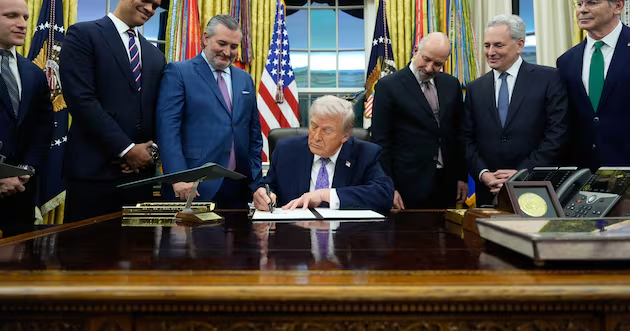
President Donald Trump has been bullish on artificial intelligence and insists that the United States will hold “global AI dominance.” This has resulted in a marked antipathy by the administration to any regulation of AI systems. The Department of Justice has gone after states, such as Utah, that have dared to attempt some regulation in the face of federal inaction, and the first federal feint at regulation, announced only a few weeks ago, is a bald pretense.
Read more How Stadler Rail is transforming public transit in North America
But the curtain has been raised on Act Two of this saga. And, as Shakespeare would appreciate, this transition is fueled by human passions: to wit, high-ranking officials in the Trump administration despise the AI company Anthropic and would like to punish it for its temerity in not allowing the government to do what it likes with its systems, such as Claude.
Just last week, the Trump administration did something quite out of character, but quite consistent with its emotional logic. It decided that another of Anthropic’s systems, Fable, was too easy to jailbreak, and its capabilities could pose a threat to national security. Rather than order Anthropic to de-deploy Fable, it took a more subtle route: The administration slapped export controls on Fable, including forbidding the company from allowing access to Fable by any foreign citizen, including Anthropic employees.
Anthropic, in turn, chose to completely de-deploy Fable — indeed, it was not much of a choice, to be honest. The company also sent a high-level team to Washington to try and smooth things over.
In a statement about the government’s action, Anthropic notes, “If this standard was applied across the industry, we believe it would essentially halt all new model deployments for all frontier model providers.” They are not wrong, and that represents a very significant new turn in the relationship between the federal government and AI companies. The government has shown it does indeed have some big sticks at its disposal, despite its stated laissez-faire policy, and that it may decide to use them.
This new development has repercussions far beyond the United States. The U.S. has just revealed, in essence, that it has its finger on the “off switch” of every AI system created by a U.S. company. Foreign companies and countries that use these systems have now been put on notice that their access to these systems can be abruptly terminated. For just this reason, France has recently announced its government will not use American-made AI. The quest for dominance, alas, will always create an equal and opposite force seeking independence.
Act Two of the American AI saga is a fascinating one, for it has been easy to assume that the inordinate riches of the AI companies, plus their significant contribution to the GDP and to national security, would see the government bend the knee to their wishes. Certainly our polarized Congress is in no position to lay down the law — any law — and the Trump administration’s behavior up to this point bolstered the assumption there would be no leash at all. Now a new possibility opens to view: that the government will actively seek to retain and assert its power vis a vis the tech lords.
The federal government’s economists are also currently in discussion about how best to tax AI, another assertion of state power. After all, AI companies sell their products as a replacement for labor; unfortunately, our tax system is premised on our citizens having income to tax for the state coffers. Over half of government revenue comes from citizens’ income tax, whereas only about 11% comes from taxes on corporations. The AI business model, therefore, threatens to wreak havoc on the primary source of government revenue.
Read more Opinion: Graham Platner is not representative of America
None of the taxation alternatives being discussed will make AI companies happy. The federal government under Donald Trump has bought into more than 20 companies deemed critical to national security, in some cases becoming one of the largest shareholders in these companies. Applied to AI, this could be a novel form of taxation since the profits owed to the government would then be considered public funds.
Others (including Dario Amodei of Anthropic) have proposed a tax on AI “tokens” — the unit of AI processing. The more tokens used, the more tax paid. This approach to taxation would offset the gains to be made by companies seeking to replace their workers with AI.
Indeed, Andrew Yang has proposed ceasing to tax human labor entirely and instead taxing AI agents. Still other schemes involve taxing electrical use by AI companies, or instituting a highly progressive tax on capital in all forms, whether income or assets (such as robots).
No matter what taxation approach is taken, this is another manifestation of a growing backlash to AI laissez-faire, and it’s not just a grassroots backlash, but now also a government backlash. This backlash is also evident in the political struggle over data centers, where local governments, and not just outraged citizens, are beginning to say no despite the promise of increased revenue and some jobs.
And, finally, policymakers are finally making a reasoned and ethical case for ensuring that AI supports human wellbeing and does not degrade it. A recent essay by Missouri Sen. Josh Hawley in the journal First Things is a well-articulated exhortation to the government to ensure AI works for the people of this country. Hawley says we must “bend the arc of this technology toward the welfare of the nation, toward the welfare of our families, of our children, and of labor. We will not surrender our principles to the technology. The technology will answer to our principles.”
Amen to that. The government must stand with its people, and I am so very happy to see, at long last, the first stirrings of that praiseworthy impulse in Act Two.
Read more Fear of data centers outpaces knowledge about them