
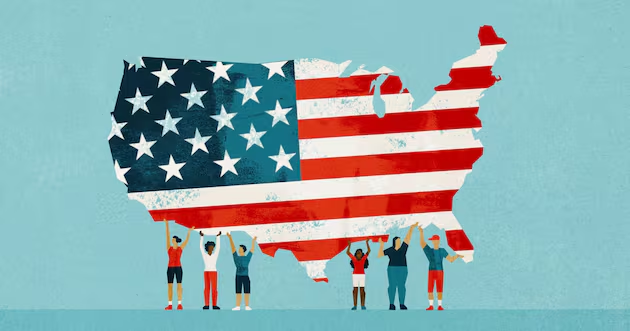
“This land is your land. This land is my land. From California to the New York Island. From the redwood forest to the Gulf Stream waters, this land was made for you and me.”
Read more British Prime Minister Starmer resigns, joins string of early exits
And as we move toward our nation’s 250th birthday — and amid the most polarized nation in my lifetime — I’ve been thinking a lot about the identity of our country. I’ve been pondering the differences between patriotism and nationalism. I am concerned that they are being conflated, but they are most definitely not the same thing.
In Utah, and around the country, feelings of patriotism are on the decline. I wonder how much of that, however, is due to a lack of agreement on what patriotism is.
According to Charles de Gaulle, who led France against Nazi Germany during World War II and later became president of France, “Patriotism is when love of your own people comes first; nationalism, when hate for people other than your own comes first.”
The power of devotion vs. the hunger for power
Patriotism is “devotion to a particular place and a particular way of life, which one believes to be the best in the world but has no wish to force on other people.” On the other hand, “nationalism is power hunger tempered by self-deception,” George Orwell wrote in a 1945 essay titled “Notes on Nationalism.”
America is not just a place, although it is indeed a beautiful place, from sea to shining sea. America is an idea. It’s one of the things I love the most about America. It’s an aspirational idea, grounded in constitutional order, a belief in individual liberty, unalienable rights, that we allare created equal. An aspirational idea also leaves room to acknowledge gaps in where we’re trying to go.
Nationalism, on the other hand, isolates and separates. It drives comparison, not so we can learn and improve, but to use as a wedge and a weapon with which to beat our opponents.
“Every nationalist is capable of the most flagrant dishonesty, but he is also … unshakeably certain of being in the right,” Orwell wrote in the aforementioned essay.
“All nationalists have the power of not seeing resemblances between similar sets of facts,” he wrote. “Actions are held to be good or bad, not on their own merits, but according to who does them, and there is almost no kind of outrage — torture, the use of hostages, forced labour, mass deportations, imprisonment without trial, forgery, assassination, the bombing of civilians — which does not change its moral colour when it is committed by ‘our’ side.”
It’s almost as if Orwell, who died in 1950, could see our day.
The ‘golden calf’ of national idolatry
Patriotism says, “I love my country and I know you do too, even if we don’t agree.” Nationalism says, “Because you look different than me/think differently/worship differently/belong to a different political party, then you hate your country,” or, even worse, “You don’t belong here.”
Episcopal priest Joseph Yoo describes the differences between patriotism and nationalism as he sees them:
View this post on Instagram
“Patriotism is love. It’s gratitude. It’s saying I care about my country enough to tell the truth about it, to celebrate what’s good, to work to fix what’s broken.”
Read more Opinion: Did the pandemic change American downtowns for good?
But, he says, nationalism is idolatry. Nationalism is when you say, “My nation is the nation above critique. It’s God’s favorite. And once you slap God’s seal of approval on your flag, congratulations, you’ve just made your country a golden calf.
“Patriotism says, ‘I love my family enough to admit when we’ve messed up, and I will help us grow,’” Yoo said. “Nationalism says, ‘My family is perfect, everyone else is trash, and if you disagree, you are out.’”
I’ve never seen a time in my lifetime when neighbors, colleagues and even family members can have such intensely adverse feelings for each other based on the lawn sign they have.
Patriotism requires truth
Living up to the ideals set forth in the Declaration of Independence requires the ability to see and share the truth. Mark Twain said, “Patriotism is supporting your country all the time and your government when it deserves it.”
President Theodore Roosevelt said, “Patriotism means to stand by the country. It does not mean to stand by the president or any other public official, save exactly to the degree in which he himself stands by the country. It is patriotic to support him insofar as he efficiently serves the country. It is unpatriotic not to oppose him (or her) to the exact extent that by inefficiency or otherwise he fails in his duty to stand by the country. In either event, it is unpatriotic not to tell the truth, whether about the president or anyone else.”
“The difference between patriotism and nationalism is that the patriot is proud of his country for what it does, and the nationalist is proud of his country no matter what it does,” said American journalist Sydney J. Harris.
Hannah Stratford, a high school social studies teacher and master’s student at UVU, wrote recently about why the Declaration of Independence promised equality if it wasn’t true, especially when it was written. “We hold these truths to be self-evident, that all men are created equal,” but 1776 was a time when even the author of the declaration held slaves, when women largely could not own property and could not vote, and when any non-white, non-male residents were often barely an afterthought, if that.
But instead of being used as a weapon with which to further exclude the excluded, Stratford wrote that “the declaration has been a beacon of hope for marginalized communities. Across history, Americans did not reject the declaration because its claims fell short. Rather, they grasped its promises and used it as a powerful leverage for change.”
She pointed to the Frederick Douglass question about the meaning of the Fourth of July to a slave, to the women’s suffrage movement and to the Rev. Martin Luther King Jr.’s assertion that the declaration was a promissory note that the Civil Rights Movement was there to cash.
The Declaration of Independence, she said, “wasn’t written because equality was already in place, but because it is worth fighting for.”
I agree with her. Equality is still worth fighting for. Our friends and neighbors are worth fighting for. People we have never met are worth fighting for.
Read more Hill Air Force Base, Utah National Guard to celebrate America 250 with statewide flyover
America, with all her flaws, is still an idea worth fighting for.