
A version of this article was first published in the Right to the Point newsletter. Sign up to receive the newsletter in your inbox every Wednesday morning and to vote in subscriber-only polls.
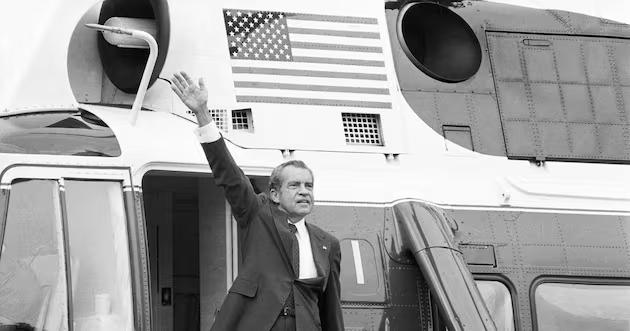
Vice President JD Vance wasn’t yet alive when, in 1974, Richard Nixon became the first U.S. president to resign, or two years later, when the movie “All the President’s Men” came out and was nominated for multiple Academy Awards.
Some of us who were have a quite different assessment of the Watergate scandal than Vance offered last week in remarks for the Richard Nixon Foundation.
JD Vance: “I think Nixon’s historical legacy is enjoying a bit of a renaissance, and deservedly so. I joked that if Watergate happened tomorrow, it would be like a 12 hours news story. The idea that it took down a presidency is crazy.” pic.twitter.com/osy0V3QLyN
— Aaron Rupar (@atrupar) June 25, 2026
As is always the case, the context is essential.
Vance said, “As I joked with Robert backstage, if Watergate happened tomorrow, it would be like a 12-hour news story. The idea that it would have taken down a presidency is crazy.”
Those comments have been repeated in The Atlantic, The Washington Post and elsewhere, without the antecedent “As I joked with Robert backstage.”
That’s a pretty significant omission. The other context is that Vance was speaking to an audience inclined to believe Nixon got a bad rap. (The website of the Nixon Foundation says “Nixon now. More than ever. Carrying the legacy and vision of President Richard Nixon into the 21st century.”)
But because Vance went on to say “I’ve always liked Richard Nixon” and suggested, like Tucker Carlson, that the “Deep State” had taken down Nixon just as it tried to take down Donald Trump in his first administration, a video clip went viral.
Everyone from Hillary Clinton to David French weighed in, with French saying on X, “The reason why Watergate would be a 12-hour news story today is that Trump is so corrupt that Nixon seems almost quaint by comparison.”
You don’t have to think the president is corrupt, however, to notice the other differences between 1974 and today.
Watergate ushered in a new scrutiny of American presidents, as Bob Woodward and Carl Bernstein became famous for their investigative work and journalism as a profession was temporarily elevated by their efforts. (The same thing happened in the aftermath of “Spotlight,” the cinematic telling of The Boston Globe’s reporting on sexual abuse by Catholic priests.)
A majority of Americans trusted the press then; in fact, Gallup first began asking about trust in media in 1972, the year the Watergate break-in took place. Throughout the 1970s, trust in media remained high, climbing at one point to 72%, and The Washington Post’s reporting was no doubt a large part of it. That trust has fallen precipitously, along with trust in other institutions.
At the same time, we have seen reprehensible behavior from other presidents that have not resulted in a resignation. Was Nixon an uncommonly bad president, or have the standards of the American people changed? His resignation speech is worth reading, or rereading, as the case may be.
Meanwhile, as Woodward and Bernstein’s book agent recently wrote, the break-in was a one-day story, until it wasn’t. “Most top reporters didn’t even notice it. The Washington Post literally scraped two reporters from the bottom of their reportorial barrel,” David Obst wrote for the Santa Barbara Independent after Vance’s remarks went viral.
For the past 50 years, most Americans have believed that the revelations by those two reporters brought down the president who later conceded, “I would say only that if some of my judgments were wrong, and some were wrong, they were made in what I believed at the time to be the best interest of the nation.”
Now the sitting vice president says it was the “Deep State.” And Vance, just 41 years old, may live to see Nixon’s legacy fully rehabilitated. There are signs that it is already happening: The Richard Nixon Library and Museum in Yorba Linda, California, is the site of several America 250 events this week, including a concert of patriotic music and a “Morning with the Presidents” event.
The “presidents” involved are George Washington, Abraham Lincoln, Ulysses S. Grant and James Madison — not Nixon. It remains to be seen whether the legacy of the 37th president, lauded for his diplomacy and work with China in the early ‘70s, can be rehabilitated enough to receive such honors in the future.
But stranger things have happened, and the Manhattan Institute’s Christopher Rufo has predicted that Nixon will be “vindicated by 2035.”
Thanks to the Nixon Foundation team for the tour of RN’s childhood home and presidential library. As I told Bill Maher last night, Nixon will be vindicated by 2035. 🇺🇸 pic.twitter.com/11Ctz3JU9T
— Christopher F. Rufo ⚔️ (@christopherrufo) August 23, 2025
Where’s Freddy?
My X feed, which as of just a few months ago was largely featuring profane tweets by animal accounts like “Moose” and “Cow,” has rehabilitated itself and is now awash in patriotic content, probably because I’ve spent so much time following Freddy, the German who traveled to the U.S. for the World Cup and promptly went viral by praising us.
Read more Why Trump’s Religious Liberty Commission wants to rethink ‘separation of church and state’
To that, I must now add “allegedly.”
Freddy always seemed too good to be true, an influencer who wasn’t seeking money or fame. Even though his posts won him attention and lavish gifts from celebrities and governors (including Utah’s Spencer Cox), he never showed his face or gave his last name or any identifying details. When he announced a few days ago that he intended to delete his X account upon returning to Germany later this month, he got even more accolades.
Cincinnatus.
George Washington.
Freddy. https://t.co/Xvyp6KsB2u
— Derek T. Muller (@derektmuller) June 30, 2026
Now some Freddy fans are feeling duped, after his account disappeared from X soon after Germany lost to Paraguay, and Fox News and OutKick’s Austin Perry reported on social media posts that suggested Freddy had not been entirely truthful about his time in the U.S. and that he had been here before.
Some are questioning whether the account was a scam of some kind, although Perry is still on the side of Freddy.
“There have been a ton of people who have unearthed posts from Freddy speaking ill of the United States, and honestly, this just drives home what I and several others have been saying,” Perry wrote.
Freddy, he added, “clearly gave the country a second chance and even fell in love with it in the process. He got to see the absolute best that small-town America had to offer during his trip here, and it looks like he’s changed his tune.”
We can only hope.
Woodward and Bernstein, can you get on the case?
Meanwhile, for the Freddy bereft, may I suggest the X account that is “live-blogging” America in June and July 1776. It’s a great idea, both entertainment and history lesson.
To break a deadlock in the Continental Congress’s vote for independence, Delaware delegate Caesar Rodney rides through a thunderstorm all night and arrives in Philadelphia in muddy clothing just as voting begins.
Unfortunately, the first vote does not pass, which was… pic.twitter.com/vHF9BvrPi7
— 1776 Live (@250YearsAgoLive) July 1, 2026
There is some off-putting advertising content, but to be fair, there was plenty of advertising going on in 1776, as you can see at the Adverts 250 Project, an online repository of ads published in the Revolutionary period — including some deeply disturbing ones for enslaved people.
It’s why so many Unitarian Universalist congregations will read Frederick Douglass’ “What to the Slave is the Fourth of July?” on July 5, which was the day the speech was originally given.
Recommended Reading
Karlyn Bowman and Nicole Penn break down a new report from the American Enterprise Institute that sheds lights on why so many young Americans say they are not patriotic.
“The percentage of parents who agreed that the United States is a unique country that stands for something special in the world dropped by more than 20 points between 1998 and 2026 (84% to 62%, respectively). There was also a substantial decline in the percentage of parents who agreed that it is essential or important for schools to teach kids that the United States is a fundamentally good country … and for schools to teach kids to be patriotic and loyal to the nation …”
Parents were surveyed in 1998 and 2026. How have things changed?
Asbury University President Kevin Brown invites us to consider what higher education is for, in the aftermath of a commencement season that saw so many students boo speakers.
“A school worthy of the name does not simply develop skills among students; it considers their moral application. As the ethicist Martha Nussbaum reminds us, ‘A good doctor is also a good poisoner.’”
Commencement boos and our understanding of higher education
And Asma Uddin notes that the same qualities that make chatbots good companions for seniors makes them horrible for vulnerable young people. Can this dilemma be fixed?
“Last month, Pennsylvania sued Character.AI to stop its chatbots from posing as doctors. A bot on the platform had told a state investigator it was a licensed psychiatrist, down to a fabricated Pennsylvania medical license number, in what the state describes as the first enforcement action of its kind.”
A tale of 2 robots: How AI heals lonely seniors and harms vulnerable teens
End Notes
I live in the deep-blue suburbs of New England, so it’s been a surprise and a delight to see the occasional yard sign that isn’t political but patriotic: “This house was here in 1776,” the signs say.
In that vein, Adelle Banks at the Religion News Service recently wrote about churches that are older than American independence. There aren’t many left — about 1% of U.S. churches that were around on July 4, 1776, are here today, Banks said. But of those that are, some are still holding worship services, including the Old North Church, worth a visit if you’re ever in Boston.
Finally, last week Right to the Point subscribers weighed in on whether this is a happy birthday for America or not. An overwhelming percentage of us said yes, it is.
Happy America 250 to you, no matter how you voted. (And if you’re wondering, I’m with historian Fergus Bordewich, who said, “Every birthday of America is a happy birthday. Every single one.”)
Read more America’s greatest piece of writing