
All people are created equal. We have unalienable rights. Just government is based on the consent of the governed.
Read more Everyone should take religious freedom seriously
The day the founders gathered in Philadelphia 250 years ago to state these ideas changed their lives, our lives and the world. It’s why we celebrate this day and love our country.
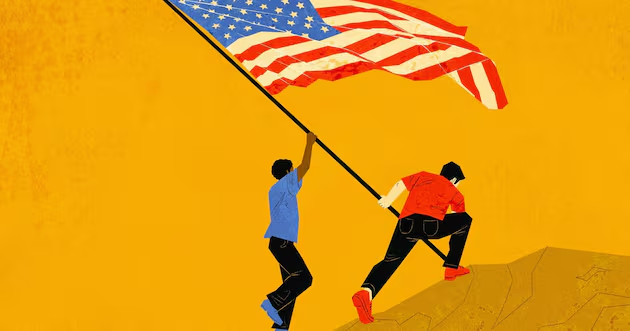
But a specter is haunting American patriotism — the specter of political polarization. Rather than celebrating our love of country in a way that draws us together, we have devised two patriotisms — one for each half of the country, with each patriotism repugnant to the other and with no shared foundations.
A patriotism celebrating our past
One of these patriotisms mainly looks back in gratitude. To comprehend it, consider these words from “America the Beautiful,” one of our most beloved national anthems, by Katharine Lee Bates: “O beautiful for heroes proved / In liberating strife, Who more than self their country loved, And mercy more than life!”
More guest opinion pieces relating to America 250
- Opinion: Limited government and the pursuit of happiness
- Opinion: The founders bet their future on the American experiment
- Opinion: Defining the heart of a nation — patriotism vs. nationalism
- Opinion: The civic virtue of everyday citizens
- Opinion: The Declaration of Independence is more than America’s birth certificate
In this patriotism, I love America for what she has been and stood for. I revere what the founders accomplished and what so many have fought and died for.
My love draws strength from lived experiences together and a shared past — what Lincoln called our “mystic chords of memory” — and from the ways in which America from the beginning has been a force for good and a beacon of freedom in the world.
A patriotism envisioning our future
The other patriotism mainly looks forward in determination. To comprehend it, consider these words from “Let America Be America Again,” by Langston Hughes: “O, yes, / I say it plain, / America never was America to me, / And yet I swear this oath — America will be!”
Read more How the founders used biblical language to justify the American Revolution
In this patriotism, I love America for what she might become. I believe, despite some evidence that I shouldn’t, in America’s possibility.
Although America as I see her has never lived up to its principles — as Frederick Douglass asked in 1852, “What, to the American slave, is your 4th of July?” — my pledge to America is that one day she will. I believe with a patriot’s fervor in the future realization of what can now only dimly be seen.
The great temptation today, a danger on this July 4, is to view these two sides of American patriotism as hostile to one another. Such a view is deeply misguided. Each side, when viewed as alien from the other, is a distorted patriotism. And each can rightly accuse the other of misunderstanding the land we love.
An American patriotism
Surely we can do better than this. Can’t we, in civic love, look both forward (as many progressives do) and back (as many conservatives do)?
Can’t we revere our achievements and recognize where we’ve fallen short? And why can we not honor the profound work of America and face up to what Lincoln — who said that he “never had a feeling politically that did not spring from the sentiments embodied in the Declaration of Independence” — called at Gettysburg our “unfinished work.”
Surely this is the truest form of American love of country.
The two chief qualities of American patriotism are thankfulness and aspiration, and they stand best when they stand together.
Read more Sports on the air: Here’s what games are on TV and radio for the week of July 5-11