
American politics consistently asks voters to do something strange: buy an entire ideological bundle when they want only part of it.
Read more Opinion: A passive-aggressive culture hurts us more than we think
If a voter favors higher taxes on high earners, pundits and the political class often assume that voters must also favor every progressive position on gender, sexuality, immigration and policing. If a voter favors a border wall, the same political world often assumes that voters must also favor every conservative position on taxes, healthcare, abortion and foreign policy.
Yet that is not how many Americans actually think about politics. They do not pick a side and accept the whole ideological package.
In a recent survey, we asked a representative sample of 1,000 Americans about their position on 25 contemporary policy issues. The questions covered criminal justice, marijuana, gun background checks, abortion, immigration, taxes, education, healthcare, defense spending, voter identification, free speech and the Ukraine War. After documenting each voter’s positions, we compared each respondent with every other respondent, creating 499,500 possible pairs of people.
For every pair of respondents, we were curious: For how many of the 25 issues did these two people share the same opinion?
The answer is not what contemporary political commentary would lead you to expect. In the survey, 369,437 respondent pairs agreed on a majority of the 25 issues. That is 74% of all pairs.
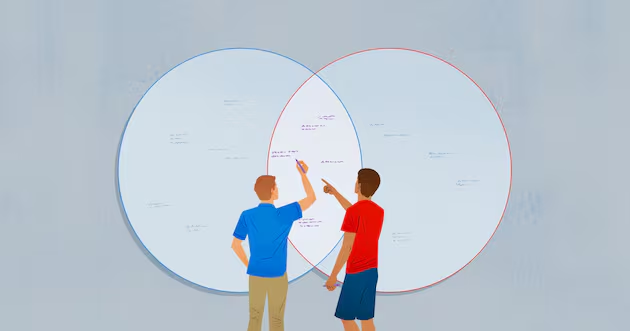
This cuts against the familiar story of an electorate divided into two diametrically opposing ideological camps. And it says instead that most people agree with most other people most of the time.
Substantial issue agreement exists across party lines
While it’s true that an even higher number of pairs from the same political party (93%) agreed on a majority of the issues, cross-party agreement was also substantial — with a majority (53%) of Democratic-Republican pairs agreeing on a majority of issues.
Partisanship organizes a great deal of public opinion and policy debate, but it does not turn Americans into two blocs of voters with opposite issue positions.
This ideological overlap is politically important because parties and candidates do not offer voters an issue-by-issue cafeteria. They offer bundles of issues. A presidential candidate is not a series of separate referendums on taxes, abortion, immigration, healthcare, education and foreign policy but a tightly packaged deal.
Voters look more ideologically uniform than they are when we naively assume a vote for a candidate or party is an agreement with every issue in that package deal.
That package creates the illusion of a partisan monolith. Voters look more ideologically uniform than they are when we naively assume a vote for a candidate or party is an agreement with every issue in that package deal.
Likewise, shifts in partisan control of government should not be read as proof that voters have somehow abandoned one entire party basket for another. The takeaway may be far more modest: When a different issue rises in importance in their own mix of views, some voters may choose a different party. That’s very different from entirely changing worldviews. Instead, they may be changing which part of that worldview they want government to act on first.
Voters often disagree with their party’s issue basket
Consider the party “basket” implied by voters themselves. For each issue, we identified the majority position among Democratic respondents and the majority position among Republican respondents. Then we asked how often partisans matched their own party’s basket.
Read more Deseret News archives: Fischer beat Spassky in chess Match of the Century
Again, the answer runs against the usual image of disciplined ideological teams.
In the survey, no Democratic respondent matched the Democratic majority basket on all 25 issues. Less than 1% of Republicans matched the full Republican basket. The average Democrat differed from the Democratic basket on six of the 25 issues.
Likewise, the average Republican differed from the Republican basket on six issues. That is roughly one-quarter of the issues we asked about.
These results present a picture of citizens holding mixed bundles of issue positions, not a picture of voters perfectly adhering to complete ideological contracts.
That helps explain why American politics can feel both polarized and volatile at the same time. Many voters are not moving from one fully coherent ideology to another. They are choosing which part of their own mixed worldview feels most urgent at the time.
A voter may be culturally conservative but economically liberal. Another may be pro-life and also support stricter gun laws. Another may support immigration restrictions and also support more healthcare spending.
Within our binary politics, we often interpret these people as confused, inconsistent or persuadable. Some certainly are. But many are simply “cross-pressured” — and not fitting neatly into the partisan packages offered to them.
For years, cable companies forced customers to buy hundreds of channels to get the few they actually watched. Political parties still do something similar — bundling issues together and asking citizens to buy the whole package. Many comply, but incompletely. Others switch packages. Others opt out entirely.
Political parties simplify politics, organize coalitions and help voters make choices in a complicated political world. As part of that practice, they make it seem like the world is binary. But that simplification hides a remarkable amount of agreement that exists underneath the partisan conflict.
Unmasking this hidden agreement will not, by itself, solve polarization. People can agree on several policies and still distrust the other party.
But even with those divisions, the partisan monolith is largely an illusion. Americans are often divided, but not always as cleanly as our political language would suggest. Beneath the parties’ ideological packages is a public with more overlap and internal complexity than a strictly red-blue world allows.
A healthier politics should start by seeing citizens as they are: not as mere representatives of partisan teams but as people with complex combinations of opinions that often cut across the ideological packages they are offered.
Ask someone their opinion about a contemporary political issue. Statistically, you’ll probably agree with them.
Read more Beaver community rallies around firefighters and affected families amid devastating Cottonwood Fire