
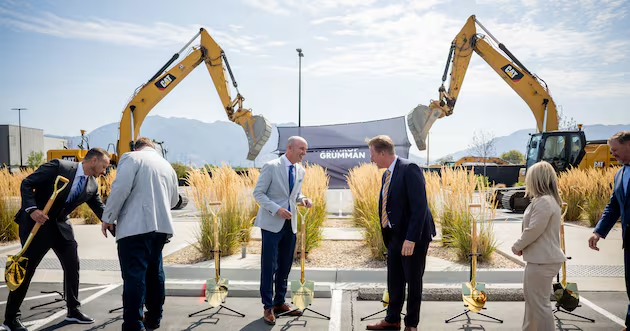
- Utah Gov. Spencer Cox takes part in groundbreaking ceremony Tuesday for Northrop Grumman’s future Legacy Building.
- The new facility will support the next-generation Sentinel missile program.
- Cox touts the state’s growing role in developing innovation to protect the nation.
While Utah Gov. Spencer Cox was meeting Monday with President Donald Trump in the Oval Office, Secretary of State Marco Rubio walked in with bad news.
Read more War in Iran: The latest
“Mr. President,” Cox recalled Rubio saying, “(Iran’s) hit two more ships in the Strait.”
For the governor, that conversation was an unnecessary reminder that the world’s a dangerous, unstable place — even while fortifying his resolve to keep Utah at the forefront of keeping Americans safe.
“Here in Utah, we support the warfighter,” said Cox at Tuesday’s ceremonial groundbreaking of the Legacy Building at Northrop Grumman’s Roy Innovation Center that will support the next-generation Sentinel Intercontinental Ballistic Missile program.
“We support the families who are sacrificing,” he added. “I personally know some of the people who are dropping bombs and refueling the planes that are trying to keep the Strait of Hormuz open — and trying to prevent the most evil nation on Earth from getting a nuclear weapon.”
Gov. Cox: Utah is stepping up to keep America safe
The governor was joined Tuesday by company and local civic leaders outside of Northrop Grumman’s sprawling Roy campus to ceremoniously commence construction of the new facility.
The Roy Innovation Center was founded several years ago to support the U.S. Air Force’s Sentinel program.
Once completed, the Legacy Building will feature 32 new unique containers for Sensitive Compartmented Information Facilities, along with secure meeting spaces, high-end laboratories and a large pedestrian plaza and extended skybridge walkway connecting to the main Northrop Grumman campus.
Northrop Grumman is the Beehive State’s largest defense employer, directly employing more than 11,000 Utahns and supporting over 46,000 jobs statewide — while generating $12.4 billion for the economy, according to the company.
Cox saluted local leaders, the Utah Legislature and Northrop Grumman for believing in northern Utah’s capacity to develop and support a key element of the country’s national security apparatus and the state’s economy.
But the work happening at the innovation center, said Cox, goes beyond new buildings and even new jobs.
“As proud as I am of the economic development and the jobs. … I’m even more proud of what Utah is doing to protect our country and to make our world a safer place.
“We desperately need it — and there are far too many places where they’re not interested in that anymore.”
The governor thanked Northrop Grumman for doing business and building talent in Utah — adding that many in northern Utah are doing things that will keep the world secure for generations to come.
“I hope that we will continue to be a state where we welcome this type of investment. Where we welcome this type of innovation. And where we show the rest of the country that the very best of America still lives.”
Building upon Northrop Grumman’s Utah legacy
Northrop Grumman’s Utah story is built on decades of innovation, partnership “and a steadfast commitment to national security,” said Ben Davies, corporate vice president and president of Northrop Grumman Defense Systems.
The future Legacy Building, added Davies, represents the company’s commitment to extending its rich Utah legacy. But “legacy” is about more than what’s already happened.
“Legacy is about people,” he said. “It’s about the generations of employees who came before us and laid the foundation for the work we do here today. It’s about the teams who built the capabilities that have helped preserve peace through strength for decades.”
The new Legacy Building is expected to become a key innovation center component — increasing its total campus capacity to accommodate hundreds more employees tasked with enhancing critical programs supporting national security.
Read more CDC warns of ‘very big shift’ as cyclospriasis cases surge
“When completed in early 2028, it will provide the space and infrastructure needed to support continued growth across our workforce and across our programs,” said Davies. “It will help us attract and retain top technical talent, strengthen collaboration, and create an environment where innovation can thrive.”
Davies promised that in the years to come, Northrop Grumman employees at the Roy facility will accomplish things not yet imaginable.
“They will develop new ideas, mentor future leaders, strengthen partnerships, and achieve milestones that become part of Northrop Grumman’s story,” he added. “That is the true meaning of legacy — not just honoring the history that brought us here, but creating a future that will follow us.”
The company’s investment in facilities and programs is also an investment in Utah, said Davies. “Our presence fuels local businesses, educational partnership and a thriving innovation ecosystem that is increasingly recognized nationwide.”
Meanwhile, Northrop Grumman prioritizes technologies and manufacturing capabilities that support advanced missions and programs such as the Sentinel missile.
“We’re also investing in the talent pipeline, internships and partnerships with universities and local schools, apprenticeships and workforce development programs, and volunteer hours and charitable contributions from our employees who live and work in these communities,” said Davies.
“Together, all of this represents something deeper: a shared commitment to the warfighter, to Utah’s economy and to the communities that support us.”
Accelerating the Sentinel missile program
In her remarks Tuesday, Sarah Willoughby, Northrop Grumman vice president and general manager of strategic deterrent systems, noted that the future Legacy Building will be the sixth major facility at the Roy campus.
The innovation that will soon be happening in the new facility will accelerate the Sentinel program — “a modern answer to our nation’s need for strategic deterrence.”
Sentinel, explained Willoughby, marks a critical modernization of the “ground leg” of America’s strategic nuclear triad — the three-pronged military strategy consisting of land-based ICBMs, submarine-launched ballistic missiles and strategic bombers.
“Sentinel replaces every aspect of the Minuteman III intercontinental ballistic missile system, which has been in service for over 50 years,” said Willoughby.
She expects the Sentinel missile system to be in active operation by the early 2030s.
“We’re transforming the Roy-Ogden-Salt Lake corridor from a regional defense hub into a nationally recognized innovation powerhouse,” said Willoughby. “By retaining and attracting top technical talent, we ensure Utah remains at the forefront of defense technology.”
Current conflicts boosting urgency at Northrop Grumman
Tuesday’s groundbreaking ceremony was happening even while war continued in the Middle East. And the nation’s missile capabilities remain a key talking point.
With fighter jets from neighboring Hill Air Force Base flying overhead, Davies was asked if the current global conflict is accelerating program timeframes at Northrop Grumman.
“It’s probably given us all a heightened sense of urgency and awareness about why delivering this operation critically matters,” he answered. “That’s true for us in industry, for our workforce, for our customers and for the officials that help sponsor this.”
Cox said Utah is well-positioned to support national security in the decades ahead because of the state’s patriotism, talent and capacity to do difficult things.
“We want Utah to be not just an economic center for aerospace and defense — but a center of excellence for innovation in aerospace and defense and securing our country.”
Read more Opinion: Affordable housing helps Utah families live the American dream