
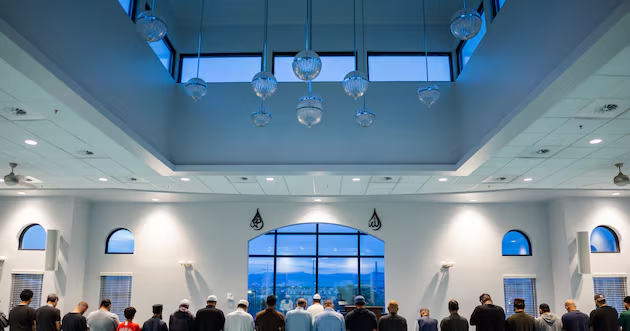
“One hurts, everybody hurts,” Mohamed Mohamed, one of the congregants of the Utah Islamic Center, told me. This quote stood out to me from my visit to the Utah Islamic Center in West Jordan, a mosque and place of worship for Syed Sohail Uddin, who was stabbed last week over a dozen times, allegedly because of his religion. Uddin has been at the hospital and faces a long road to recovery.
Read more Salt Lake City wants to limit nonresidential water use to 200,000 gallons daily
I wanted to visit the mosque because I wanted to better understand how the attack had affected the whole community. So on Friday, I attended Jumu’ah, the weekly congregational prayer held at the Utah Islamic Center.
The community’s leader, Imam Shuaib Din, invited me to sit in the prayer room with men. It was unusual to be the only woman in the room of about 100 men, but it allowed me to watch the worshippers up close, chanting and prostrating in sujood, an act of worship when believers place their foreheads, palms, knees and toes on the ground in submission to God. The women, a smaller group, prayed in a separate prayer room behind a partition.
I witnessed a tight-knit community that came together to pray and mourn an attack on one of their own, but also a community that refused to respond with hate and violence.
Most people I spoke with didn’t know Uddin personally, but everyone could relate to the possibility of a hate crime like this against their own family. I heard from men who feared for their children and their wives. Still, most people viewed the incident as an extreme and a glimpse into what could happen if the Muslim faith is portrayed in a way that doesn’t reflect the reality of the faith and its people.
Imam Shuaib told the worshippers that Muslims should hope that everyone — even those who may hold prejudice against the faith — comes to see the good in the message of Islam rather than misinformation.
“Our job is to show every person the light of Islam, that Islam is a beautiful religion,” he said.
Sim Gill, Utah’s district attorney who later that day announced the charges against the suspect, attended the prayer service. He said it was important for him to address the community in-person.
“This is our community, this is our home, this is where our families live, this is where our children will grow up,” said Gill. He invited the worshippers to keep an eye on each other and report any suspicious misconduct or offenses they experience or observe.
Gill said the community the victim belongs to is also a victim.
“As soon as something like that happens, that victimization goes to that community. Are we safe? Are our children safe?”
The attack was also a kind of call to action. On Wednesday, the Utah Islamic Center will be hosting a town hall to talk with elected officials about security and other issues facing the Muslim community.
Fresh off the press
One of the things about the Valley Fair Mall incident that I’ve continued to think about were the alleged words of the suspect before the attack. According to court documents, the suspect said, “Everything is like Jesus Christ.”
You can read more about the attack and what may have led to it:
- The toll of hate: Muslim community responds to violent attack.
- The suspect in the stabbing of a Muslim man allegedly told police he wanted to “rid the country of Muslims” and invoked the name of Jesus Christ before he attacked Uddin.
- My colleague Jacob Hess took a deep dive into the many ways that plummeting literacy rates impact spirituality and faith formation. “Faith requires attention, reflection, memory, imagination and the ability to sit with sacred truth over time,” Pastor Gary Grogan told the Deseret News. “When people stop reading deeply, they often lose some of the very capacities that help sacred texts move from information to transformation.”
What I’m reading
Faith, its various expressions and pluralism were on greater display during the World Cup this year, writes Ethan Bauer. “That’s not coincidental. Soccer can help cross divides because it embodies what Eboo Patel, founding president of Interfaith America, sees as the fundamental requirement of pluralism, religious or otherwise: a shared activity.” — The Deseret News
Read more Roy railroad corridor fire destroyed around 30 outbuildings in addition to 3 homes, fire chief says
Lionel Messi, family man and believer. — The Deseret News
One Ugandan pastor has lived in the U.S. for 15 years. Then he was taken to an ICE facility. — The Washington Post
Despite recent excommunication of the priests from the Society of St. Pius X, a breakaway Catholic group, the society’s churches continue to hold services and preserve tradition. — National Catholic Reporter
Some Catholic dioceses are having success with more young people choosing to become priests. — The Pillar
Americans’ faith in institutions, including churches, has hit a new low. The decline appears to stem in part from Americans’ diminishing shared trust in key civic, government and other institutions; “instead, their confidence varies with who holds political power.” Especially striking is the party divide on trust in religion — 57% of Republicans have “great confidence” in churches; among the Democrats that group makes up 17%. — Gallup
Emma Waters is a “a rising leader for a conservative movement” — an analyst at the Heritage Foundation who is shaping parenting policy. — The New York Times
Pastors are still wrestling with whether AI should write their sermons. — The Wall Street Journal
End note
While staying with friends recently, I stumbled on a collection of stories by children who recount their experiences on the Mormon Trail, the journey of the Latter-day Saints from Winter Quarters, Nebraska, to the Great Salt Lake Valley.
As Utah is gearing up for Pioneer Day later this week, here’s a small passage from the book that describes a moment of difficulty and joy by one child.
This one is from Peter Howard McBride, whose family left Scotland to come to America. He was 6 years old in 1856 when he traveled across the plains with his parents.
“We camped at the Sweetwater River. A meeting was held. It was decided that we could go no further, the snow so deep and no food. We were doomed for starvation. They gave me a bone of an ox that had died. I cut off the skin and put the bone in the fire to roast. And when it was done some big boys came and ran away with it. Then I took the skin and boiled it, drank the soup, and ate the skin, and it was a good supper.”
Thank you for reading and being part of the State of Faith community. I love to hear from readers, so feel free to reach out at any time with ideas and comments: [email protected].
Read more Is ‘Blue MAGA’ really a thing, or just a fever dream of young progressives?