
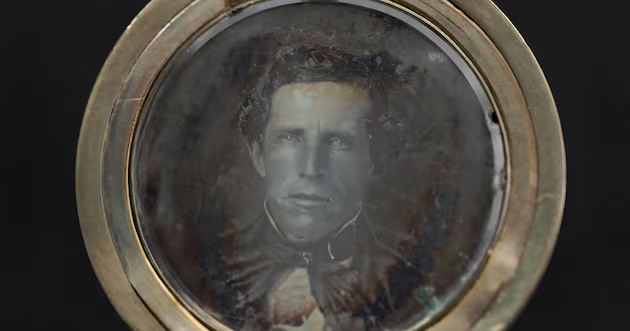
The question that has consumed two researchers and others throughout the last several years has now consumed roughly 10 hours of my time.
Read more Amid France’s turmoil, the country’s faith leaders offer a different diagnosis
Does the daguerreotype that was discovered by a Smith family descendant in 2020 truly show the face of Joseph Smith?
In June, I watched as two researchers and Latter-day Saints — Patrick Bishop and Joseph Brickey — spent eight hours presenting their research and defense for the purported Joseph Smith daguerreotype.
Last week, I watched the two researchers pack about 25 years of historical and forensic research into their new, roughly two-hour film titled “Brother Joseph Again.”
The findings and ideas Bishop and Brickey presented in both cases are solely theirs and are not endorsed by The Church of Jesus Christ of Latter-day Saints.
My opinion on the daguerreotype after viewing a combined 10 hours of research is nuanced.
Does the daguerreotype truly show Joseph Smith?
“I’m not fully convinced,” I told my mom after watching the film and letting my thoughts about it settle.
The film “Brother Joseph Again” takes viewers through a meticulously elaborate journey to discover Joseph Smith’s visual image.
Researchers Bishop and Brickey use 3D skull reconstructions, forensic overlays and details gathered from early portraits of the American prophet — plus a series of other tools and tests — to build their case.
Their ultimate assertion is that the man in the daguerreotype is a forensic match to Joseph Smith.
“I’m convinced that this image that we now see is Joseph Smith,” Bishop says in the new film.
Brickey adds, “My personal gain from this — more than any other things that I’ve discovered — is I have felt that I can personally know Brother Joseph again.”
A study of early Latter-day Saints’ recollections and often conflicting claims about Joseph Smith’s visual image is also included.
Bishop quotes Emma Smith as once saying that Joseph couldn’t have a good likeness because his “countenance was always changing.”
As a nonexpert, I found the rigorous historical and forensic exploration impressive to watch.
Bishop and Brickey seemed to emphasize precision as they analyzed photos taken of Joseph’s exhumed skull in 1928 and gathered 3D measurements to reconstruct it.
They also seemed to pay diligent attention to detail as they relied on various methods — including ray projection and triangulation — to verify their 3D reconstructions.
At a certain point, however, I felt the research began taking a turn. Rather than feeling like an open inquiry, it began to feel like a case being built backward with evidence sculpted to fit a specific narrative.
Bishop and Brickey, for instance, added skin to their virtual skull model using “standard tissue depth markers.” They then sculpted the face with surface details they said were likely lost in Joseph’s death mask, ultimately landing on the image of a person that looks identical to the man in the daguerreotype.
This seems beyond what forensic science can now support.
So is the case all wrong?
Not necessarily.
The Church of Jesus Christ of Latter-day Saints acquired the daguerreotype by third-party donation earlier this year and concurred in 2022 that the image and enclosing locket “were created of the materials and methods appropriate to the 1840s.”
The church also welcomed research and scrutiny of the artifact in 2022, saying: “We welcome the recent publication of the image and hope it will prompt the discovery of additional information helpful to determining its authenticity.”
Read more 1 in 3 people live where older adults outnumber children
That said, the church was also clear that a definitive conclusion about who is pictured in the daguerreotype cannot be drawn given that “nothing is definitively known about the locket’s history before 1992.”
Thus, we cannot say it’s impossible for the daguerreotype to show Joseph Smith.
But I do think that a serious look at the current argument’s assertions and the broader context of the evidence Bishop and Brickey presented should be considered.
Both in their film and eight-hour presentation, Bishop and Brickey landed on five key claims:
- Joseph Smith’s iconic front-view oil painting is a stylized portrait and not an entirely reliable source.
- Sutcliffe Maudsley’s side-profile portraits appear to be more precise and consistently true to life.
- Hyrum Smith is likely not the man on the daguerreotype, given discrepancies between the image and Maudsley’s side-profile portraits of Hyrum.
- Joseph Smith’s death mask is a valuable source but likely does not paint a complete picture.
- The man in the daguerreotype is a forensic match to Joseph Smith, according to skull and facial reconstructions.
A deeper dive into how Bishop and Brickey arrived at each of these conclusions is available here, but for now let’s look at the broader context.
Bishop and Brickey spent a good chunk of their argument revealing patterns and discrepancies found between certain descriptions and early portraits of the prophet. Knowledge of these discrepancies is not new.
Researchers and artifact experts have known for decades about these inconsistencies and long concluded that no one source is entirely reliable.
The same is true for the death masks of Joseph and Hyrum Smith, which were hastily made after their martyrdom in 1844. These masks are valuable sources but likely preserve distorted images of the prophet and his brother due to facial deformities sustained during and after their deaths.
Because of these discrepancies, researchers and others have at times been able to curate cases for other purported images of the prophet — selecting only supportive evidence and dismissing the rest.
The fact that the latest daguerreotype was discovered within the Smith family makes an argument for the image compelling and reasonable. However, as the church has stated, nothing is definitively known about the daguerreotype’s origin, and thus nothing can be currently concluded.
The man could be Joseph, Hyrum or any other man from the time.
A broader understanding of forensic facial reconstructions — and their limitations — also reveals leaps in Bishop’s and Brickey’s argument.
Forensic facial reconstructions only produce approximations of a person’s facial structure. They rely on a combination of cranial anatomy, standard tissue depth markers and other biological (and sometimes biochemical) data.
“The process is inherently dependent on a series of assumptions about the relationship between cranial morphology and soft tissue structures, which vary considerably across populations and are not always predictable in a deterministic way,” states a 2026 peer-reviewed study in the journal Applied Sciences.
Tissue depth markers only estimate the thickness of soft tissue, based on averages, at specific points of a skull. Fine traits — such as wrinkles, nose shape and lip shape — cannot be determined by a skull’s anatomy.
Thus, the broadest leap Bishop and Brickey seem to make in their new film and argument is asserting that their forensic facial reconstruction of Joseph Smith traces directly to the man in the daguerreotype.
Am I convinced?
I ultimately don’t believe that a conclusive match between Joseph Smith and the daguerreotype discovered by his great-great-grandson, Daniel Larsen, can be currently determined.
More well-grounded research, evidence and discoveries are needed — and these same discoveries could lead the research in entirely different directions.
I also don’t believe that uncovering Joseph Smith’s visual image today is a matter of great spiritual importance.
At one point, the film frames the long debate over Joseph Smith’s true likeness as a “tumult of opinions” and a “war of words,” directly borrowing words from one of the prophet’s First Vision accounts. The daguerreotype is then framed as “another testimony of (Joseph’s) living likeness … engraven on a metal plate.”
Personally, I don’t believe that the daguerreotype’s discovery is a spiritual event parallel to the restoration of the gospel of Jesus Christ itself.
Of course, it’d be exciting to finally see Joseph Smith’s face. But I believe what truly matters for Latter-day Saints is obtaining sincere and personal testimony of the prophet, his teachings and his role in restoring the fulness of the gospel of Jesus Christ.
Read more ‘We’re going to have to be on point’: Houston coach previews marquee matchup at No. 10 Utah