
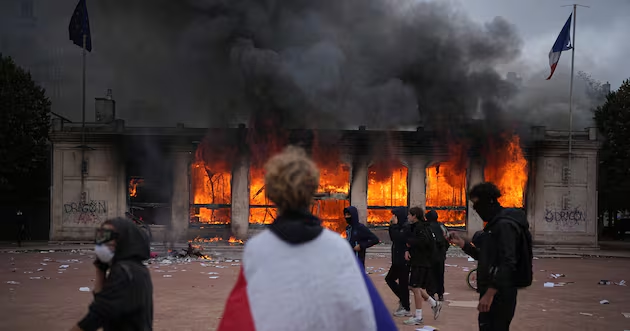
Lamia El Aaraje, Paris’ first deputy mayor, lamented on Sunday “a level of violence we have never seen.” That includes nearly 1,000 injured law enforcement officers and 3,000 looted or damaged businesses.
Read more 1 in 3 people live where older adults outnumber children
That is hundreds more people hurt and double the number of businesses damaged compared to the 2023 French protests that followed the shooting of 17-year-old Nahel Merzouk in a traffic stop.
The destruction in a single weekend has also reached levels comparable to France’s Yellow Vest protests in 2018, according to Sebastian Roché, a French researcher. Those protests, against a proposed fuel tax, spread into riots that burned hundreds of vehicles, looted businesses and vandalized the Arc de Triomphe.
In this case, the spark came on Sept. 17 when a school in the Paris suburbs began protesting school conditions and demanding more resources. Explanations of the expanding protests have since naturally focused on these material questions. For instance, in explaining his decision to join protests, Erwan Le Clech, a middle school science teacher, told Reuters, “There is a blatant lack of resources.”
As labor unions and other activists subsequently joined the student demonstrations, they have raised other resource-focused grievances about the surging cost of living and rising fuel prices.
Now that rioters have turned the protests violent, more of the commentary has shifted toward political extremism in both directions — with centrists and conservatives accusing the radical left of fueling the violence and left-wing leaders criticizing governmental policies and heavy-handed policing.
Easy to miss in all these voices are those of faith leaders, who are highlighting a very different diagnosis and potential solutions for what’s taking place.
‘Peace built deep within each of us’
In a speech on Sept. 25 at the Stade de France, Pope Leo XIV urged young people not to get swept away in violence and to “become peacemakers, which is the eternal desire of God for us, and humanity’s constant task.”
He said the Christian struggle is “not a battle against others” and must not be waged with “the weapons of violence, contempt or oppression.”
As student protests began escalating across France on Sept. 28, religious leaders representing diverse faith traditions joined Pope Leo for a gathering in Metz, a city in northeastern France near the German border — a symbolic site of major conflicts involving France and Germany in both world wars.
The gathering included representatives of Catholicism, Protestantism, Orthodoxy, Judaism, Islam and Buddhism. A local Latter-day Saint stake president also attended.
That same day, a statement from “the principal representatives of the Catholic, Protestant, Orthodox Jewish, Muslim and Buddhist faiths in France” was published. The authors described themselves as standing “side by side today in the service of peace.”
“The Appeal of Metz” acknowledges the serious challenges facing modern society but emphasizes solutions beyond the material realm alone. “We know from experience that dialogue, prayer, meditation and various forms of spiritual practice open paths to peace,” the leaders said.
“For peace is also built deep within each of us: in our capacity to recognize and disarm within ourselves that which fuels rejection of others, fear and hatred.”
Pope Leo XIV added separately, “The greatness of a civilization is not measured by its material achievements but by the way it nurtures, protects and uplifts the human person.”
‘Brothers and sisters in humanity’
Throughout, the statement repeatedly referenced “the dignity of each person” — stating “we believe, in fact, that every human being possesses inalienable dignity. Our respective traditions invite us to welcome others not as a threat but as brothers and sisters in humanity.”
These leaders affirmed their “commitment to serving the entire human family together.” They are conscious, they wrote, of our “profound interdependence and the responsibility each of us bears toward all others, faithful to our respective traditions and with respect for everyone.”
“We solemnly call for dialogue and fraternity, for reconciliation and peace,” the statement said, cautioning that this peace “cannot be lasting without justice, without respect for human dignity, without solidarity among peoples and generations, and without a shared commitment to preserving our common home.”
Read more ‘We’re going to have to be on point’: Houston coach previews marquee matchup at No. 10 Utah
“We differ in our religious convictions,” the statement later continued, “but we are united by the responsibility to serve together for peace in the world and respect for the dignity of every human person.”
“No lasting peace can be built without the other, nor against them.”
‘Agents of reconciliation’
“We humbly wish to contribute to opening paths of reconciliation, rejecting the logic of vengeance, rejection and humiliation,” the statement emphasized. “We wholeheartedly desire, along with all men and women of goodwill, to be agents of reconciliation.”
“In a polarized world, we want to cultivate a genuine culture of peace education,” they concluded. This “requires the contribution of families, schools, leisure and sports organizations, as well as each of our traditions and communities.”
In separate remarks, Pope Leo emphasized that “religious discourse must constantly call for the disarming of hearts and words.”
He added, “Our shared responsibility as religious men and women is to bear witness that, beyond borders, it is always possible to meet, to establish friendship and to build peace.”
The pope concluded, “Dear friends, ‘the church considers as fellow travelers all those who sincerely seek truth, goodness, and beauty,’” citing a Catholic encyclical. “I thank you once again for your closeness and presence. May God’s infinite goodness and wisdom accompany us and teach us to live ever more fully as his children, and as brothers and sisters to one another. May we be, wherever we live, peacemakers and witnesses of a hope that continues to grow in our world.”
Renewed calls for peace after weekend escalation
Since the violence worsened this weekend, a number of faith leaders have made additional public appeals. The Lyon archbishop, Olivier de Germay, acknowledged in a Sunday message on X that violence was a “sign of a society that is ailing.” He rejected the notion that the unrest offered any way forward: “I want to say again emphatically that it is a dead end and can only give rise to further injustices and divisions.”
Les violences qui ont eu lieu à Lyon en ce 17 octobre dépassent largement le cadre d’une manifestation dans laquelle peuvent s’exprimer de légitimes revendications. La ville a été le théâtre d’affrontements, de haines, de destructions et de pillage qui sont inacceptables. Nos…
— Église catholique à Lyon (@diocesedelyon) October 18, 2026
“Let us pray for peace and to be peacemakers,” Archbishop de Germay also wrote.
“Our country deserves better than this,” Cardinal Jean-Marc Aveline, Archbishop of Marseille, said in a Sunday statement on Instagram. “With all believers, we pray for this unrest and for peace to return.”
View this post on Instagram
Bishop Jean-Pierre Vuillemin Le Mans was quoted as expressing hope over the weekend “that the forces of dialogue and rebuilding will always prevail over the forces of destruction.”
In a statement Monday morning titled “Blessed are the peacemakers,” Bishop François Touvet of Fréjus-Toulon called the violence a “distressing sight.”
“While expressing concerns and anger is legitimate, it must not be done through violence,” he wrote, lamenting specifically how the violence had “robbed demonstrators of their legitimate freedom of expression.”
“More than ever, our society needs peace and fraternity,” Bishop Touvet said. “I ask everyone to pray that responsibility, dialogue and respect for others will prevail …. Division leads to disaster; peace charts a path of hope.”
In Paris, Archbishop Laurent Ulrich similarly said in a Monday statement the violence was “overshadowing the legitimate concerns of so many of our fellow citizens — especially young people, worried about their future and eager to embrace the responsibilities of adulthood — and rendering these concerns invisible and inaudible.”
He called on believers of his faith to “rise up” and “be instruments of consolation, builders of peace and mutual understanding” — while also “redoubl(ing) our fervor in our prayer for our country.”
In a statement, the French Bishops’ Conference likewise lamented the “unacceptable violence” that had “plunged the country into shock, fear and despair.”
“We urge everyone not to be drawn into the spiral of this deadly violence: Our country deserves better,” these Catholic leaders continued. “With all believers, we pray that these disturbances will cease, that legitimate demands will be heard and addressed, and that, through dialogue and respect for justice, peace may return.”