
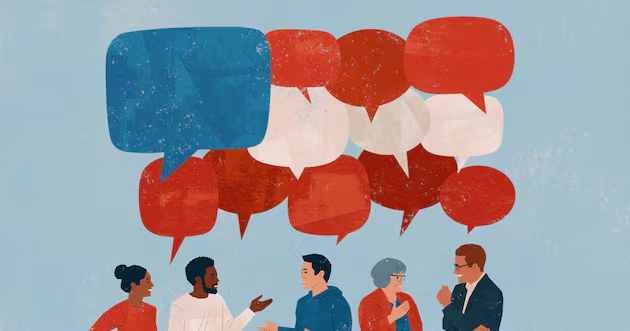
- Respondents to the Deseret News/Hinckley Institute of Politics polls in Utah and nationally were asked how they feel about this year’s midterm elections.
- Republicans were more likely to say “hopeful,” while Democrats were more likely to say “anxious.”
- Stanford professor Jon Krosnick said the way President Donald Trump has governed means this year’s election might not lead to much change.
Are too many negative ads showing up on your social media feeds? Is the family group chat getting you down? Do you feel like you can’t watch a football game or an awards show without someone saying something that makes you cringe?
Read more Utahns might see their electricity bills drop — and coal might be to thank
Yes, it’s that time again. Election season.
If you are online, or a close watcher of politics, this season might be putting you on edge. Those of us at the Deseret News who spend a lot of time thinking about politics are feeling it, and we wanted to know if our fellow Utahns and Americans were feeling it too.
Turns out, we weren’t as in touch with our fellow voters’ feelings as we thought we were.
Americans and Utahns are a lot more positive about the upcoming election than we assumed they would be — at least the ones who responded to our latest poll.
One of the questions we asked in our Deseret News/Hinckley Institute of Politics poll, conducted in mid-September by Morning Consult, was: Which of the following, if any, describe how you are feeling about this year’s elections?
Respondents could choose any three from the following: excited, hopeful, happy, anxious, sad, angry, confused, hopeless or apathetic. Those whose feelings were less describable could choose “other” or “none.”
Overall, almost half of national and Utah respondents chose “hopeful,” which was the top vote-getter, while “anxious” came in second and “excited” third. At the bottom of the list were “apathetic” and “sad.”
Republicans, Democrats and independents feel differently about elections
It turns out, as with most things these days, a voter’s political party mattered when it came to the emotion that bubbled to the top.
With the projected blue wave likely coming, you might think Democrats would be feeling pretty excited about the November midterms.
Not Utah’s slate of Democrats. The No. 1 emotion they checked off: anxious. In the national poll, 51% of Democratic respondents chose that option, while among Utah Democrats that number was 65%.
Hopeful was the second-most selected option for Democrats, both at the state and national levels. But while for Democratic respondents nationally the third-most selected emotion was “excited,” for Utah Democrats “angry” came in third.
Meanwhile, Republican respondents were most likely to choose hopeful, at 57% both nationally and in Utah. Anxious came second, followed by excited.
Independents were the wild cards at both the state and national level. Their top three emotions: hopeful, anxious and hopeless.
Trump changed everything
Stanford University professor Jon Krosnick, who specializes in political psychology (among other pursuits), told the Deseret News he was not surprised to hear about the partisan differences.
“First of all, it’s not at all surprising that voters are very emotional about politics these days,” Krosnick started out by saying.
As the pendulum swings between Republicans and Democrats in control of Washington, we’re used to things changing, he said.
But, “it all pales in comparison to the dramatic radical changes in government and the country that we’ve seen in the years since the Trump administration started,” Krosnick said.
Read more Which BYU players are on the latest injury report ahead of Cougars’ matchup with TCU?
Some voters, including many Republicans, may see these changes as good, he pointed out, while others, including many Democrats, do not.
And even as we approach an election where Democrats could see their power in Congress increase, that is unlikely to derail the president’s agenda, which has largely been achieved outside congressional channels. This, he said, is one reason why Republicans may be feeling more hopeful and Democrats more anxious.
“(Republicans) are not worried about President Trump’s capacity to continue effortfully pushing forth his agenda. I mean, very little has slowed him down, right?” Krosnick said.
By using executive orders and other administrative levers, Trump has been able to reshape entire federal agencies, as well as long-standing policies.
So while Democrats look likely to retake one or both chambers of Congress, “that’s not necessarily going to change the direction of policy,” he said.
Keep an eye on the independents
While it’s tempting to see power in Washington split into the binary choice of Republicans versus Democrats, Krosnick argued who we should really be watching are the independents, who typically have the most power in general elections.
Trump was elected because he was successful in getting independents to vote for him. “The real issue is, from election to election, what do the independents do?” Krosnick said. “They are the people who are actually determining who wins the election.”
And they are not happy right now over the rising cost of living, he pointed out.
That lined up with the findings of the Deseret News/Hinckley Institute poll — as independent voters were the only respondents who chose “hopeless” as one of their top three.
Are voters optimistic or pessimistic about the future of the country?
Even though “hopeful” topped the list of feelings both in Utah and nationally, that doesn’t appear to be the general feeling about the direction the country is heading in.
When respondents were asked whether they feel optimistic or pessimistic about the future of the country, both Utahns and all Americans were more pessimistic than optimistic.
Among U.S. voters, 43% expressed optimism compared to 48% who expressed pessimistic. In Utah, 41% said they were optimistic about the country’s future compared to 53% who said pessimistic.
Nationally, independent respondents were less likely to say optimistic than Republicans or Democrats.
On the flip side, respondents at both the state and national level were much more likely to say they were mainly voting for their chosen candidate or party, versus voting against the other party or candidate.
“People tend to vote for candidates who make them happy, optimistic and proud,” Krosnick said. “And they tend not to vote for candidates who make them feel angry, fearful and frustrated.”
He wanted to add a footnote to the conversation about today’s divisive politics potentially stirring up negative emotions.
Research shows that people don’t necessarily shut down when they feel negative emotions, Krosnick said. It can actually help them become better listeners, and to pay closer attention to what’s happening around them.
Read more Opinion: Elective abortion isn’t progress — it’s an ancient regression
That should lead to more “thoughtful, attentive and wise” voters, he said.