
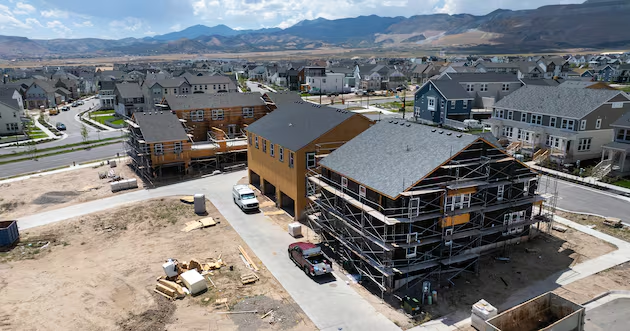
- Housing affordability ranked last of 20 factors in the 2026 Utah Community Quality of Life Index, which fell to 63 out of 100, its lowest score since the survey began in 2011.
- 91% of Utah renter households are now priced out of a median-priced home, up from 59% in 2015.
- Utahns agree housing is a problem but are divided on the fix, with some calling for denser housing and others for less development.
Utahns may love their mountains and communities, but affording a place to call home remains one of their greatest concerns, according to a new statewide report released Monday.
Read more Clayton Young overcomes injury to clock second-fastest marathon by an American
The 2026 was headed by the Utah Foundation, the Utah Chamber and the University of Utah’s Kem C. Gardner Policy Institute and ranked housing affordability last among 20 factors affecting residents’ quality of life. While natural surroundings and religious activities received the highest ratings, housing affordability has experienced the steepest decline since 2013, and 91% of renters are now priced out of a median-priced home.
The growing cost of calling Utah home
The index finds that Utahns still consider the state a great place to put down roots. Respondents gave their highest ratings to strong communities, beautiful natural surroundings and plenty of recreational activities that make Utah a good home.
However, increasing economic pressures are threatening residents’ quality of life. Utah’s overall score measured 63 out of 100 in 2026, which is down slightly from 64.1 in 2022 and is the lowest point since the survey began in 2011. Although the difference is small, researchers are concerned about the steady decline in quality of life over the past decade.
Survey respondents rated 20 things about their community, such as housing, jobs, schools and parks, on a 5-point scale ranging from “poor” to “excellent.” Of those 20 factors, housing affordability remained the lowest-rated with a score of 2.1 out of 5. Cost of living, which specifically excludes housing, was the next lowest-factor with a score of 2.7.
This means that the two worst-rated factors in Utah together cover most of a household budget: the cost of a home, plus everything else like groceries and utilities. Housing affordability has declined the most over the past 13 years, making it the lowest-rated factor as well as the one that has fallen furthest.
That said, the index shows that housing isn’t in worse shape this year than in 2022. The big drop in housing affordability occurred in the late 2010s, and has been stuck at the bottom ever since. Dejan Eskic, a senior research fellow at the University of Utah’s Gardner Policy Institute, doesn’t expect this to change anytime soon.
“I think we’re in a stubborn cycle. I don’t think much happens just at the macro level,” Eskic told the Deseret News. “Without a major economic disruption like COVID or a global financial crisis … there’s not much change in our outlook in terms of prices. I don’t see affordability, at least in the next 12 to 24 months, drastically improving or getting worse.”
The widening gap between renters and homeowners
While rising home prices have increased the wealth of existing homeowners, they’ve also made it increasingly difficult for renters to enter the housing market. According to the report, 91% of Utah renters were priced out of a median-priced home in 2026, compared with just 59% in 2015.
With the median single-family home selling for $544,000 and the home-price-to-income ratio sitting at 5.2 in 2025, homes cost more than five years of typical income.
The gap between those who already own a home and those hoping to buy one remains a significant challenge for Utah’s housing market. This is because when home prices rise, people who already own a home get wealthier on paper because their house is worth more. Those trying to buy fall further behind because the target keeps moving.
“It’s that disparity. The people who have a home, they can move in the market. It’s the entry point that’s really a problem,” Eskic said.
Read more High school girls soccer: 6A/5A/4A/3A/2A state tournament scores, schedules
While 9 out of 10 renter households in Utah can’t afford to buy a typical, middle-priced home, the report noted that rent affordability has improved.
“Our rental market is more affordable because it’s more competitive now from a renting perspective,” Eskic said. “Landlords are competing with each other to capture new renters … because of supply, we have more rental abundance and not really enough for-sale supply … you’re seeing two different housing markets.”
These results show that renting and buying are different problems. Rents may have leveled off relative to incomes and be easier to pay each month, but home prices have climbed so high that finding cheap rent doesn’t get Utahns closer to buying. Although renters may be getting by today, high home prices mean they can still be shut out of ownership.
More housing, or less development?
While the survey shows that many Utahns agree that housing affordability is a problem, they don’t necessarily agree on how to solve it.
Nearly half of respondents to the Quality of Life Index identified housing or growth as an area that could improve their communities, but their suggestions revealed conflicting priorities. Some called for more housing and denser development, while others voiced concerns about overcrowding and continued growth.
“Less high-density housing, everywhere is crowded” one respondent wrote in the survey, while another expressed the exact opposite by calling for “denser housing and more urban development.”
According to Eskic, the problem lies not in how much Utah is building, but in what it is building.
“If you want affordability, you need to have flexibility in your housing stock,” Eskic told the Deseret News. “If we were to use a car term, right now we just have suburbans and hatchbacks. We don’t have sedans and minivans.”
Utah mostly builds single-family homes (“suburbans”) and small apartments (“hatchbacks”). There is little in-between, such as townhomes, duplexes and smaller starter homes (“sedans and minivans”). That middle range is what first-time buyers can afford, yet their options are limited.
As Utah continues to grow, the report warns that housing affordability challenges could further threaten residents’ quality of life. Researchers emphasized that improving access to affordable housing, reducing living costs and expanding opportunities for good jobs could help reverse the state’s long-term decline in quality-of-life ratings.
Read more How to make a name for yourself, Utah Mammoth style