
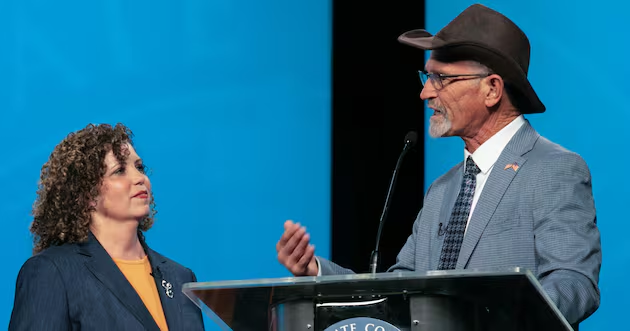
- Kent Udell blamed high prices on corporate “gouging” and tax breaks for the wealthy, while Rep. Celeste Maloy pointed to tax cuts on tips, overtime and Social Security as proof she voted to help families keep more of their money.
- Maloy wants an energy mix that includes nuclear power, and wants states and local governments to set the rules for data centers, while Udell called nuclear unproven and called for a moratorium on new data centers.
- Udell called for Bears Ears’ earlier boundaries to be restored, while Maloy backed President Trump’s July cuts to the monument.
With access to water, housing costs and public lands shaping daily life across southern Utah, Rep. Celeste Maloy, a Republican, and her Democratic challenger Kent Udell took the stage Friday at Utah Tech University in St. George to make their case to voters in Utah’s newly drawn 3rd Congressional District.
Read more Can Colorado make oil companies pay for climate damage? The Supreme Court will soon decide
Ahead of the Nov. 3 election, the debate offered a preview of how the candidates would address issues facing the district.
They debated the boundaries of Bears Ears National Monument, problems with water and drought, data centers, energy, wildfire prevention, housing, Social Security and the national debt.
Maloy argued for cutting federal red tape and giving state and local officials more say, while Udell emphasized corporate accountability, protecting federal lands and investing in workers.
The 3rd district in which Maloy and Udell are competing is new for 2026 and stretches from St. George to Park City to the Uinta Basin, making it an extremely diverse area both politically and geographically.
Different explanations for high costs
The debate quickly turned to one of the most prominent topics on voters’ minds: cost of living. The candidates blamed high prices on different causes, and pointed to different ways to fix the problem.
Maloy said she is focused on lowering taxes so families keep more of their pay, while Udell said he wants wants to go after how companies set prices.
According to Udell, corporations and the wealthy raised prices during the pandemic and never lowered them, even after supply chains recovered.
“We feel that the system is rigged against us, that the money is coming from our pockets to the pockets of the large corporations and the billionaires,” Udell said. “There’s a lot of gouging going on.”
Maloy referenced tax cuts on tips, overtime and Social Security that she voted for in Congress to keep more money with families.
“I agree that Utahns should keep as much of their own money in their own pockets as possible. That’s why I voted for making the tax cuts permanent from 2017,” Maloy said. “I listened to one of my colleagues tell a story the other day that she talked to a single mom who works for tips, and because of the tax changes, she was able to put one of her kids in braces and another one in private school.”
Housing and AI jobs test their plans for younger Utahns
A Utah Tech student asked how the candidates would create good jobs as AI threatens young adults entering the workforce. Neither candidate named a specific policy. Instead, they focused on the attitude students should have toward AI.
“You’re going to be the human intelligence behind the machines, and you’re going to have a bright and beautiful future in this country,” Maloy said. “Don’t believe all the doom and gloom. People who are selling you that you don’t have a future have their own agenda.”
Udell said that AI can provide knowledge but not wisdom, and urged young people to get real-world experience.
“Focus on the experience and the wisdom,” Udell said. “Get the experiences that allow you to be able to make the right decisions in this AI world.”
The conversation then shifted to housing and young Utahns expressing concern about their ability to someday buy a home. Both candidates support Gov. Spencer Cox’s push for starter homes but have different ways to get there.
“I love the idea of starter homes, and finding ways of getting state, municipal and federal grants to be able to build these starter homes,” Udell said. “We need to get people out of the basement and into their homes.”
Maloy pointed to a federal law she backed that cuts regulations on building homes.
“I also love the idea of starter homes, and that’s why I supported the 21st Century Road to Housing Act,” Maloy said. “It’s actually passed in Congress and focused on making the inputs to housing less costly and cutting a lot of the red tape that drives up the cost of housing.”
Growth raises questions about infrastructure and data centers
Both candidates said paying for roads, water and other infrastructure is mostly a state and local job. Maloy said Washington’s role is to cut duplicate regulations so each dollar goes further, and Udell questioned where local property taxes are going, saying his doubled in one year.
The candidates split sharply on policies involving data centers. Fast-growing areas like Washington County are struggling to pay for roads, water and schools, and data centers bring investment but raise other concerns. Udell said local officials in Box Elder County ignored public input on a project, and called for a suspension on new data centers.
Read more Yep, the Utah Mammoth are going to be good this year
“I look at data centers and I see billionaires that are playing Minecraft on how they’re putting these things together,” Udell said. “In Utah, we understand what it’s like to be driving on slick roads. This is a slippery slope we’re going on. And we know as Utahns that if we hit a slippery slope, we pump the brakes. We don’t hit an accelerator.”
Maloy believes that states and localities should be the ones to make policies regarding new data centers, highlighting that Utah already passed a law requiring data centers to protect other energy customers and add power to the grid.
“I think this is very much a state and local issue,” Maloy said. “Sometimes one size fits all doesn’t actually fit anybody.”
Energy and water expose different views of Utah’s future
Maloy and Udell also split sharply on which energy sources are best for Utah. Maloy pointed out that the appropriate kind of energy is whatever energy mix the market demands, which includes oil and gas that provide rural jobs in addition to geothermal and nuclear energy that are carbon-free and power AI.
“I think we should have whatever mix the market is asking for,” Maloy said. “The reason to develop nuclear is because it’s reliable, it’s baseload, it’s dispatchable. It’s going to be the energy source of the future that doesn’t disappear … it’s going to power the AI future.”
Udell said he was an energy engineer and said nuclear energy is the most expensive power source, unproven in small reactors and uses large quantities of water. Udell expressed a strong preference for wind and solar energy instead.
“Nuclear power is the most expensive way that we produce power in this country,” Udell said. “We have better options. We have wind and solar that doesn’t use water.”
Clash over monument boundaries and federal land
The sprawling new district includes Bears Ears and Grand Staircase-Escalante, which were shrunk by a combined 3 million acres in July through a proclamation signed by President Donald Trump. Both candidates said a president shouldn’t decide monument boundaries alone, but disagreed over the government’s involvement in reducing the size of the monuments.
“Utah is not for sale,” Udell said. “Our public lands, our federal lands, are not for sale, and they are not to be taken over by a state government. I do not want to see one square inch of that land being sold or to be taken away from federal and from public use.”
Maloy supported the recent reduction of the parks and was in the Oval Office when it was announced. She has since introduced a bill to take away presidents’ power to create national monuments and leave it to Congress instead.
“I think the people who live closest to the land are in the best position to make decisions about how it should be managed,” Maloy said. “I am okay with square inches of federal land being turned over to state and local governments when they’re necessary for transportation, for infrastructure, for qualify of life in Utah. We do not have room to grow.”
Wildfire prevention brings the debate back to local impacts
The debate ended with a conversation on the devastating wildfires seen throughout Utah this past summer. Maloy argued that leaving dead trees in place feeds catastrophic fires, and that forests should be thinned and the wood sold to mitigate wildfire risk.
“We need to manage our forests like they are an asset to the United States of America,” Maloy said. “We have sawmill operators who would love to go cut timber, reduce the fuels on our mountains, and turn that timber into a product, which is another thing that creates jobs in rural Utah.”
Udell disagreed.
“You’re right,” he said. “If we cut down all the forests, we won’t have any forest fires. Great idea. We can’t just say we’re going to cut them all down and that’s going to get rid of our forest fires.”
Maloy was given the opportunity for a rebuttal and quickly responded to Udell’s comment.
“I am not in favor of cutting down every tree in the forest,” Maloy responded. “But what we have done is not cut down any trees, not reduce the fuels, and then let fire burn it all down so that we don’t have a forest, and then we get floods. I’d rather see us making good ecological decisions.”
Candidates make their final case to voters
In their closing remarks, Maloy and Udell made personal appeals to voters. Maloy urged young people to believe in the country’s future, and Udell drew on his Utah roots and pioneer legacy as he asked voters for support.
“I will work for the people in this country because these are the people and the lands and the rivers that I love,” Udell said. “My roots go deep in this state. My great-grandfather … founded Kanab. My other great-grandfather … founded Santa Clara. That is my legacy. That’s what I’m bringing to this.”
Maloy expressed her gratitude for the opportunity to represent the people she serves and called it an honor to stand on the stage and answer questions before her constituents.
“I think part of my job also as a representative is to make sure I’m bringing back the good news,” Maloy said. “Look at how far we’ve come since 1776. I’m excited to see how far we go in the next 250 years.”
Read more The latest on what El Niño means for the ski season