
I have always wanted to help people. When I started looking into social work, I knew that it would be the type of career that would allow me to spend every day of my life improving the lives of others.
Read more Garth Brooks’ Utah fans had to fight the bots. The country superstar made up for the struggle
What I have also found is that social work and related fields are chronically understaffed and those who work in the field are at high risk of compassion fatigue and burnout. In fact, some research suggests that anywhere from 62-75% of social workers experience burnout during their career. This is especially prevalent in child welfare, which is alarming. If the workers who protect society’s most vulnerable children are burning out, that leaves the children underserved and unprotected.
With the understaffing and burnout issues, there should be policies in place that help more social workers to join the field and lighten the load. Instead, the current administration has passed a bill that will make it more difficult for people to become social workers and disproportionately affects women, people of color and people who come from poverty.
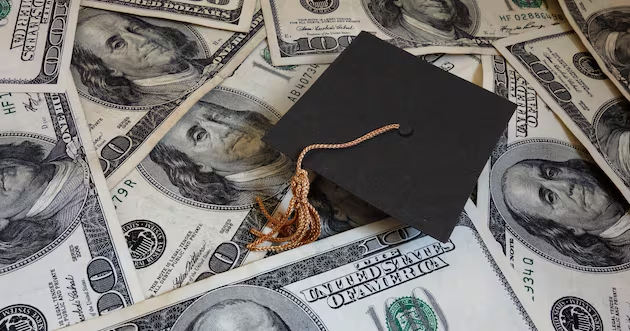
Starting in July of 2026, the Trump administration put out a policy, as part of the One Big Beautiful Bill Act, to prevent “non-professional” careers from taking out more than $20,500 per year in federal student loans. “Non-professional” happens to include social work. Starting in 2027, if those same careers make less than a certain threshold, determined by how much someone can make with a lesser degree, student loans will be cut off altogether.
An article in the New Republic describes it this way: “The Education Department intends to use IRS data to determine students’ salaries four years after they graduate and compare them to those of people similar in age who just have high school diplomas. If they’re below that baseline, that degree will be ineligible for loans.” For master’s degrees, the salaries will be compared with bachelor’s degree salaries instead.
This system presents several problems. First is that a degree’s value should not be based solely on its monetary potential. Another problem is that we have a lot of evidence that women in the United States make less than men, which means that female-dominated fields will be disproportionately affected by these cuts. Additionally, women are more likely to take time off from their careers to raise children, which causes the data concerning salaries in female-dominated fields being to be skewed.
Read more 3 storms are approaching the U.S. Here’s where they could hit
Limiting access to loans will primarily affect people who do not have the means to attend school without federal loans, which includes a lot of people of color. It also includes people who come from poverty and may not qualify for private loans.
From a personal perspective, I have been very fortunate in that my parents set up a 529 for me from a young age, I have qualified for a few scholarships, and after I was married last year, I qualified for Pell Grants for the last few semesters of undergrad. Despite having everything going for me, however, it is likely that during my last one to two semesters I will need $10-18k in student loans in order to finish my master’s degree in social work.
Taking away loans for social work students would mean the delaying of education for many, more potential for burnout (from working extra hours while pursuing a degree), or complete loss of accessibility for others. This will directly affect the mental health field as fewer people are able to get degrees in this already understaffed field.
Social workers are essential to the progress of this country and for protecting society’s most vulnerable populations. This latest change in legislation that moves society away from progress and equality feels like a slap in the face to the people whose only desire is to make this country a better and more equitable place.