
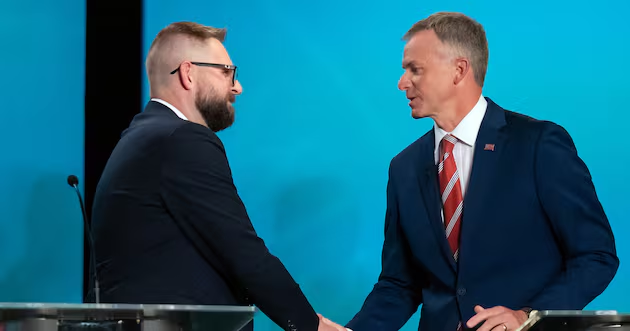
At a debate Tuesday for Utah’s newly-structured 2nd Congressional District, held at Utah State University in Logan, Utah, the candidates dove straight into the issues constituents have been most vocal about: data centers, energy consumption, water policy, and inflation-driven affordability.
Read more Agent who helped inspire ‘Jerry Maguire’ sounds warning about sports gambling
The district is home to the highly controversial Stratos Project — a massive AI data center campus proposed in Box Elder County.
Rep. Blake Moore, who currently serves as the U.S. representative for Utah’s 1st Congressional District, and Democratic challenger Peter Crosby gave replies with a similar undertone: More local involvement and transparency is needed.
Moore said that local officials learned one thing from the chaos last spring: “They have to bring the public along” — though he acknowledged that the technology is a part of the state’s immediate future.
Crosby pointed to top-down pressure, instead, saying he advised Box Elder commissioners to vote “not yet” on the data center project — something many other local leaders did not do for fear of the county being sued.
“As we talk about the future of data centers in Utah specifically, we have to acknowledge that local control is oftentimes being ignored because external pressure coming from the top down is forcing a decision against the will of local residents,” he said. “That’s inappropriate.”
The Military Installation Development Authority — which is overseeing the Stratos Project — isn’t only building in Box Elder County. It’s already built Falcon Hill, a business park on about 550 acres of underused land on the west side of Hill Air Force Base.
Crosby pointed to this example as something that needs to be mimicked — using military bases and land that we already have designated for elements of national security to build data centers, leaving less local impact.
Moore, on the other hand, said MIDA is a board of “unappointed, unelected officials that have zero accountability to the voters.”
“And so a reform of MIDA, from my perspective, is absolutely needed,” he added. “And a House bill with some teeth would be needed …
However, both candidates agreed future requirements for data center developers should include transparency with resources and potential impacts to the community — especially when it comes to water, which the state is running out of.
Saving what’s left of the Great Salt Lake
When it comes to the state’s largest water issue, both candidates made it clear the Great Salt Lake is at the top of their priority lists.
The water levels in the lake — the largest salt water lake in the Western Hemisphere — are at a record lows.
Read more Pope Leo has been diagnosed with lung cancer, Vatican reports
Moore pointed out that the state will soon have to decide between different priorities: Giving water to agricultural needs, data centers or a growing population. There is no longer enough water to accomplish all three.
Crosby, in a similar way, said Utah leaders “have seen the long-term consequences of a water policy that has failed to account that you can’t always persist with conflicting priorities.”
He spoke about the highly anticipated $1 billion the Trump administration has put in the operating budget to support lake operations.
“I love the attention that the administration is putting on it, but just by saying $1 billion does not equal it’s going to turn out to be $1 billion,” Crosby noted. “That’s not the way our appropriations process works.”
Moore called the lake’s current state an “existential crisis,” saying it doesn’t simply need more money — it needs more water.
Putting more water into the Great Salt Lake is the most effective solution that can be almost immediately implemented, he said.
Affordability for Utahns
Crosby and Moore also spoke on one of Utah’s most pressing issues: Affordability and inflation.
Consumer prices have risen 3.4% over the past 12 months — and high gas prices are the fuel behind it, Moore said. He pointed to the Bipartisan American Affordability and Jobs Act of 2026 — the Senate’s big permitting reform package — as an optimistic change.
“What we’re hoping to see out of the permitting bill, which is likely going to pass here in the coming months, is an ability to be able to embrace what we have, increase our domestic supply so we don’t have to rely so much on foreign sources,” he said. “And if we can accomplish that, you could see some relief that’s actually substantive.”
Crosby took a more direct approach.
“We don’t need hope, we need votes,” he said, claiming voting to end the war in Iran and ending a “broad tariff regime” would stop the rise in inflation.
“That doesn’t require committee work, it just requires courage,” he said.
Moore also agreed the war should come to an end, saying he encouraged a ceasefire during his time in Congress.
Read more General election ballots to be mailed out this week