
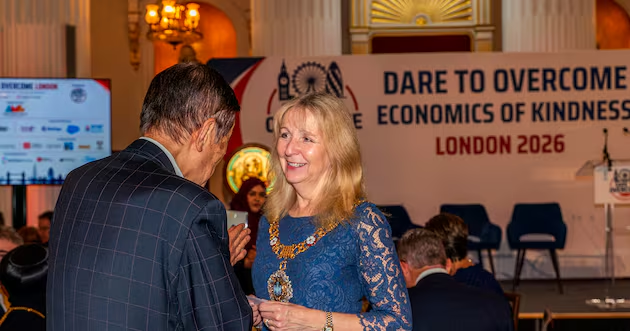
Kindness typically looks like a small, thoughtful act, a word of reassurance or a gesture of support. But inside the ornate interior of London’s Mansion House on Tuesday evening, the Lady Mayor of London offered a more ambitious vision for this virtue.
“Kindness is a powerful force in business,” said Lady Mayor Susan Langley, who opened the doors to her residence to welcome the group of religious and business leaders at the “Dare to Overcome: The Economics of Kindness” gala.
“Kindness, I think, is about having the courage to do the right thing … because trust, integrity and compassion are not simply admirable qualities, they are actually also competitive strengths.”
Freedom of religion underpins many of these human qualities and allows them to flourish. It’s also the most fragile of freedoms, according to Elder Patrick Kearon, a member of the Quorum of the Twelve Apostles of The Church of Jesus Christ of Latter-day Saints, who gave a keynote address at the “Dare to Overcome” gala on Tuesday.
“So it’s the first freedom by definition. Very interestingly, and rather simply, it is often the first to go,” he said. To create an environment of openness to faith and kindness, he said, it takes humility and “a surrender of personal ambition.”
As artificial intelligence tools accelerate in their humanlike capacities, these qualities matter now more than ever before. “Technology, of course, we know will transform what we do, but our values must continue to guide what we do,” said Lady Mayor Langley.
The celebration honored five leaders with the King Husein Business and Interfaith Peace Awards for their work fostering interfaith and cross-cultural understanding across education, business and the arts.
The awards are named after Firoz “King” Husein, an Indian American engineer and philanthropist with long-standing ties to Utah. Husein came from India to study and went on to get a master’s degree from Brigham Young University in 1971. He eventually rose to become the founder and CEO of Span Construction and Engineering, a major metal-building construction company based in California that also builds facilities for Costco across the country.
This year’s award recipients included Dame Elizabeth Corley, chair of Schroders and former chair of the Impact Investing Institute; filmmaker Jian Shen; Elder Matthew Eyring, who worked for BYU–Pathway Worldwide before being named a General Authority Seventy for the Church of Jesus Christ; Po-Wen Yen, CEO of the Buddhist Tzu Chi Foundation; and Sanjoy Roy, the founder of cultural initiatives that bring writers and artists together through festivals and other programs.
The awards were presented as part of the “Dare to Overcome: Economics of Kindness” conference, held in London this week. Husein helped host the conference in India for two years in the past prior to this year’s support.
“Growing up in India, at least I was very grateful that Mahatma Gandhi received independence through nonviolence,” Husein said at the gala. “I wish the rest of the world would follow that example.”
Despite their different backgrounds, all five leaders had experienced a moment that sparked their commitment to elevate people, their personhood and human dignity over ambition and profits.
When Corley became a managing director, she recalled, a colleague took her aside and told her, “You need to make a choice, because you’ve got to stop being kind.” She rejected the premise that kindness and professional success were incompatible.
Research confirms that prioritizing people actually yields better results. Seventy percent of employees report that they are more engaged at work where managers offer support as opposed to “authoritative oversight,” according to research from Baringa, a United Kingdom consulting company. Psychological safety also results in an increase in productivity among workers.
Read more Beyond the Fanta: Milwaukee shortstop Cooper Pratt’s faith and journey to the big leagues
Today, Corley advocates for building bridges in the workplace, including through difficult interfaith conversations. Without opportunities to discuss faith at work, she said, employees can be left in “a vacuum of silence.”
“So instead of the whole place being a vibrant, lived, shared community, people come into themselves,” she said. “Kindness is absolutely the bedrock of being human.”
For Po-Wen Yen, another award recipient, an act of kindness from his wife helped shape the course of his own life.
Yen remembers the way that his wife handed him a shower towel when he forgot to grab one. “She neatly folded it in a square and with her two hands and presented it with a 90-degree bow,” Yen told me. “I was so shocked that she did that.”
The thoughtful gesture, he said, was a result of the service his wife had been learning through the Tzu Chi Foundation, a Buddhist humanitarian organization, where she started volunteering (the two words mean compassion and relief). At the time, Yen was working for United Microelectronics Corp., one of Taiwan’s major chip manufacturing companies. He became interested in the foundation’s work, completed three years of volunteer training and eventually left his corporate position to become the foundation’s CEO. Yen credits his professional achievements in part to what he learned through his humanitarian work.
Art and storytelling can also build understanding across cultural and religious divides, said Jian Shen, chairman and CEO of Shinework Media and Shinework Pictures and another award recipient. His film projects include “The Composer,” a Chinese-Kazakh production, and “Kung Fu Yoga,” starring Jackie Chan.
“Film has this special power, movies change how we see the world,” Shen said during the day portion of the conference that took place at the Salesforce Tower on Tuesday. Movies can help bring understanding and trust and “trust creates lasting impact-driven economy.”
Sanjoy Roy similarly believes people can achieve their potential through sharing their sharing stories and deep-held beliefs. The managing director of Teamwork Arts and another award recipient has created spaces for cultural exchange through theater, literature and festivals across London, India and the United States.
One of his festivals was attended by Oprah Winfrey in 2004, and his programs reach an online audience of about 30 million people. Roy sees storytelling as a way to challenge prejudice and promote peace.
“By pushing back against ignorance, can we push back against hatred?” he asked. “And by pushing back on hatred, can we make a difference to the kind of violence that we see?” Roy called for a collective effort to share positive stories of hope and love, especially to help young people who risk being left behind.
But building a society, where culture, art and spirituality can thrive also means addressing the material needs that would help people reach their potential.
Elder Matt Eyring, an award recipient who worked for BYU-Pathway Worldwide, believes that a person’s spirituality and faith life are affected by factors like economics, emotions and relationships. “And it’s important for us if we really love others, that if we want them to come close to their potential, to address those things,” he said.
Elder Kearon, who had converted to the church in his 20s, extended a call to foster a culture at work, and beyond, where religious openness and trust can flourish. “It requires turning that energy that might be consumed in personal ambition to shared ambition is the characteristic, it’s the nature of the great team captains,” he said.