
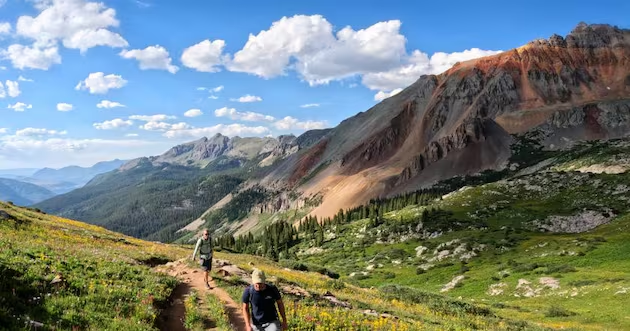
PROVO — In the Beehive State and throughout the Mountain West, massive water reserves are frozen, sheltered and hidden under some of the region’s most striking mountain ranges.
Read more Here’s where homebuyers are more likely to get concessions
Utah’s own Mount Timpanogos is home to one of these hidden supplies, called a rock glacier, that feeds into Emerald Lake, near the mountain’s summit.
Essentially slow-flowing masses of ice and debris, rock glaciers contain and slowly release water, well after snow melts even at Utah’s highest elevations.
Rock glaciers like the one at Mount Timpanogos are the subject of a collaborative study by the Utah Geological Survey, Brigham Young University and other Utah universities.
“Rock glaciers are similar to an ice glacier that we’re familiar with… It basically looks like a pile of rocks, but it’s all moving downhill, just like a glacier would be,” Greg Carling, a BYU geology professor and researcher on the project, said in a video.
For a state that gets about 95% of its water from snowpack, rock glaciers are an important and intriguing piece of the water supply puzzle.
“They are becoming a major source of water,” Lerato Thoka-Cole, a BYU geology graduate student, said in the video. “What’s cool is that once it snows again, the water will go back into the rock glacier, and the ice will be stored right back in, and they’re (rock glaciers) not as exposed as normal glaciers are.”
For the research, Carling and his students embarked on a six-week expedition, hiking to nearly 100 high-country rock glaciers throughout Utah and Colorado in search of outlet streams fed by the glaciers.
Read more What conservatives can learn from a liberal at Fox News
Carling said he wasn’t expecting the results they found.
“What we ended up finding out was nearly all of them had water, so it’s pretty exciting for us to be able to find that, “Carling said, “Especially late in the summer, when we need that water the most.”
In addition to identifying the water sources that these glaciers feed, the team collected water and macroinvertebrate samples to assess water quality.
As one might expect from high-alpine sources, the majority of the water samples have come back quite clean, Carling said.
It’s welcome news for a state that has remained in drought conditions over the summer and into meteorological fall, with over 90% of the state in severe or worse categories, the U.S. Drought Monitor also reported on Monday.
“It’s great for our water supply,” Carling said when discussing rock glaciers.
Water scarcity is an issue Thako-Cole is familiar with. She hopes she can apply what she’s learned in the Mountain West’s high country back home.
“In my time here, I’ve grown the feelings of wanting to give back more to my community,” Thako-Cole said. “Right now, Africa is considered a very water-scarce continent, but so much of its water is trapped in aquifers, which is groundwater, and it hasn’t been tapped into. I want to take everything I’ve learned and give back.”
Read more Utah becomes first state to adopt Trump administration’s faith-based recovery model