
- Skiing and snowboarding have become too expensive for some people to take up the sports.
- A Utah man wants to explore the feasibility of a publicly owned ski area in the state.
- At least 50 nonprofit, community or municipal ski resorts exist in the U.S.
Most skiers and snowboarders don’t buy expensive single-day lift tickets any more. Season and multi-day passes are much more common among regulars at Utah resorts. Though still pricey, those passes can significantly reduce the per-day cost, depending on how many times they’re used.
Read more The U.S. is expanding its military presence in Greenland. Here’s why it matters
But for people who just want to go on a random weekend or who want to get their kids into the sport, a day ticket at Wasatch-area resorts runs around $200 on average and about half that outside the Wasatch. At peak times, a lift pass at top-tier Utah ski areas exceeds $350.
The University of Utah’s Marriner S. Eccles Institute for Economics and Quantitative Analysis found occasional or beginning skiers face 60% higher prices than they did in the 1990s.
“These skiers either pay more or decide that the high price is not worth it and choose not to ski altogether,” according to the 2025 analysis. “In fact, the number of unique skiers has declined in recent years even as the number of total visits to ski resorts has increased.”
Man with a plan
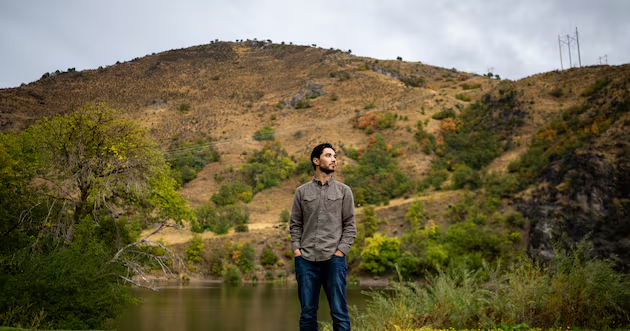
Clint Richins worries that locals, especially kids, are being priced out. And he thinks he has a solution to the high cost of skiing and snowboarding in Utah: a publicly owned ski area.
“What I’m trying to do is I’m trying to preserve ski culture in the state of Utah,” he said. ”And the reason I think it needs to be preserved is because over the past several years, more and more Utah families have decided that they can’t participate in the sport because it’s too expensive and it’s too crowded.”
Richins, who has a degree in finance and economics from Utah State University and works for a fitness equipment supplier, acknowledges his idea is “crazy.”
But he did his homework on finances, locations, operations and snowfall before launching the nonprofit Utah Public Ski Area Coalition or UPSAC. He has an attorney, map expert, marketers and outdoor recreation industry leaders, among others, on board. He’s had conversations with the Utah Division of Outdoor Recreation, Utah State Parks, Ski Utah, Utah legislators and the U.S. Forest Service.
UPSAC intends to apply for a grant from Utah’s $20 million Outdoor Recreation Initiative to conduct a feasibility study, the first step toward a state-supported ski area. The program leverages municipal, state, federal and private resources to build new or expand outdoor recreation facilities.
“I tell everybody I only want to do this if it makes sense,” Richins said, adding he has no interest in raising taxes. “I don’t necessarily want to build a resort if it’s going to be a drag on state resources.”
View this post on Instagram
The big question: Where?
Richins, a 31-year-old husband and father of a nearly 2-year-old son, lives in Cache Valley. He grew up snowboarding and skiing at Snowbasin. He was 8 during the 2002 Salt Lake Olympics. His parents took him to collect pins. He found the competition inspiring. But as the 2034 Olympics in Utah approach, he’s concerned that opportunities for Utah kids to become one of those athletes is fading.
And instead of complaining about the mega pass model — season passes like Epic and Ikon that bundle dozens of resorts — that has become the industry standard, he said he’s trying to find a solution. “I’m saying let’s see if we can do something different,” he said.
Richins put together a detailed financial plan estimating $83.9 million to open a state-supported resort and $104.1 million for full buildout. It anticipates a $38 million appropriation from the legislature, state government bonds and private donations, among other sources to finance the project.
Utah resident lift tickets would run $59 for adults, while nonresidents would pay $139. Children ages 6 -11would cost $30.
Beyond questions about whether the state should be in the ski business at all, Richins sees the biggest operational controversy is the resort’s location. He’s exploring five to eight sites, mostly on Forest Service property as well as private property. Any site would come with hurdles. Construction on federal land would require an environmental study and approval of a special-use permit. Private property would up the cost.
Richins isn’t disclosing the sites because of the uproar it could cause before there’s a chance to evaluate them.
But he said the resort must be within 90 minutes of Salt Lake City and at a high enough elevation — 7,200 feet at the base — for consistent snow as well as snowmaking ability. The terrain would have to appeal to beginners and advanced skiers and snowboarders, he said. He envisions roughly 1,000 skiable acres with five fixed-grip, four-person chairlifts, magic carpet and terrain park rope tow.
Thinking big
Richins posted his idea on Instagram at localslift.utah for the first time earlier this month, drawing more than 9,600 likes along with some negative comments. Initially apprehensive about going on social media, he’s now willing to take the arrows and has posted five more times since. He said some of the questions raised in response to his proposal are valid but the feasibility study is the right way to answer them.
In his latest post, Richins displays a map of all the municipal and state-owned golf courses in Utah and wonders why skiing isn’t treated the same way.
Read more High school girls soccer: Herriman bests Mountain Ridge for solid spot atop Region 2
“Is it the greatest grass on Earth or is it the greatest snow on Earth?” he asks.
Jason Curry, Utah Division of Outdoor Recreation director, said Richins’ idea isn’t something the state has ever considered, nor is it a priority.
“And so while I certainly wouldn’t be opposed to it and would try to do everything in our ability to make something like that work, it’s not something that’s really in our long-range planning,” he said, noting it would take buy-in from the governor and state lawmakers.
Curry said he favors “thinking big and doing big projects” that get Utahns outdoors.
“I’m interested to look at the data and see what the possibilities are and figure out where we might be able to increase people’s ability to participate in skiing and snowboarding,” he said.
Not a new concept
Publicly owned ski resorts aren’t a new concept. Howelsen Hill in Colorado, now owned by the city of Steamboat Springs, dates back to 1915. There are now at least 50 nonprofit, cooperative or municipal resorts in the U.S., including Bogus Basin in Idaho and Bridger Bowl in Montana.
OnTheSnow recently published a list of some of the nonprofit ski areas, writing, “The word “nonprofit” isn’t often associated with skiing, especially as lift ticket prices and trip costs continue to rise — not to mention the high overhead required to run a mountain. However, a growing number of ski areas around North America, often in smaller communities, are making it work as a nonprofit while also making the ski experience both fun and affordable.”
Snowland in central Utah is the state’s only publicly supported ski area. The tiny resort in Fairview Canyon opened this past January with a rope tow and two runs. It received a $1.46 million grant through the Outdoor Recreation Initiative to improve parking and build a new surface lift to service dozen beginner and intermediate runs, per a concept drawing on its website.
Ski Utah president and CEO Nathan Rafferty likes Richins’ passion and energy. But he thinks his effort would be best spent on a significantly smaller, less capital-intensive resort, something along the lines of Snowland.
“Ten of those around the state would be amazing, I think,” he said. “I’ve been to Snowland when they’ve got it going on and kids are having so much fun.”
Rafferty said that would allow families to try out skiing and snowboarding at a lower price point.
“For me, a lot of it comes down to the where,” he said regarding Richins’ proposal. “I wouldn’t be too stoked if a taxpayer-funded, direct competition resort moved in next to Beaver Mountain or any resort. We’ve got places to do these (small resorts) and spreading them out and getting to some places that don’t have access to these things.”
Rafferty said Ski Utah, a nonprofit that promotes and markets the state’s 15 ski resorts, is supportive of Richins’ efforts and willing to help along the way. And like Richins, he believes kids need to get outside.
“Kids need recreation, outdoor recreation year-round, and can’t just have it in the summer,“ he said. ”If we’re going to host the Olympics in 2034, it makes sense that we get more opportunity to more people leading into those games.”
Affordable options
Nordic Valley in northern Utah offers affordable skiing and snowboarding but its terrain caters mostly to beginners and its relatively low elevation doesn’t produce as much snow as other resorts. It hasn’t posted lift tickets for the 2026-27 season but kids under 13 ski free. Brian Head in southern Utah offers day passes as low as $9 on weekdays if purchased in advance. Kids under 13 ski free there as well.
Though a publicly owned ski resort is a lofty idea, Richins is a realist. If it proves unfeasible or even if it pencils out and Utahns don’t want it, he’s willing to drop it.
“I’m fully aware that this is an extremely ambitious project. If all of this effort comes to nothing, and it’s very likely that that might happen, that’s OK,“ he said. ”I’m OK with that because I’ll know that I gave it a shot. I looked into it, I explored it, I asked some, in my opinion, good questions.”