
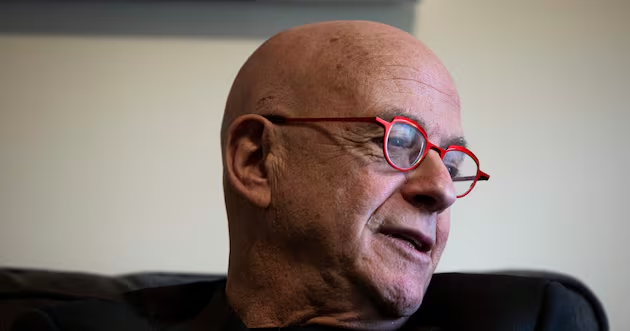
- A University of Utah law professor advocates for making those who enable wrongdoing subject to criminal prosecution.
- Amos Guiora uses the war and politics in Israel to argue his case in his new book “Enablers: Normalizing the Unimaginable.”
- The son of Hungarian Holocaust survivors, Guiora weaves his mother’s experiences into the book.
A new book argues that enablers — defined as those in a position of authority who are aware that a vulnerable person is being abused or harmed yet choose not to act on their behalf — should face criminal prosecution.
Read more How the West could determine control of Congress
Amos Guiora, a University of Utah law professor and son of Hungarian Holocaust survivors, makes his case in “Enablers: Normalizing the Unimaginable,” using the failure of Israeli Prime Minister Benjamin Netanyahu and government leaders to immediately negotiate the release of 251 hostages Hamas abducted on Oct. 7, 2023. He also cites Netanyahu’s proposed judicial reforms, contending they attack the rule of law and threaten democracy.
“The enablers in this current crisis are politicians, which could be seen as problematic because politicians can explain their actions as reflecting the will of the electorate,” Guiora wrote.
“However, the traditional argument that politicians have immunity does not hold if their actions directly contribute to the crisis. To wave off their actions as ‘politics is politics’ is too convenient and fails to take into account that the exposure to harm goes far beyond political opponents.”
Guiora wants to see legislation — not just in Israel but other countries as well — that criminalizes enabling, which he sees as a step below aiding and abetting or conspiracy but just as harmful to victims.
“The goal is to create the legal infrastructure by which prosecutors can indict for an act that has, to date, not been understood to be criminal,” he wrote.
In the book, Guiora recounts his Jewish mother’s escape from Hungary as a 17-year-old during the Holocaust. “My mother’s life, like that of all Jews living in Hungary at the time, was forever altered by enablers,” he wrote.
That, in part, pushed his research toward the question of bystanders’ and enablers’ roles in wrongdoing. Guiora directs the Bystander Initiative at the University of Utah law school. His books include “Armies of Enablers: Survivor Stories of Complicity and Betrayal in Sexual Assaults” and “The Complicity of Silence: Confronting Ecosystems of Child Sexual Abuse in Schools.”
His book “The Crime of Complicity: The Bystander in the Holocaust” is a nonfiction narrative about his parents’ experiences during the Holocaust. He initially set out to write a second edition drawing on his mother’s memories.
“It became clear, particularly regarding the Netanyahu government’s determined efforts to eviscerate the rule of law through what it called ‘judicial reform,’ that the shift would be so dramatic it would require an entirely new book,” Guiora said in an interview with International Policy Digest. “Then, in the aftermath of Oct. 7, 2023, and the government’s refusal to make a deal to release all the hostages, it became very clear that I could use my mother’s post-Holocaust experience as a segue into contemporary life in Israel.”
In addition, Guiora, who served nearly 20 years in the Israel Defense Forces, relied on interviews with high-ranking current and former Israeli officials — he allowed them anonymity — to make his case. And he pulls no punches, naming current government leaders whom he asserts enabled the action or inaction of the prime minister.
“I’ve been to a bazillion demonstrations, and it became clear that because he knew that he had his base, he had those politicians who I name in the book enabling him, that he didn’t need to make any deal,” he said.
“And so for me to write the book was a way to articulate the powerful role played by enablers in enabling. I absolutely view this through the lens of criminal law. And like there’s child endangerment, there would be hostage endangerment, and they are the enablers. Those politicians who protected Netanyahu are enablers.”
Read more Here are the 4 singers from Utah competing on ‘The Voice’
On Oct. 23, the law school will host a discussion of the book titled, “Enablers: Normalizing the Unimaginable — Legal Accountability and Professional Responsibility.” The book is due out Oct. 13.
In a Zoom interview from his home outside Jerusalem, Guiora talked with the Deseret News about what he found in researching and writing the book. The conversation has been edited for length and clarity.
Deseret News: What’s the basic definition of an enabler?
Amos Guiora: An enabler is a person in a position of authority who knows of present and/or future harm and makes a conscious decision to ignore the harm and to protect the institution. And for me, enablers, the politicians who I named, some of whom I know, did make the conscious decision to protect Netanyahu directly. Some of them see themselves as his heir apparent. You have a better chance of being the next prime minister of Israel than they do. So the enabler is a person who knows and is in a position to protect the vulnerable and makes the conscious decision to not protect the vulnerable.
DN: Why should enabling become a prosecutable crime?
AG: Enabling should be a crime because that ecosystem is responsible for the harm. There’s the perpetrator. Think about sexual assaults. There’s the perp. Think about Cornell, right? . . . And just like we have child endangerment laws, I think that anybody who is in a position to prevent harm — not to view this through the lens of morality or faith or whatever — but to view this through the lens of the law, because I think they absolutely need to be held criminally accountable. It’s not quite aiding and abetting. It’s not quite co-conspirator. It’s one step beneath. But without the enabler, without that ecosystem of enabling, the perpetrator is unable to cause the harm that he or she does.
DN: Why don’t crimes like aiding and abetting or failure to prevent a crime or conspiracy cover enabling?
AG: They’re close, but they’re not quite there. Aiding and abetting is someone who’s part of the plan. The co-conspirator is part of the plan. (Enablers) are not part of the plan. They’re one step below that. And having met by now with legislators and having testified in this not only in the States but also elsewhere — testified in Australia, testified in the Netherlands and here, here being Israel — they agree with me that it’s not quite (aiding and abetting or conspiracy). But there’s an understanding that without that ecosystem, the perpetrator would not be able to act.
DN: What makes these proposed judicial reforms and the failure to negotiate the release of the hostages a good case study for making enabling a crime?
AG: From the American Bar Association’s perspective — the publisher — if they were here, they would tell you this book is about Israel. But it’s not about Israel, because threats to democracy are threats to democracy. And eviscerating the rule of law, minimizing the judiciary, that’s not only an Israeli issue, that is an issue confronted by democracies elsewhere. If you believe in the rule of law and if you believe in an active judiciary that serves separation of powers, checks and balances, doing away with that legislatively is a slippery slope in terms of harming democracy. Democracy really is fragile.
With respect to hostages, first of all, I wouldn’t wish hostages on anyone. I have met, I shook the hand of one hostage mom and I stood next to a guy whose daughter was killed. There’s nothing you can say. But I think anybody who’s a parent or has loved ones who are in harm’s way — that the government is in a position to minimize the harm — it makes the deliberate decision not to minimize the harm for political purposes, narrow political purposes. Maybe the hostages are an Israeli issue, but a government failing to protect the vulnerable, that’s not exclusively an Israeli issue. I think that any democracy, when confronted, do we have narrow political considerations or do we actually do the right thing and save vulnerable people?
DN: Should politicians be prosecuted for trying to carry out political agendas they believe would be best for a country or state or city?
AG: Under no condition was keeping the hostages in Gaza good for the country. It was good for (Netanyahu) politically because it showed him not giving in to Hamas. It served his political purposes. It certainly didn’t serve the hostages who were murdered. It certainly didn’t serve the hostages, male and female, who were sexually violated. And I emphasize men and women. And to the men’s credit, it’s not easy for a male to acknowledge having been sexually violated and the women who are sexually violated repeatedly. I don’t see how that serves, in my view, a politician. In his view, from his basis, perspective, the word is spin.
DN: What impact do you hope the book will have?
AG: The mere fact that people are willing to engage in the conversation about the enablers and to understand the power of the enabler and the need to have this discussion. I think if it makes that contribution, I don’t think there’s anything more important than that. The hostages became such a visceral issue, and the fact that I could address it through a lens that was not addressed elsewhere, for me, is the word not rewarding but reaffirming . . . If I gave voice to those who were harmed by those in a position to protect them, then I think that’s a really impactful book.
Read more Tyler Huntley leads Ravens to comeback win in his first start of the season