
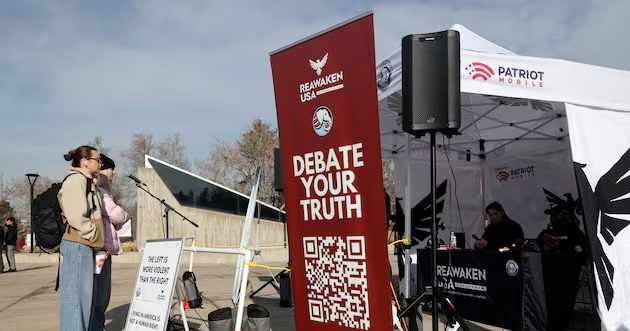
The Foundation for Individual Rights and Expression’s (FIRE) new College Free Speech Rankings tell a now all too familiar story about American campuses. Cancel culture is rampant, with too many students being afraid to speak, too many anticipating social or professional consequences for saying the wrong thing, and too many having come to regard censorship — even disruption and violence — as acceptable responses to ideas they dislike.
Read more Opinion: Why family is essential to human development and flourishing
After seven years of survey work, this has become a campus norm and it shouldn’t be. But buried inside FIRE’s troubling 2027 findings and the headlines about toxic campus climates of expression is a more hopeful story: Students are still talking. And the FIRE data give universities clues about where and under what conditions they are willing to do it.
Campus culture is not fixed and improvement is possible.
The data shows that half of students nationwide say the Israeli-Palestinian conflict is difficult to discuss openly on campus. Forty-six percent say the same of President Donald Trump, 44% of Charlie Kirk and 43% of abortion. Nearly a quarter report that they hold back their views with classmates a couple of times a week or more. Fifteen percent have been disciplined or threatened with discipline for something they said. And 3 in 10 consider violence acceptable in at least rare cases to prevent a campus speaker from speaking.
I serve on FIRE’s board and know this data well. After seven years of annual surveys, FIRE has collected data on almost 350,000 undergraduates and created a record of our nation’s collegiate speech climate that cannot be dismissed or ignored. Sadly, of the 261 schools ranked in the 2027 survey, 121 received a failing grade, and only 24 earned a grade of C or better. Even the top two schools on the list — the University of Chicago and Claremont McKenna College — received only a B-minus.
The record on expression uncovered in the FIRE data is alarming, and the findings are dangerous because they shape our civil sphere and the norms forming among our younger generations. But here is the positive story that needs to be told too: campus culture is not fixed and improvement is possible. Last year, 166 schools failed FIRE’s rankings. This year that number fell to 121, and the national average score is the highest FIRE has recorded in seven years of surveying. The gains are modest, but they are real, and they show that a campus can change course in a single year.
There are also schools that have improved their campus climates, and Harvard is a good example. In the 2025 rankings, Harvard finished dead last, at 251 out of 251 schools. Two years later it had climbed to 71 out of 261. FIRE attributes the rise not to new policies but to students reporting greater trust that the administration will defend speech, along with the fading of penalties from older controversies. Harvard is hardly a model of free expression today — it still earns a D — but that is a substantial improvement. The University of California, Davis, is another example, moving sharply upward from 252 out of 257 last year to 24 out of 261 this year after adopting the Chicago Principles, embracing institutional neutrality, and earning a “green light” rating for its speech policies. Chancellor Gary May even commented on the rankings, noting that “free speech can be uncomfortable and even at times hurtful to members of our community” while also recognizing the progress the university had made and the difficult work that remains.
These cases matter because they show that campus culture is not fixed and the current state of free expression is not some immutable condition of higher education. University leaders can change the campus climate if they make clear what the rules are and then actually follow them.
The FIRE data also gives us a chance to see what students themselves say about what they are comfortable discussing. FIRE presents students with a long list of subjects and asks whether it is difficult to have an open and honest conversation about them on campus. The topics at the top are not surprising: Israel and Gaza, Trump, Charlie Kirk, abortion, immigration and transgender rights. But the bottom of the list deserves attention too. Only 10% of students say China is difficult to discuss openly. Thirteen percent say the same about climate change and the Supreme Court, 14% about crime, and 18% about economic inequality and affirmative action. Seventeen percent say that nothing on FIRE’s list is difficult to discuss at all.
These are hardly trivial subjects. Crime, affirmative action, questions of inequality are certainly salient and very real in the minds and lives of my students, and it is no secret that students disagree about crime, inequality, climate change, China and the Supreme Court all the time. However, the FIRE data reveals that most students still say they feel comfortable talking about them.
While there are clearly topics where students fear that a wrong word can carry immediate social consequences, we now know that this pressure does not extend everywhere. Colleges and universities can and should build the habits of dialogue, disagreement and diversity of ideas around these topics.
Read more The gospel and grace of Jesus Christ are for everyone, Latter-day Saint president says
But what students are willing to talk about is only part of the story. Where they are being asked to talk matters too. Fifty-four percent say they would be comfortable disagreeing with a professor about a controversial political topic in a written assignment. Fifty-three percent say the same about an in-class discussion, and 57% would be comfortable expressing their views in a dining hall, lounge or on the quad. But only 38% would feel comfortable posting an unpopular political opinion under their own name on social media — an action that is hard to delete and can circulate forever in the digital world.
That gap says a lot. Students may be less afraid of disagreement itself than of having that disagreement become permanent, public, searchable and attached to their name.
I see this regularly in my own seminars. Last week in my course on polarization, we were talking about the midterm elections and how international affairs can shape electoral outcomes and choices. Understandably, the discussion turned to Israel and the Middle East, and it didn’t shut down. In fact, for about 20 minutes, my students and I talked seriously about Israel, the war, the behavior of states and international law, and the obligations countries have toward one another in global affairs. There were real disagreements, but the conversation was thoughtful, respectful and engaging. Students were not all on the same page and that was unquestionably clear, but we talked and considered how Israel is impacting domestic politics, which was intellectually valuable.
Sarah Lawrence College, where I teach, is no stranger to national attention over how many on campus feel about Israel. The school has been investigated by Congress for antisemitism, but my class and I were able to have a meaningful and productive dialogue about Israel and that did not happen by accident — it happened because I worked to create the conditions for open inquiry. On the first day of class, I told my students that we are going to discuss difficult subjects and that people will disagree. Someone may occasionally be uncomfortable and that is absolutely normal when pushing boundaries, challenging prejudices and learning something new. I set the rules that there may be no recording of our discussions and individual comments cannot be attributed outside the room.
Students should be able to try out an argument, ask a question imprecisely, make factual errors, rethink something, and come back the following week without worrying that one sentence is going to become a screenshot or a viral social media moment.
Faculty have an obvious role here because the classroom is one place where students still say they are willing to take these risks. As a result, we as faculty should be asking more questions and harder questions, not fewer of them, and making disagreement and dialogue around difference a normal part of academic life.
Administrators have a notably different responsibility. They should stay out of the classroom, but they must make rules clear before the controversial speaker arrives or the protest begins, and then enforce those rules when problems develop. Speakers should be allowed to speak, protesters should be allowed to protest, and neither side should get to silence the other.
Rabbi Tarfon put it well in Pirkei Avot, Ethics of the Fathers: “It is not your duty to finish the work, but neither are you free to desist from it.” Higher education has a role here and needs to actually embrace it. Universities are not going to make every student comfortable discussing every difficult subject, but they can create more places where students are able to ask questions, disagree, reconsider and come back into the same room together. They can help students think differently about disagreement and show them that difference and discomfort are part of living in a pluralistic society.
The FIRE data contains many findings that should worry us about speech and open expression. But the data is not entirely negative either; we do not have to rebuild a culture of debate and inquiry from nothing. Students are still talking and some schools are actively improving. Colleges and universities need to notice where it is happening and build on it.
Read more Opinion: The false compassion of euthanasia and surrogacy