
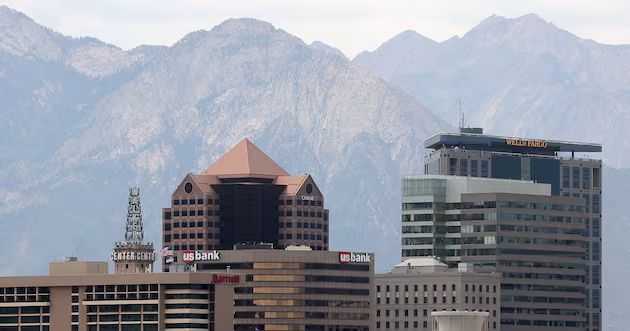
Utah has come out on top of yet another study of American flourishing: the Independence Index, which measures how states are faring in the pursuit of the American Dream.
Read more Why the new ‘Narnia’ movie is already getting backlash online — from some Christians
There are secondary explanations for Utah’s success, from its pro-business policies to its diversified economy and young workforce. But in my view, these benefits flow downstream from Utah’s core strength: social capital.
When the social fabric of a community is strong, positive effects naturally follow. The Independence Index, produced by Advancing American Freedom (AAF), measures many of those effects:
Utah leads the nation in job growth, volunteerism and low out-of-wedlock birth rates. It also boasts some of the best scores on obesity rates, homicide rates and multiple other measures.
AAF found that our government spends far less than the national average, imposes fewer regulations and collects fewer taxes. And yet, on the vast majority of Independence Index measures, we beat out much wealthier states with higher tax rates that outspend us on social programs.
That contrast suggests that, as AAF’s Vice President of Policy John Shelton put it, “not every challenge … can be solved through public policy … Many of the most important indicators of national strength originate in families, congregations and other voluntary associations that bind the country together.” In other words, our social capital makes the difference.
How Utah’s strong social capital has helped me
My own life is a testament to that. By American standards, I grew up poor, with a Ukrainian immigrant mother and a father with debilitating health challenges. I was a free lunch kid who got made fun of for wearing the same clothes every day and for bringing stinky beet-and-garlic salads to school.
I could easily have floundered academically, socially and emotionally.
But what my family lacked in health and wealth, we made up for in social capital. My church youth leaders stepped in to nurture me when my parents were too stretched to meet my emotional needs; one even took me to volunteer outside a homeless shelter in downtown Salt Lake City every week. My grandmother volunteered in my school, and my uncle paid for extracurriculars. My church organized weekly youth activities that provided consistent positive socialization when home felt gloomy and isolated.
When times were especially tough, my congregation provided groceries. Two members of my congregation even funded my missionary service on the Texas-Mexico border that taught me a host of life skills, two languages and the perspective to realize just how special Utah really is.
Read more ‘Great for our water supply’: BYU study examines how rock glaciers fit into Utah’s water puzzle
Bolstered by that community and familial support, I qualified for enough scholarships, many granted by fellow Utahns, to graduate from college debt free. Utah’s strong families and communities took me from welfare dependency to self-sufficiency and flourishing.
Mine is just one of many stories behind another favorite Utah statistic: we rank first in the nation in upward mobility — a fact made famous by Vice President JD Vance’s book “Hillbilly Elegy.”Vance attributed the Beehive State’s high upward mobility to our “strong church, integrated communities and intact families.”
Utah’s strong social networks create resilience in children and teens when home life is turbulent. They provide support for marriages and families. They facilitate job searches for adults and teens. They create community for young adults in a nationwide .
For many kids in Utah, government intervention is not the first safety net when home life gets hard — our families and communities are. Without recognizing how rare a privilege it is, Utah families leverage their social capital so that far less government intervention is even necessary.
It takes all of us to make Utah great
But the news is not all positive.
Social capital is dwindling throughout the nation, including in the Beehive State. With that decline comes backsliding on a range of indices — our nation is losing ground on 21 of the Independence Index’s 24 measures.
Too many of us look to the government to solve these problems. We place responsibility for change on politicians and bureaucrats. Consequently, even as social outcomes continue to fall, our government grows, and with it grow tax rates, regulations and debt.
The empowering lesson of Utah’s success is that the politicians you send to Washington won’t save the American Dream. You, your family and the community organizations you support will.
Read more Here’s where homebuyers are more likely to get concessions