
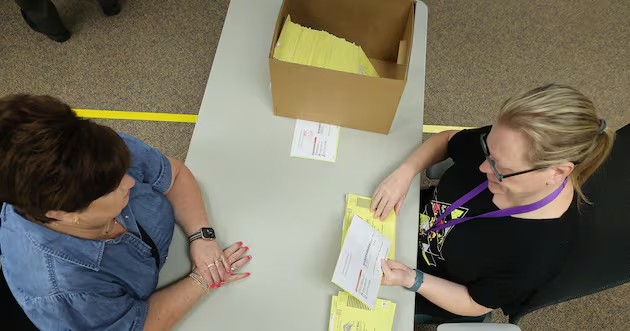
The Supreme Court on Monday ruled against President Donald Trump and his effort to create new mail-in ballot restrictions ahead of the 2026 November midterm elections.
Read more Rob Reiner’s record-breaking Emmy win comes amid emotional night of remembrance
The order stops the United States Postal Service from implementing changes to mail-in ballots proposed by the Trump administration and instead instructs the agency to continue with the upcoming election as normal.
Justice Brett Kavanaugh wrote a short concurrence in which he agreed with the majority of justices who said the administration’s request should be denied.
Their decision will leave in place a block from late last month by a federal judge in Boston that said USPS’ finalized rule was unconstitutional.
U.S. District Judge Indira Talwani in August reluctantly lifted a nationwide injunction she previously placed after the Supreme Court said she and state challengers to Trump’s order acted prematurely.
The justices in that emergency order said Trump could begin executing parts of his executive order since the Postal Service’s rule for changing mail-in ballots was in a preliminary stage and not finalized. However, once the agency issued its finalized rule, the Democratic-led states sued again, leading Talwani to issue another block and bring the matter before the Supreme Court again.
The court’s more ideologically conservative justices, Samuel Alito and Clarence Thomas, opposed the decision. Alito, in his dissent, argued some of the Democratic-led states didn’t have grounds to sue the administration.
Sen. Lee continues to push for SAVE Act
Mail-in voting is an issue that’s important to Utah Sen. Mike Lee, who authored the SAVE Act in Congress, which requires proof-of-citizenship to register and voter ID to cast a ballot, but it has stalled in the Senate.
He shared online after the justices ruling that “Alito and Thomas are right–again.”
“The Senate still needs to pass the SAVE America Act–now more than ever,” Lee wrote.
The other part of Trump’s order would have directed the Postal Service to follow new provisions for mail-in ballots.
Envelopes sent by state election offices must be marked as “Official Election Mail,” and include a unique, trackable barcode.
The Postal Service would have had to coordinate with the Department of Justice for investigations into the unlawful use of federal election mail.
The preliminary rule published by USPS required states to provide the federal government with a list of voters who receive mail-in ballots, including name, address and the individualized barcode on their ballot envelope.
The group of 24 states and the District of Columbia that sued the administration over the order argued the measures violate the Constitution and other federal statues. Under the Constitution, only Congress can pass laws related to elections and individual state legislatures have their own authority to conduct elections as they see fit.
Read more Jimmer Fredette is coming out of retirement
They also argued it would harm the states by imposing “burdensome” mail-in voting requirements, particularly so close to the November election.
It wasn’t just Democratic-led states opposed to the changes, though. Utah Lt. Gov. Deidre Henderson told the Deseret News in a statement that her team was “relieved” the Boston-based judge blocked USPS from enforcing the changes, calling them unconstitutional.
Henderson said the ruling from the Supreme Court was “expected.”
‘Utahns can have confidence that the 2026 election will proceed as normal,” she said. “We encourage voters to check their voter registration.”
Utahns can check their voter registration and sign up for ballot tracking. Registration ends Oct. 23 but voters can sign up for same-day registration with two valid forms of ID on Election Day.
Ballots will begin being mailed to Utah voters on Oct. 13.
Midterm elections only 7 weeks away
Before Monday’s late ruling, the clock was ticking for the matter to end up before the court again. The ruling came less than two months until the Nov. 3 midterm elections, and ballots in at least two states, North Carolina and Alabama, had already begun to be sent out.
The battle over mail-in ballots isn’t new to Trump, who has long been against the voting method and claimed the 2020 presidential election was rigged due to changing rules around mail-in ballots because of the pandemic.
While no evidence has surfaced of widespread voter fraud, Trump’s order directed the Department of Homeland Security, in partnership with the Social Security Administration, to compile state-by-state citizenship lists of confirmed U.S. citizens who are 18 years or older.
It’s the latest move from the administration to ensure non-citizens aren’t voting in U.S. elections. States that sued over Trump’s order argued their voter rolls would be targeted because of their majority-Democratic constituencies.
Trump, who saw some wins at the high court this term and some major losses, issued a blistering post after the justices’ ruling, saying the Republican Party got “another bad decision” from the Supreme Court.
He argued the justices took “forever” to take up the issue and then “blamed it” on having “no time left to implement a solution” before November. Trump argued that the country’s mail-in voting system is a “laughing stock all over the world.”
“The Supreme Court has really let our Country down! Certain Justices are petrified of these crazed and depraved Democrats, and are totally unable to show the courage necessary to save our America,” he wrote.
Trump went on to criticize the justices for the two rulings against his key agenda items, his tariff agenda which was struck down in February, and the effort to overturn birthright citizenship which the justices deemed unconstitutional in late June.
“The Supreme Court is bullied and cajoled by the Radical Left into making decisions that have set America back at least a hundred years. These are not the people I interviewed to serve on the United States Supreme Court, they are merely a shell of their original selves,” he wrote of his three nominees, Justices Kavanaugh, Amy Coney Barrett and Neil Gorsuch, who often are the deciding group for if rulings go in the presidents’ favor.
Read more Church of Jesus Christ advances 3 temples across the U.S. and South America