
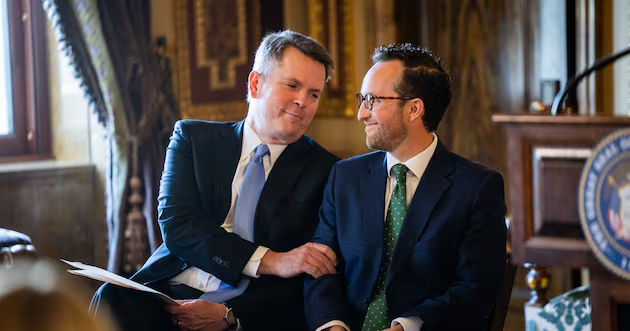
A Utah Senate committee has endorsed two new nominees for the state Supreme Court, sending their nominations to the full Senate for a vote later this week.
Read more Utah political leaders urge Big 12 to take action against Texas Tech
The Utah Senate Judicial Confirmation Committee voted largely along party lines on Monday to approve the nominations of Jay Jorgensen and Stephen Dent to fill two brand-new seats on the high court.
All Republicans on the panel supported the nominees, while the two Democrats opposed Jorgensen, citing concerns about whether he met the residency requirements to serve on the high court. One Democrat voted against Dent.
Jorgensen, a senior attorney for The Church of Jesus Christ of Latter-day Saints and former corporate attorney, pushed back on questions about his residency during Monday’s hearing. He said he still met the state Constitution’s requirements of living in the state for five years after a recent three-year church mission in Chile.
Jorgensen said he moved back to Utah in 2020 after spending much of the prior two decades outside of the state. He then served as a Latter-day Saint mission president from 2022 to 2025 and said he accepted the job with the church before returning to the state.
“It says the nominee to this position must have been a Utah resident for five years,” Jorgensen said, pointing out that the Constitution doesn’t require those years to be immediately preceding the nomination.
Even if that were the case, Jorgensen argued that his years in Chile are not disqualifying because he always intended to return to Utah after his church service and still owned a home in Provo during the time.
Both Democrats on the committee pressed Jorgensen over the issue and ultimately voted against his confirmation.
“I think the most recent mission is in question, but even before that, Mr. Jorgensen spent — by my math, if it’s not wrong — 23 years working outside of Utah,” said Sen. Stephanie Pitcher, D-Salt Lake City. “I think it’s important that we have individuals on the bench, especially the Supreme Court, that actually have lived in Utah and have practiced in Utah.”
Sen. Brady Brammer, R-Highland, defended Jorgensen and pushed back on the questions about his residency, saying the “key issue” with residency and military or church service is “not necessarily where you’re located” but “where you intend to return when you’re done.” He said he doesn’t believe the Constitution intended to disqualify people for religious service.
Read more UK, Australia ban social media for youth. Could U.S. ban follow?
“I think the timing is very clear on this. The law is clear: it’s five years,” Brammer said. “This is one of the most qualified potential jurists we’ve had apply in the history of the state of Utah. … I worry that the questions about residency are partisan under the pretext of residency and so I fully support this pick.”
Senators questioned Dent, a federal prosecutor in southern Utah, about the separation of powers between different branches of government and his philosophy on legal matters.
“Any case that comes before me, the law and the facts will be what guides me,” Dent said.
Like Jorgensen, Dent has no experience as a judge, but he said he had to wear “many hats” as a prosecutor and believes that experience would transfer to the Supreme Court.
“You wear a prosecutor hat and so you’re looking to protect the community and to build your case, but you’re also wearing the hat of a defense attorney,” he said. “You’re applying neutral principles and you’re saying, ‘We’re not here just to send people to prison, we’re here to seek justice.’ And so I believe that level of neutrality and applying those neutral principles does help with the transition to the bench.”
Sen. Karen Kwan, D-West Valley City, voted against both nominees. She said she wasn’t confident Jorgensen had spent enough recent time in the state to fully understand how the culture has changed. She did not publicly explain her reasons for opposing Dent’s nomination.
Monday’s confirmation hearing was the second one held over several days. The nominees also answered questions from the Senate panel on Friday.
The full Utah Senate is set to vote on the two nominees’ appointments to the Supreme Court on Wednesday afternoon.
Those are not the only open seats to be filled on the high court. Gov. Spencer Cox plans to announce two new appointees in the next few months to fill the seats held by Chief Justice Matthew Durrant, who is retiring, and Diana Hagen, who resigned last month.
Read more What’s inside the U.S.-Iran deal to end the 3-month war