
- New Utah law prohibiting K-12 students from having cellphones during school hours will soon take effect.
- Local schools and districts have the option to modify the default policy.
- Recent national study suggests bell-to-bell school cellphone bans are yielding mixed results.
If teen fashion mavens prove prescient, Utah high schoolers will be returning to class in August wearing elevated athleisure, retro sneakers and what influencers are dubbing “Y2K nostalgia.”
But here’s what Utah teens won’t be accessorizing with at school: a new iPhone 17 — or, for that matter, any cellphone.
An enhanced law goes into effect on July 1 that essentially prohibits cellphones at Utah’s K-12 public schools, unless a school or district opts for a looser policy.
Earlier this year, the 2026 Utah Legislature passed a bill enhancing the state’s current default school cellphone policy by restricting cellphones in school from opening bell to closing bell.
In 2025, lawmakers passed a bill banning cellphones during class time — while, again, allowing schools or districts to opt for a different standard. But many lawmakers, educators and even students — along with Utah Gov. Spencer Cox — argued the limited cellphone prohibition didn’t go far enough.
“I am convinced, more than ever, that a ‘bell-to-bell’ cellphone ban is the single most important thing that we can do for our students in our schools today,” said Cox prior to the 2026 legislative session.
The governor’s not alone in his “school/cellphones” animus.
As reported by The Associated Press, a 2024 found that about 1 in 3 teachers consider students distracted by cellphones “a major problem.” Among high school teachers, that figure rises sharply, to 72%.
More recently, Pew researchers found that 74% of U.S. adults say they would support banning cellphones during class for middle and high school students, up from 68% last fall.
Cox and others Utahns were granted their bell-to-bell wish by the 2026 Legislature, but only time will tell if the state’s fast-approaching cellphone prohibition will result in higher test scores, less absenteeism and more student engagement across the state’s K-12 schools.
Study: School cellphone bans yielding mixed results
Meanwhile, and authored by scholars from several prestigious institutions — including Stanford University, Duke University and the University of Michigan — indicate school bell-to-bell cellphone bans are yielding mixed outcomes, at least in their early stages.
The national study looked at school cellphone prohibitions, examining data from about 4,600 schools.
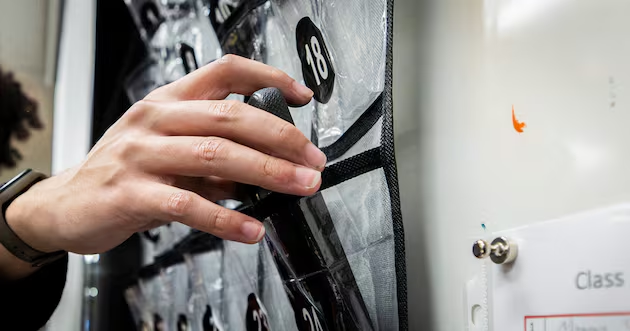
The analysis focused on a well-defined cellphone intervention — lockable phone pouches designed to limit students’ access to their phones during the school day. Nearly 5,000 American schools were reportedly using such pouches in 2026.
No surprise, the pouch system works if the primary aim is to keep phones out of school. Cellphone access and use during the school day dropped significantly, noted the study.
But of greater interest are the study’s findings regarding student behavior outcomes, academic achievement and other impacts to school environment, such as attendance.
What are the early results regarding student discipline, academic performance?
If the measured results from the national study extend to Utah in the coming year, the state’s schools could expect a few mild bumps during the policy rollout — at least initially.
Disciplinary “incidents” increased slightly in the first year of cellphone bans, the study noted — but added “this effect fades in subsequent years.”
Meanwhile, student-reported well-being declined in the first year of bell-to-bell cellphone restrictions before rebounding, becoming “positive” by the second year of policy adoption.
Regarding bell-to-bell cellphone bans and academic achievement, the average effects on test scores reported in the study are “close to zero” over the first three years following adoption.
“In high schools, we find modest positive effects — particularly in math,” the report noted.
Read more Celebrating 5 years of Wordle
But the middle school academic effects, albeit small, were generally negative.
The study’s authors also found little evidence that restricting phone access is improving other aspects of the school environment. Effects on the attendance rate, for example, were close to zero.
“We find similarly precise and small effects for chronic absenteeism and no measurable improvements for perceived online bullying or self-reported classroom attention,” noted the study authors.
So what’s behind the varied cellphone ban study results?
Several plausible mechanisms could explain the study findings.
“The increase in disciplinary incidents may reflect the enforcement of new phone restrictions,” according to the study.
“Alternatively, students may substitute from phones to other disruptive behaviors, including peer interactions that could lead to more disciplinary incidents.”
And the differences in test scores between high schools and middle schools may come down to simple maturity.
“Younger students may have more limited impulse control, making them more likely to substitute toward other disruptive behaviors when phones are removed,” the study speculated.
“Differences in the magnitude of phone use reductions may also contribute: in our data, phone activity declines more in high schools than in middle schools, so middle schools may bear the costs of introducing and enforcing the restriction while generating smaller benefits.”
School/cellphone national study: Acknowledging shortcomings
The authors of the study cautioned its various outcome measures capture only limited elements of student performance and school environments. And most cellphone restriction policies are still in early implementation stages.
“While test scores and validated survey instruments are widely used in the education literature, they may not reflect all potential effects of phone restrictions,” according to the study.
“Second, because restrictions have expanded only recently, we observe outcomes for at most three years beyond adoption; longer-run effects remain an open question.”
The study tracked three cohorts of schools, which adopted phone bans in 2022, 2023 and 2024, respectively.
Thomas Dee, a Stanford economist who co-led the study, told The Associated Press that the early stage results are “sobering” and “somewhat disappointing.”
But he added that as schools keep their bans in place, indicators like student well-being and suspension rates improve. In the first year of the phone bans, students’ self-reported well-being dropped substantially, as disciplinary rates rose, Dee said. “But within three years, students’ well-being is actually above what it was at baseline.”
Dee also noted in the Associated Press report that the newest cohorts have actually seen test scores rise in a short time.
Dee’s not sure why, but offers a theory: “The entire social context around which we understand phone bans may be changing. I think people are much more likely to see phone bans in a beneficent light now, as something that’s meant to help us rather than constrain us, even relative to several years ago.”
And don’t forget, Dee added, the study findings offer glimpses into the infancy of school cellphone prohibitions.
“I firmly believe that getting student phone use down, recapturing their attention in classrooms within schools, is a critical antecedent to realizing their academic potential,” he said.
Read more Utah Supreme Court nominee faces tough questioning about his residency