
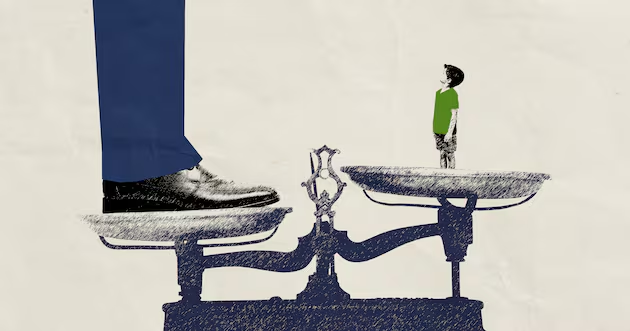
Not long ago, I was standing in line with my children at a busy lunch counter. My son had been waiting patiently for a good while, his heart set on the famous macaroni and cheese he loves, when a well-dressed group walked in and stepped straight to the front, skipping the line entirely. Nobody stopped them. Nobody objected. The line simply adjusted, as if this were the natural order of things.
Read more 3-star Syracuse safety Kaleb Hall commits to Utah
My son noticed at once.
Children are remarkably attentive to fairness. They may not grasp the complexities of adult life, but they understand turns, and waiting, and rules. He had stood there long enough to feel the wrongness of it, and the question came out with real frustration. “Dad,” he asked, “why did they get to skip the line?”
I looked at him and told him the truth: I did not know why.
A woman in the group glanced down at him. Whether she intended it or not, my son drew a simple conclusion: Some people mattered more than others. The line moved on. We ordered our food. No scene was made, no argument occurred.
I let it pass, and I should be honest about why. We live in a world where every public disagreement risks becoming a recorded and viral spectacle. A parent learns to pick his battles, and this was not one worth fighting. I was not at peace with what had happened, but I was unwilling to make my children part of a stranger’s performance.
But my son could not let it go. “Who is she?” he asked. Then, after a pause: “Why is she more important and special than everyone else who has to wait?”
He had stumbled onto something larger than he knew.
Children see contradictions the rest of us have learned to ignore. Most adults have grown accustomed to hierarchy. We watch people escorted through special entrances, seated at the best tables and ushered past ropes behind which everyone else waits. We may resent it. We may admire it. More often we simply accept it.
Children still ask why. Adults often stop asking because they have learned how the system works — and where they stand within it.
What makes one person important enough to be treated differently from everyone else? I did not have a ready answer. Status is real. It opens doors, wins access and bends ordinary rules. Anyone paying attention knows this.
Part of me wanted to give him the easy version. Some people are rich. Some are famous. Some are powerful or well connected and that is just how life shakes out. Life is not perfectly fair. There is painful truth in that, but it is not the whole truth.
In one sense, some people really are important. The surgeon in the operating room is important. The teacher shaping young minds is important. The judge weighing a hard case is important. The minister or rabbi who sits with the grieving and marks the milestones of a life is important. A society depends on people who carry authority, responsibility, expertise and care.
The trouble is how easily importance gets confused with worth.
Those are not the same thing.
My son was not asking whether some people carry heavier responsibilities than others. He was asking whether some people are simply better than others. That is a very old question.
Read more Trump targets Utah mail-in voting — state officials say he has it backward
The Jewish tradition in which I am raising my children answers it in a way that is both simple and demanding. Human beings are not identical. We hold different talents, different roles, different obligations. Some lead institutions; others follow them. Some teach; others learn. Some command authority over thousands of lives. And yet every last one of us is created b’tzelem Elohim — in the image of God. Rabbi Jonathan Sacks often observed that dignity is not something society confers; it is something every human being possesses before society ever recognizes it.
That principle does not erase the distinctions between us. It puts a limit on them. A healthy society should celebrate excellence and reward achievement. The danger comes when admiration hardens into the belief that some people possess greater human worth.
Accomplishment may deserve admiration, office may deserve respect, expertise may warrant deference, but none of it makes a person any more fully human than the child standing beside him in line.
My son kept circling back to it all afternoon. What struck me was that he was not angry. He was genuinely puzzled. Why do some people receive privileges that others never will? What does a society owe achievement, and what does achievement owe the society that made it possible? How do we honor excellence without coming to worship it? Those are questions philosophers and theologians have wrestled with for centuries. That afternoon, they arrived in the voice of a young boy waiting for lunch.
Every parent wants his children to succeed. I am no exception. I hope mine do meaningful work, lead worthwhile lives and earn the respect of others. But standing in that line, I found I wanted something for them that mattered more than success, and I reached for the answer my tradition handed me first.
In Pirkei Avot, Ben Zoma asks, “Who is honored?” The answer is not the rich, the powerful or the famous. “Who is honored?” He teaches, “He who honors others.”
The idea has lasted 2,000 years because it turns our instincts upside down. We measure importance by the privileges a person collects. The tradition measures it by the respect a person gives; status may open doors, influence may command a room, and achievement may earn applause. But honor, rightly understood, shows itself in how we treat the people from whom we have nothing to gain.
The woman vanished from my afternoon as quickly as she had entered it. I never learned her name, and I may never know whether she was truly someone of consequence or merely used to being treated as though she were. What stayed with me was my son’s question.
If my children grow successful, I hope they stay humble. If they gain influence, I hope they spend it well. If they ever become known, I hope they remember that every person they meet carries the same God-given dignity they do. And if they are ever honored, I hope it is never because they expected the world to step aside for them.
I hope it is because they learned that greatness is not measured by how many people step aside for you, but by how you treat the people who have no reason to.
Read more The challenges dual-income families face