
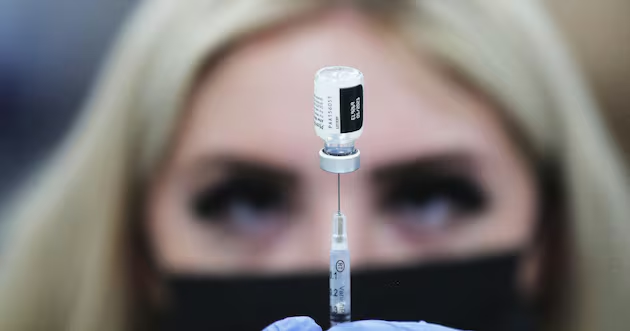
- The CDC withheld a vaccine study, disparaging the scientific methodology.
- JAMA published the study, which found vaccine reduced COVID-related hospitalizations.
- Critics of the decision to squelch the research fear it was political.
JAMA Network Open just published a COVID-19 vaccine study that the Centers for Disease Control and Prevention decided not to publish back in March.
Read more Why different literacy measures for Utah kids tell different literacy stories
The study found that the vaccine cut both emergency department visits and hospitalizations for COVID-19 approximately in half last winter among adults, reducing the risk of severe illness. And that held true even among those who had prior vaccination or infection.
While CDC officials said the study’s planned publication in its Morbidity and Mortality Weekly Report was cancelled because it didn’t meet rigorous scientific methodology, critics of the decision question that explanation and lean toward a more political motive.
“Science was never the issue,” Michelle Barron, one of the study’s authors and senior medical director of infection prevention and control for UCHealth, a nonprofit health system in Colorado, told The Washington Post. “Certainly it was within (the CDC’s) purview to keep it out, for whatever reason, but it was clearly not for scientific reasons that the study was withheld from publication in the MMWR.”
She told the Post she thought the study was withheld because Health and Human Services Secretary Robert F. Kennedy Jr. has opposed the use of that vaccine and the science with which it was developed.
An HHS spokeswoman, Emily Hilliard, rejected that notion. In an email to the Post, she wrote, “The CDC does not make scientific determinations based on predetermined conclusions. We evaluate the weight of evidence using rigorous methods, communicate uncertainty and limitations, and subject our work to scientific scrutiny before publication.”
The findings
The study included 85,725 emergency department and urgent care visits and 26,073 hospitalizations from September through December 2025 for COVID-like symptoms in adults 18 and older who were not immune-compromised, which would increase their risk of severe illness.
Included were patients with COVID-19–like illness who were tested for SARS-CoV-2, the virus that causes COVID, in the 10 days before to three days after the hospital or urgent care visit or hospitalization.
The estimated effectiveness of the 2025-26 COVID-19 vaccines was 50% against needing urgent care or emergency department care, and 55% against requiring hospitalization, compared to those who had not received the vaccine.
Read more Opinion: New trends and old rules revealed in the primary election
Among adults 65 and older, the effectiveness was slightly lower, estimated at 48% effective at preventing emergency department and urgent care visits and 53% against hospitalization.
The study concluded that “receipt of 2025-2026 COVID-19 vaccination was associated with additional protection beyond existing immunity in adults against medically attended COVID-19, including (emergency department/urgent care) encounters and hospitalizations, compared with no receipt of a 2025-2026 vaccine dose. These findings suggest that adults can reduce their likelihood of severe COVID-19–associated outcomes by obtaining a 2025-2026 COVID-19 vaccination.”
Background on the controversy
Dr. Jay Bhattacharya, then acting director of the CDC, criticized the test-negative design of the study, although that’s what Medpage Today called “a staple of vaccine effectiveness research” that has been used for decades by the CDC itself to monitor the flu vaccine.
He also noted that the CDC’s publication is not a peer-reviewed journal, which he said was a change that was underway. JAMA Network Open, which did just publish the study, is peer reviewed.
In an accompanying editorial in the JAMA publication, Natalie Dean, of the Emory Rollins School of Public Health in Atlanta, said that researchers weren’t ignoring limitations of the study design. As MedPage Today reported her response, “Those limitations include confounding by health-seeking behavior, in which people who are most likely to get vaccinated are also more likely to seek medical treatment when they’re symptomatic. But because the design restricts its test-negative controls to those people who seek care, she said, the approach has an advantage over other observational study designs.”
As Deseret News reported in May, the U.S. Food and Drug Administration also blocked publication of studies that found COVID and the shingles vaccine to be safe. Millions of taxpayer dollars had reportedly been spent on the studies.
The large studies found few risks and overall safety in the vaccines. Per the article, the studies were conducted by federal employee scientists who examined millions of patient records. They “rarely found serious side effects.”
One of the examined studies included medical records for 7.5 million Medicare enrollees to see if the COVID-19 vaccine could safely be given to older adults, 65 and up. It concluded it could. The New York Times reported that study was accepted by Drug Safety, a peer-reviewed journal, but was withdrawn.
Read more How the World Cup is being protected against drone threats