
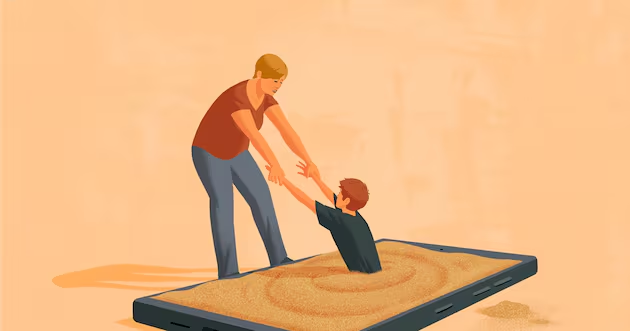
- A new study found Australia’s social media ban for those under 16 isn’t working.
- In the country, 85% of 12-15 year olds still use social media despite the law.
- Australia plans stricter oversight and legal actions against social media platforms.
Countries planning to follow Australia’s model for banning social media for those under age 16 might want to find a different approach. A new, large study in that country shows it’s not working very well and children are still largely online.
Read more Prized guard Noam Yaacov signs with Utah
Australia is planning tougher enforcement of the world’s first ban of social media by younger teens, which went into effect last December. But a large study just published in the journal BMJ (British Medical Journal) found that 85% of youths ages 12-15 who are not supposed to have social media accounts are still actively on them.
Per Reuters, “Australia’s prime minister vowed on Friday to bullet-proof laws supporting a social media ban for under-16s as the government prepares legal action against platforms amid a steady stream of evidence that the ban has had little impact on teen use.”
Prime Minister Anthony Albanese noted that the eSafety commissioner, who regulates the internet in Australia, needs adequate authority to see that the ban is honored. Australian officials have said they plan to sue five of the big platforms, “which face a fine of up to A$49.5 million ($34 million USD) if they are found to have systemically failed to uphold the ban.”
”What we want to do is to make sure that the laws are as strong as possible and that they will withstand any legal challenges which are made,” Albanese told the Australian Broadcasting Corp, per the article.
The study’s authors, led by researchers at the University of Newcastle, collected data from just before the ban’s implementation and three months after, examining self-reported use of social media in the past week and time spent on social media each day. The data is based on 408 youths.
They found “limited implementation, incomplete compliance and substantial circumvention of social media restrictions.” Of those findings, they wrote that “despite the intent of the Social Media Minimum Age Act 2024 to delay access to social media platforms and reduce the potential for online harms, little evidence was found of immediate substantive reductions in reported social media use by adolescents under 16 years.”
Kids are bypassing age verification
The main problem, according to the researchers, lies not with clever kids, but with age verification checks that are not effective. More than half of the children still online reported they were using their own accounts, not setting up new ones with fake tools to overcome age checks.
“Although two-thirds of teenagers in the study said they had to complete age verification checks, only 5% of 12- to 13-year-olds and 11% of 14- to 15-year-olds had to provide a photo of official ID. The two most common checks were asking teens their age and uploading a selfie,” per The Guardian.
As for being sneaky, a “significant minority actively foiled age verification. Just 15% of those ages 12 and 13 and 19% of those ages 14 and 15 said they created a fake account. Three percent used a virtual private network.
A number of tools have reportedly been used to pass age-verification requirements by the social media companies. Reuters noted that studies found “in many cases, the children have never been asked to prove their age.”
Read more What Richie Saunders said at his introductory press conference with the Memphis Grizzlies
On Reddit, someone from the UK — which is enacting a ban — asked people from Australia how well theirs is working. In response, one user noted that “my 14yo son bypassed the youtube age check by holding a black and white pic of thomas edison on the container of a wax cylinder he collects up to his laptop webcam. ”
Another replied that “my 11yo daughter bypassed the instagram age check by clicking “i am over 18” after being logged out. so yeah🤣🤣🤣🤣”
Reddit, incidentally, hopes to overturn the ban, claiming it violates free speech protections, according to Reuters.
Per a University of Newcastle news release, “Usage remained stable among 12–13 year olds, declined among 14–15 year olds (78% to 69%), and increased among those aged over 16 (80% to 89%) over the study period.”
The release also noted that the legislation’s full impacts could take years, as bans and their enforcement naturally evolve.
What about other countries?
The Guardian wrote that there’s evidence bans like the UK’s proposal, which Deseret News wrote about recently, may not be effective either. It’s set to take effect in 2027 and blocks those younger than 16 from using Facebook, Instagram, Snapchat, TikTok, X or YouTube. It also bars them from live streaming or communicating with strangers on Roblox and other gaming sites.
Many countries are reportedly considering laws to tighten online safety for kids, including Australia, Canada, Brazil and Indonesia, all of which have either introduced legislation or announced age-based rules or restrictions. Other countries — Denmark, France, South Korea, Spain and Thailand — are reportedly actively pondering action to restrict youth access.
And with some variations, both Austria and Greece are planning bans on access with even younger age limits.
But as The Guardian put it, “The study concluded that the Australian social media ban might be more effective in preventing or delaying access to social media in children under 8, rather than restricting access to adolescents who already use it.”
Read more Opinion: Science is moving fast, Utah’s measles outbreak doesn’t have to end in tragedy