
- Four in 10 Utah adults skipped medical treatment or delayed care because of cost in past year.
- Nearly half said they paid more for prescription medications compared to year ago.
- Healthcare affordability is a defining election issue influencing voter behavior.
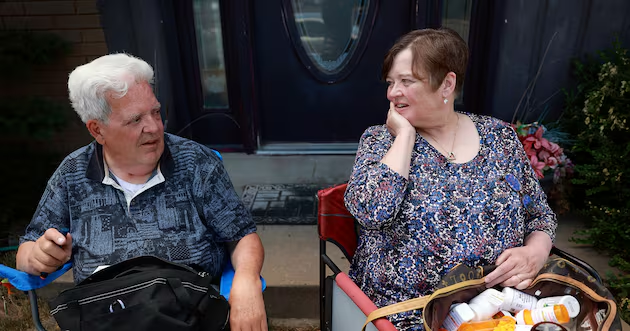
Doug Lusty, 63, and his wife Sandy, 65, both have medical conditions that are not only vexing because of symptoms, but also because the cost of care and prescription medication are challenging.
Read more A quiet, heavy day of evidence in Tyler Robinson’s preliminary hearing
He was diagnosed with Crohn’s disease in 2010 and said he takes a medication with a list price of about $28,000 per dose every eight weeks. Fortunately, he said, he has insurance that pays a big chunk of that and he qualifies for some patient copay assistance. But he retired after 32 years with state government due to health and meeting his medical needs — not just prescriptions — on a fixed income is challenging.
His wife has Medicare, he said, so she can’t get copay assistance, since the federal health coverage for older adults doesn’t allow that. And she has a “history of high-cost meds and stuff, too,” he said.
Both of them have at times in recent years skipped medication doses because of the cost. And they’re not alone.
Nationally, healthcare costs are the top financial concern for families, according to KFF, a nonprofit focused on national health policy.
A new Deseret News/Hinckley Institute of Politics poll of Utahns found that it’s also a significant concern in the Beehive State, with more than 4 in 10 adults saying cost has impacted how or if they received treatment or took medication they needed.
The Utah findings are similar to national research from KFF, which said just under half of U.S. adults say it’s hard to afford healthcare costs and about 3 in 10 note problems within their household paying for healthcare in the last 12 months.
What Utah poll found
Forty-three percent of Utahns said that within the past 12 months, they or an immediate family member skipped a medical treatment, cut back on prescription drugs or delayed seeing a doctor due to the cost.
And 55% said no when asked the question.
The yeses included half of women, compared to 35% of men and nearly half (49%) of those with incomes below $50,000, compared to about 40% of those earning more.
Younger adults were far more likely to say they’d skipped a treatment or medication or put off seeing a doctor than those 65 and older, perhaps because of Medicare eligibility for older adults. The breakdown for a “yes” answer was 57% for those 18-34, 50% for those 35-44, 38% of those 45-64 and just 18% for those 65 and up.
There were also political differences, with 52% of Democrats, 49% of independents and 35% of Republicans saying they did adjust their medications or treatments due to cost.
What happened to the cost?
The survey also asked respondents to think about any prescription medications they take and consider what’s happened to the cost, compared to a year ago.
A paltry 6% said the cost of their medications had dropped, while 46% said they were paying more. That included 17% who responded they were paying much more and 29% who said they were paying somewhat more. Another 36% said the prescription costs were about the same. Twelve percent said they don’t take medications.
Asked about the cost of medication, men were more likely than women to say they are paying at least somewhat more, at 48% compared to 42% for women. For 29% of men, cost has not changed, compared to 42% for women.
As for costs going down, in all cases they were in the single digits, with one exception. Among those 65 and older, 11% noted they were paying somewhat or much less for prescription drugs.
Read more The world of ‘Fablehaven’ still pulls Brandon Mull back, 20 years later
What share by age are paying at least somewhat more? Those 18-34 (51%), 35-44 (41%), 45-64 (46%) and those 65 and older (40%). The older adults were also the most apt to say the prices were about the same, at 46%, compared to 25% among the youngest group of respondents.
Morning Consult conducted the poll of 850 registered Utah voters June 16-22. It has a margin of error of plus or minus 3 percentage points.
Doug Lusty said the bright spot has been that some of the medication costs for them have gone down, thanks in large part to the ability Medicare now has to negotiate the prices on some of the more expensive drugs the program covers.
That’s not insignificant. “Between us, we were on five of the first 10 medications to get negotiated for Medicare,” he said. He added that the negotiated prices can still be expensive, but not as expensive as before.
The national view
In March, a Gallup poll of nearly 20,000 U.S. adults found that one-third of Americans — millions of people — cut back on a variety of things to pay for healthcare. They didn’t just skip doctor appointments or short themselves on medication, according to that poll. Among the other tradeoffs were borrowing money, skipping a meal, driving less or cutting back on utilities. Some of them took more than one step to afford needed care or medication.
Gallup found that was true of not just those without insurance, but a share of those who have insurance. Household income, of course, made a difference as folks paid for health expenses, including not just 55% of households with income below $24,000, but also 11% of those with incomes above $240,000 and a scaled range in between.
Some also postponed life events because of medical expenses. The list included having or adopting a child, retirement, a job change, getting more education or job training, buying a new home, a surgical or medical treatment and taking a vacation. And millions of Americans were believed to have done each of those things, according to Gallup.
“These findings underscore that healthcare affordability is not just a health issue: It is a significant economic and societal challenge that affects nearly every aspect of life. If the current trend continues, the situation is likely to worsen unless significant healthcare reforms are enacted,” per the Gallup report.
Unhappy with drug prices
The national organization Patients for Affordable Drugs collects stories from people who struggle with prescription costs in particular. They have a map of the states that link to patient stories.
Said the group’s CEO, Merith Basey, “The prescription drug pricing system in the U.S. is rigged against patients, which is why 1 in 3 people cannot afford the prescription drugs they need. The monopoly power of the pharmaceutical industry is a driving force behind why Americans pay on average at least four times more for the very same brand-name drugs compared to patients in other wealthy nations.”
She added, “While we’ve seen important progress made in lowering costs for patients on Medicare in particular, there’s much more work to do to ensure everyone in this country can get the prescription drugs they need at prices they can afford.”
Polling by Axios-Ipsos found that health care costs — and in particular that of prescription drugs — will be a “defining election issue” in the upcoming midterm elections.
They reported that “About half of Americans say measures aimed at drug and insurance affordability will probably influence who they’ll vote for.”