
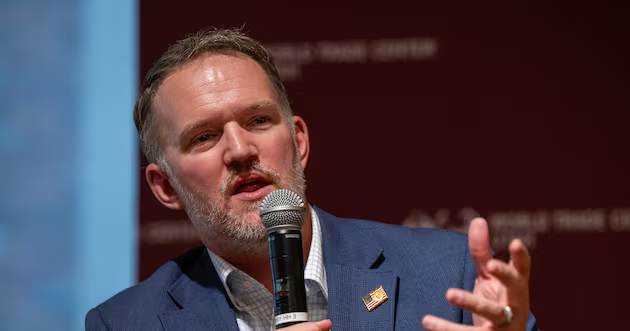
- Trump’s trade representative said time is the greatest obstacle to achieving the president’s goals.
- Jamieson Greer announced 25% tariff on Brazilian imports Wednesday using new investigative power.
- Greer said original USMCA agreement increased America’s trade deficit with Mexico, falling short of goals.
President Donald Trump’s top tariff negotiator, U.S. Trade Representative Jamieson Greer, gave Utah’s business elite on Thursday an inside look at the strategy behind the Trump administration’s tumultuous 18-month overhaul of the global economy.
Read more Utah inland port pledges $7.5M to Great Salt Lake ‘buffer,’ seeks to improve water use
Greer, who went to college in Provo before serving a mission for The Church of Jesus Christ of Latter-day Saints in Belgium, brought an air of certainty to uncertain concerns from Traeger Grills CEO Jeremy Andrus, who hosted the World Trade Center Utah event.
In constant communication with the White House, Greer is orchestrating efforts to rebuild the “Liberation Day” tariffs struck down by the Supreme Court; rework the United States-Mexico-Canada trade agreement negotiated in Trump’s 1st term; and further isolate China.
The greatest obstacle to implementing Trump’s vision of an international trade environment that values exports over imports, raises wages, and increases the share of American manufacturing, is not the courts, Greer said in an exclusive interview with the Deseret News.
It’s the clock.
“We’ve only got two-and-a-half years left,” he said. “It takes time to build factories. So time is our enemy here. We need to move extremely quickly. That’s why we took very bold action out the gate. That’s why we’re continuing to maintain our trade policy.”
A “few tariffs here and there” won’t cut it, Greer continued.
After justices rejected Trump’s reliance on emergency authority, the president tasked Greer with finding other ways to follow through on campaign promises for a worldwide tariff regime incentivizing businesses to build in America instead of outsourcing over seas.
But the whiplash in incentives has turned the past year-and-a-half into a nightmare for businesses across the country. This was the message Andrus delivered, with diplomatic polish, on behalf of the executives sitting before Greer in Traeger’s Salt Lake City headquarters.
Greer’s message to businesses
Since Trump retook the presidency, America’s tax on imports has undergone a once-in-a-century rollercoaster, surging from an average rate of roughly 2.5% before Trump entered office, to nearly 20% in April 2025, to less than 10% after the February Supreme Court ruling.
To many Utah companies, this has felt like a “wild ride,” Andrus told Greer during a armchair conversation. When Andrus asked what advice Greer would give to start ups trying to decide how to invest amid shifting costs, Greer summed up his message to industries succinctly.
The era of frictionless offshoring is over.
“The problem is we have all built up supply chains that rest on assumptions that are no longer valid — and there’s not like a cost-free way to make this adjustment,” Greer stated. “There is a transition period associated with this, and I know it can be painful for companies.”
Andrus’ takeaway from his interview with the president’s personal trade adviser is that Greer is a true believer.
Greer agrees with Trump that decades of special treatment toward other countries, based on the abstract creed that lower trade barriers always benefit domestic interests, has led to the abuse of American workers and consumers by foreign governments.
So what should business owners expect from the Trump administration? More of the same.
“I don’t have an easy answer,” Greer told his audience. What he did have was a tentative timeline: His goal is to secure certainty for the markets “within the next few months” as the outline for his new approach to tariffs, using a more legally sound statute, becomes clear.
Greer ramped up his new strategy this week. Before arriving in Utah Thursday morning, Greer’s office announced a new 25% tariff on some Brazilian imports, following a yearlong investigation of discriminatory trade practices empowered by Section 301 of federal code.
Using this tactic, Greer plans to proceed country by country to reinstate many of the tariffs tossed out by the U.S. Supreme Court because of the Trump administration’s novel use of the International Emergency Economic Powers Act, which was created for crises involving foreign threats.
Remaking the USMCA
The new process is slower than IEEPA, requiring public comment and a formal review. His office is also incorporating more feedback from the private sector, phasing in some tariffs while making exceptions for others when products are not produced within the U.S., he explained.
“So there is an opportunity for nuance,” he said. “It’s not going to be perfect. It’s not going to be painless. But it’s necessary.”
Greer added another element of surprise to America’s relationship with core economic allies at the beginning of this month, when he announced that the U.S. would not agree to automatically renew the landmark USMCA agreement he helped craft six years ago.
The deal replaced the North American Free Trade Agreement, or NAFTA, which had governed exchange between America’s top two trading partners since 1994. It was hailed for encouraging higher-wage auto production in the U.S. and enforcing labor regulations.
But it ultimately fell short, according to Greer. It actually increased America’s trade deficit with Mexico, he said. With his outcome-focused philosophy, Greer said he will meet with top Mexican leaders next week to discuss how to ensure the revised deal increases U.S. manufacturing.
Discussions will revolve around stricter rules of origin for products to be included under the USMCA, Greer said. This means companies will not be able to import products from other countries and label them as Mexican or American just because they were assembled here, he said.
As he was with Utah’s business community, Greer said he has been “candid” with Mexico, that there will be tariffs. Greer has found the most effective way to translate Trump’s instinct on trade into policy is to make it obvious from the outset that he believes in tariffs — they both do.
“I don’t do a lot of posturing,” he told the Deseret News. “My secret is I can say ‘no.’ … Because the president is so intent on reforming global trade to the benefit of America, it makes it so I have a lot of leverage, and I have a lot of ability to turn down a bad deal.”
Read more Real Salt Lake founder Dave Checketts returned to Utah with a surprising pitch for fans