
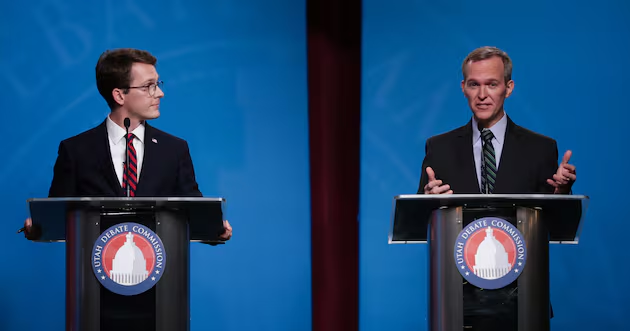
- Ben McAdams asked Republicans tired of President Donald Trump to join coalition.
- Riley Owen said a new generation must define what it means to be a Republican.
- Both candidates shared stance on importance of regulating artificial intelligence.
The debate on Tuesday night to represent Utah’s new Democratic-leaning district fixated on the issues that will define the end of the Trump-era of U.S. politics — and possibly the next century of economic transformation.
Read more ‘Saved by the Bell’ co-stars pay moving tributes to Dennis Haskins, who died at 75
Former Rep. Ben McAdams, who secured the Democratic nomination in a landslide primary win against progressive opponents, acted the part of team player, repeating anti-Trump tenets his party has perfected over the past decade.
The 1st Congressional District represents a key pick-up for Democrats, who hope to win a majority in the House in this year’s midterms, after Utah’s redistricting battle culminated in court-ordered electoral boundaries favoring Democrats by 14 percentage points.
McAdams signaled exactly what his party planned to do with divided government in Washington, D.C.: halt military action in Iran, reverse tariffs implemented by President Donald Trump and root out misconduct in the administration.
“We’ve never been more divided than we are right now,” he said. “Corruption is not the exception, it is the rule.”
While McAdams provided few specifics for his agenda to oppose the Republican White House, GOP nominee Riley Owen, a Gen Z Navy intelligence officer, broke from Trump on issues of trade, immigration and artificial intelligence.
Owen called for a default of free exchange with targeted tariffs on strategic industries, not a vacillating regime of global levies. Owen praised President Barack Obama’s focus on deporting dangerous criminals, not all illegal immigrants.
Stopping AI apocalypse
On the issue of AI, McAdams and Owen were of the same mind: it must be kept in check through federal regulation.
The president has largely ignored alarms from Silicon Valley about the chance that self-improving artificial intelligence could take a catastrophic turn that compromises national security at best, and imperils humanity at worst.
Congress has not done its job to make sure the coming AI disruption benefits all Americans, not just the billionaires who own the products, according to McAdams. This can only be achieved through “strong federal guardrails.”
In one of the rare jabs of the hour-long event hosted by the Utah Debate Commission, Owen questioned McAdams’ credibility because of a million-dollar expenditure on his behalf by a pro-AI PAC funded by OpenAI’s co-founder.
He did not request the money, McAdams rebutted, and it won’t affect his commitment to constrain the industry.
As one of the few congressional nominees belonging to Gen Z, the 28-year-old Owen broadcasted a distinctly anti-Big Tech platform that might remind voters of Utah Gov. Spencer Cox’s brand of “touch-grass populism.”
He proposed prohibiting unlimited corporate PAC donations, requiring age verification for social media and putting locals first on the question of data centers — which exploded as a top political issue in Utah last spring.
Read more Opinion: The ‘famous last words’ I’d like to hear now
“My message to developers of data centers is very simple: pay your taxes, be water positive, be carbon negative, don’t ruin the grid, and don’t ruin our lands,” Owen said. “And my message to Utahns is also very simple: your voice matters.”
This was a point of bipartisan unanimity. McAdams said data center projects will come, but they should never take away from the Great Salt Lake watershed; they must contribute water to the system, and not rely on government subsidies.
Saving the Great Salt Lake
McAdams criticized the state for not going far enough to rescue the saline lake from death by drought. The solution will require “hard choices” like serious efforts to acquire water rights to redirect the flow from rapid new growth.
Federal funding is essential, Owen agreed. But he thinks the state is on the right track. State leaders must be more aggressive about modernizing water infrastructure, removing invasive plants and leasing water rights.
In true Utah fashion, both candidates pledged support for a balanced budget. But neither stuck their neck out on what it will take to reverse the $40 trillion debt as the country quickly approaches the insolvency of major entitlement programs.
McAdams wants greater tax revenue, lifting the Social Security payroll cap for those making above $350,000. Owen suggested investing Social Security funds into the stock market, like pension systems in other countries.
Neither proposed any cuts to the retirement benefits that are driving the country into fiscally uncharted territory.
But Owen leaned into other unknowns of the next two years. The future identity of his party, he said, is up for grabs.
“2028 is going to come and go, and President Trump’s going to finish his term, and there’s going to be a reckoning of what do we do next,” he said. ” Yes, there’s an R next to my name but I don’t think it needs to mean what it always has.”
Like he did in the final days of the primary, McAdams also appealed to a different version of the Republican Party, one that he says is long gone in the age of “Make America Great Again” that he believes has alienated many Utah voters.
McAdams acknowledged that he and Owen share similar positions on many of the top issues of the day. The most important distinction, McAdams told Republicans, is which candidate will be beholden to a president like Trump.
“Does your party still represent you?” McAdams asked. “Where is your line? And when is enough enough?”
Read more A year after the Grand Blanc church shooting, survivors cling to faith as memory haunts them