
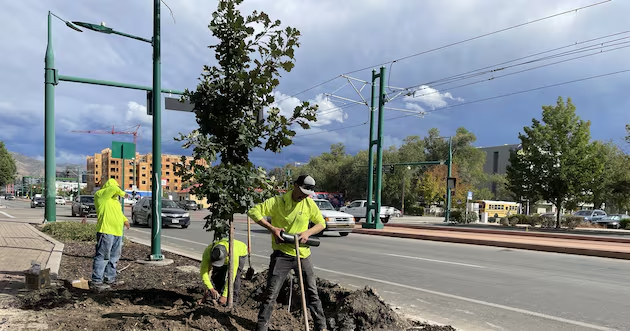
Utah’s capital city is close to finally replacing hundreds of trees that were mistakenly killed on its west side after a city employee accidentally sprayed them with a herbicide two years ago.
Read more 2026 Parry’s Power Guide: Predicting Week 7 of the high school football season
Salt Lake City Department of Public Lands employees started planting 100 new trees in August, while also repairing irrigation and soil to make way for another 100 trees that have lined the North Temple corridor in planters since the incident. Work is scheduled to continue over the next several weeks, according to Tyler Murdock, the department’s deputy director.
“We’re about halfway through the full replacement of the North Temple corridor,” Murdock told KSL on Tuesday, adding that the full replacement of the trees is expected to be completed by the end of November.
Another 30 to 40 trees will be planted along 1000 West in the Fairpark neighborhood this year, as part of a partnership with Utah State Fairpark. Those are some of an additional 270 trees planned for various locations near the fast-growing corridor, along with hundreds of new rose bushes in the area.
Once complete, it will put a cap on what many in the city say was an unfortunate incident.
Replacing the dead trees
Salt Lake City began maintaining the corridor’s beautification after Utah Transit Authority constructed the green line TRAX that links downtown Salt Lake City to Salt Lake City International Airport via the North Temple corridor. The line became functional in 2013, with over 100 trees lining the route by the time service began.
However, a mix-up in 2024 led to many of them being killed off. Salt Lake City’s public lands department said a worker accidentally sprayed the trees with a herbicide, causing their demise. Most of the carnage was found along North Temple, from about 700 West to Redwood Road, but some trees along 300 West, from 900 North to 600 North, were also impacted by the error.
Residents were frustrated by what was lost. Jeffery Olson, chairman of the Fairpark Community Council, remembers fielding phone calls from distraught neighbors about all of the trees being poisoned and dying.
“Trees add so much, right? And to have them dying, it takes away (from the area),” he said.
Salt Lake City Public Lands, out of precaution, waited two years to replace the trees and conducted regular soil testing to make sure any new trees wouldn’t be immediately lost by the herbicide. It also used planters to speed up the process, lining the road with approximately 100 of them to keep some trees in the area before they could be permanently planted.
Department officials say $95,000 was set aside for the full cost to replace them this year, along with irrigation repairs.
Read more UFL expands to Salt Lake City with 2028 start date
Another 270 trees are planned for nearby roads, parks and trails, including Cottonwood Park, Madsen Park and Folsom Trail, Murdock said. That means the area will more than double what it had two years ago.
“I wish we could plant 400 more along North Temple, but there’s just not enough space for that many,” he said, noting that he believes the planters were a good decision because those trees are already up to 20 feet, adding shade to the corridor.
The trees lost along 300 West will be replaced at a later time, he added. City officials are also adding 550 rose bushes between 600 West and Redwood Road this year, seeking to beautify an area that has become increasingly residential.
Officials say it could also ease the neighborhood’s ongoing urban heat island woes.
Will it make a difference?
Members of the Salt Lake City Council were given an update on the situation during a work session, which was held at a Utah State Fairpark building next to where some of the trees were lost. Its two west-side representatives say they’re happy to see the replacement underway, but they also shared concerns.
“I love this and want this (and) believe that we should have this, but I think the investment has limited value, and we’re putting lipstick on a pig,” said Councilwoman Victoria Petro, pointing to homelessness- and crime-related concerns that have existed along the corridor in the past.
Public safety has improved over the past two years, Murdock said. He believes the area’s growth and targeted police tactics since 2024 have added more eyes on the road, helping improve those types of issues.
Murdock told KSL he’s hopeful that the new trees and beautification can bolster those efforts by design. Some volunteer projects to clean up the route are planned in the coming months ahead of it bringing in thousands of visitors for people parking to attend the Salt Lake Temple open house next year, he added.
The temporary solution helped, but residents have longed for a permanent one, Olson said.
“There’s something really special about natural green,” he said.
Both he and Council Chairman Alejandro Puy are hopeful that all of it will help improve perceptions of North Temple, drawing people to the area’s shops and restaurants.
They believe it could build on what was once there.
“(It’s) turning something bad into something great for the community,” Puy said.
Contributing: Shelby Lofton